


Monday, June 21, 2010

Tata Nanou Came to Lunch


Ian loves his tata Nanou. She kisses his hands just so and he wouldn't dare scratch or gouge her face the way he does to maman. He is always on his best behavior with tata Nanou. She and I get together when we can. We took up a good habit of going out to little tea houses and back room places that contain a majorité des femmes some time back. Now that getting out isn't as easy, she comes to our house for lunch. On those days, I tell him that she's coming the moment he wakes up, and morning long he's all smiles, waiting for her to come.
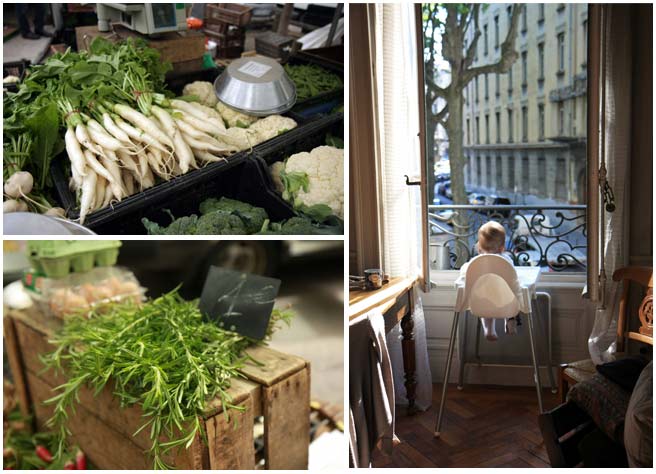


We went down to the market on St. Antoine as is our regular habit, and found many delicious things. Brigitte taught me to walk the market to the end, and buy on the way back. At the very end of the market, in the space usually delegated to newcomers and temporary stands, there was a very nice fromagerie, gleaming and new, who has not been on St. Antoine for very long. His selection struck me immediately because not only did his cheese look to be in excellent condition, but he carried the genre of cheeses that are generally not available anywhere but the best fromagers at Les Halles. Some cheese needs special handling to be at its best.

Usually when I have a dinner party and have to put together a very good plate, the kind of plate that people really remember for being perfect examples of cheese they know and love, I always go to Les Halles to visit certain fromagers. It's not just rare cheeses, in fact many of these cheeses you can get at the grocery store, or buy just about anywhere in Lyon. But the way it's handled and season makes all the difference in the world in the flavor. There are cheeses that just could not keep their unique qualities without special care, which are the ones I was seeing here.

I told him I was happy to see his selection, and after quizzing me rat tat tat about who I thought was worth visiting at Les Halles, I met his approval and we talked about his activity as one of only 12 certified trained fromagers that circulate Lyon's forty outdoor markets. These are the fromagers that keep a local cave, first of all, and keep their cheese in ideal conditions before it comes to market, and not the vendors that circulate a dizzying array of over aged, past its prime or otherwise derailed milk products. His home base is located in Lyon's 6th arrondissement, just near Le Petit Vatel on rue de Seze.

The wild asparagus is out and I snatched up a big handful. I knew that Nanou would appreciate it. I decided to do salad with a blanched snowpea chiffonade and wrap the steamed asparagus around a pile of it, layering it with a simmered brunoise of fresh spring turnips and young carrots that I cooled under water after cooking. I topped that with marinated oyster mushrooms and drizzled the lot with a soy, walnut oil and sesame vinaigrette.

Nanou appreciates the simple things in life, and this particular lunch we were both highly satisfied to end with a sackful of sour cherries called griottes here. They glow brightly in the sun at the market for a very short time, no more than a week or two in June. I brought out vintage teacups with soft white cheese, and we chatted about her upcoming wedding plans while we pulled cherries out of their rinse in a bowl of water between us, pitting them before composing each our own topping with a sprinkling of sugar.

Labels:


Share/Bookmark

Tuesday, June 15, 2010

The Garden's Progress


I like to drink a glass of wine in my garden at the end of a fruitful day
, the setting sun outlining forms in golden silhouette. I can stare at my plants, contemplate their progress, the miracle of their colors and forms. My garden is a place of magic and hope, a place to dwell, a place of quiet affirmation.

Wind blows across the pasture bringing seeds from unruly weeds. During the week they begin to creep in. When we arrive on Friday night the feeling is usually a little bit like facing the sink full of dirty dishes after a raucous dinner party. Will the weeding ever end? Then we set to work, and in short time, tugging up this and that, prying the spiraling fingers of savage wild growth away, we get it back to where we like it.

Since it is our first year, Loïc and I decided to go with a number of small beds, cloistered areas to tend to a smaller number of plants, like a botanical garden or experimental laboratory plot. This way we can lavish each plant with attention, keep up with the learning curve, and not have to spend too much time and money getting the bed's soil just right. We're in it for the joy it brings, and anything we get to eat is a bonus. We can get bigger later if we want, by moving the borders of the beds. Speaking of borders, our first concern was finding proper ones. We found non-toxic linseed oil autoclaved borders made for potagers and they were our only expense aside from seeds, costing about €80 ($120) for the whole garden. The stones are original from our Savoyard chalet roof, replaced last year.


arugula flower and a delicious mouthful from the task of thinning the carrots

When I first planned the garden, I didn't know how easy it would be to move plants around. I realize now that planning a garden is a tentative task, even planting is never set in stone. We discovered, for instance, that some of our kohlrabi seemed to be flourishing way ahead of the ones we'd planted elsewhere in the garden. Then we realized they had been placed next to tomatoes. This juxtaposition is noted in many of our references as a problem, since kohlrabi saps the life from tomatoes. If they grow too fast, they won't taste good, either. I moved the kohlrabi to another bed and grouped the tomatoes all together. They complained at first, but were bright and happy with the rhubarb chard the next weekend.

Taking a walk through the beds, we have: Eggplant, green beans, peppers, brussels sprouts, a watermelon plant, nasturtiums which in French are called capucine, cilantro, chervil, garlic, yellow onions, chives, carrots, lettuce, parsley, red onions, shallots, arugula, a bed of mixed greens, rhubarb chard, leeks, kohlrabi, a permanent bed of Mara des Bois strawberries, tomatoes, basil, sucrine lettuce and round red radishes. Outside the beds along corners in the wide pathways, I have planted oregano, sage, rosemary, lemon verbena, tarragon, dill, and extra dwarf nasturtiums. At the end of each path on the high side near the sunflowers and dahlias, I have put a cardoon plant at the end of each path. They are very popular in Lyon, and I look forward to preparing them the Lyonnais way.

The gourd hill had a rough start, because I changed my mind at the last minute and decided it should go on a slope located by the compost. We put out our tender pattypan, butternut, delicious pumpkin plants that in French are called potimarron, zucchinis, widely spaced with room to grow. They were all promptly eaten by snails, of which there are a profusion in the compost heap. We started again but had little hope. One difference was the use of some organic pellets to make the snails and slugs lose their appetite. We had just about given up on the lot, when all of the seeds we planted sprouted and grew fast. Now we're faced with this business of thinning. Never easy. Another factor is that one of us poked about 20 kohlrabi seeds into the ground all over the slope when we'd lost hope and they've all exploded into healthy plants too. My neighbor thinks it's cabbage. "Handsome cabbage patch you have there!" he says. I correct him but he doesn't hear it. "Yep, that's some nice looking cabbage." Sometimes I wonder if he planted it. Neither Loïc nor I remember planting it. I might have thrown some seeds down in frustration...


dahlias

The dahlias were a windfall, from the "magic flower lady" at the St. Antoine market of Lyon, where I shop during the week. We always go to this woman, who sings "did you know that flowers are magic?" over and over, in rhythm and harmony with the church bells that ring from time to time in the mornings. One morning she was offering a huge clump of dahlia tubers for €2 for the lot. I asked her what color they were, as if I cared. "Surprise!" she beamed. The clump filled a huge grocery store shopping bag. We tossed it in the trunk and dragged it out into the garden that evening. I spent a good hour wedging the vast knot of tubers apart with the old Parmesan knife I'd bought from a man on the street in Sicily, and burying them, one by one. It was good work. With each one that went into the ground, my little troubles melted away. Even if they don't come up for some reason like poor soil chemistry or slugs or something, I know I will have gotten my €2 worth. The hope for flowers is one of my most delectable painful pleasures. For me it sometimes ranks above the flowers themselves.


tomato flowers and our first haricots.

We're cutting herbs and greens already. Last weekend we enjoyed some flavorful young chard and arugula. I also prepared a dish using les fines herbes from my garden, which made it that much more satisfying. I am allowing some coriander to go to seed, but trying to keep the chervil from bolting by razing the lot every week. I get big bunches every weekend. The arugula made several delicious salads and went into a savory bread, and this weekend we found that it had bloomed. It's interesting to see the pretty flowers that these greens and herbs can produce.

Labels:


Share/Bookmark

Tuesday, June 08, 2010

French Market Menu Ideas for Blueberries


Different berries come out at different parts of the season. One precocious delightful berry I had the pleasure of tasting the other day is this what my neighbor is calling the "Siberian Blueberry" which from my research seems like a European cousin of the honeyberry. She gave me a big sack of them. Judging from taste, I imagine that if they were to appear on a producer's stand in Lyon they'd go for a pretty price. Her family grows and sells vegetables at a local market in her home town. I asked her if they ever put out baskets of these berries. "No, because they're mine" she responded.

Two small bushes were given to her 20 years ago by a man who appreciated her interest while she was on a horticultural themed school field trip to Poland. She explains that she put them in the garden of her childhood home, a ski station in the Haute Savoie, and they came to grow quite tall and produce amazingly huge crops of very small, intensely flavored berries that grow in clumps - ready to pick in late spring. Not your average blueberry.

While we wait for the higher altitude blueberry fields to ripen, I am happy for this exotic gift. She said that she has more than she knows what to do with. She normally freezes them, but thought I might appreciate a sack full. Do I! I went through my country notes for some examples of what the restauranteurs do with regular and wild blueberries across the country and provide you this list, while I decide what to do with these.

To begin:

A marbled foie gras terrine seasoned with blueberry infused Marc.
pan seared foie gras served simply with blueberries.
minced duck magret with Mont Lozère blueberries
a duck foie gras terrine with bonbons de myrtilles.

As part of a main dish:

Lamb chops served with a blueberry infused reduction sauce
duck breast with honey and blueberries
farm raised pigeon with a pink peppercorn and blueberry sauce
magret de canard with «blueberry blood»
filet de boeuf à la myrtille sauvage
veal loin with a blueberry seasoned jus

Or as part of a dessert:

The classic blueberry tart
blueberry crème brûlée
blueberries with licorice flavors in an entremet with a dollop of fresh young farmer's cheese sorbet
chocolate cake with a soft center of wild blueberry preserves
blueberry crumble
blueberries tucked into an almond sablé crust and crème patissière, served warm with vanilla ice cream
clafoutis aux myrtilles
matafan aux myrtilles
a fried blueberry flavored boule de crème brûlée refreshed with frozen yogurt
simple house made blueberry ice cream
wild blueberries served covered in a flurry of crushed meringue
fromage blanc with blueberries
thin crêpes with a wild blueberry sauce
a blueberry tartelette with its pistachio crème légère
thin waffles served with a lime seasoned blueberry confiture
vanilla seasoned fresh farmer's cheese mousse drizzled with a warm blueberry compote, topped with a thin sablé
a Bugundy sparkling wine sabayon with wild blueberries
thick soft pistachio and blueberry swirled cookies
white peach panna cotta drizzled with blueberry sauce
a Genepi seasoned blackberry and blueberry gratin
charlotte aux myrtilles
a blueberry tartelette served with white farmer's cheese ice cream.

In hopes that this list inspires you to expand your blueberry repertoire.

Labels:


Share/Bookmark

Tuesday, June 01, 2010

Mother's Day and His Lovely Pancakes


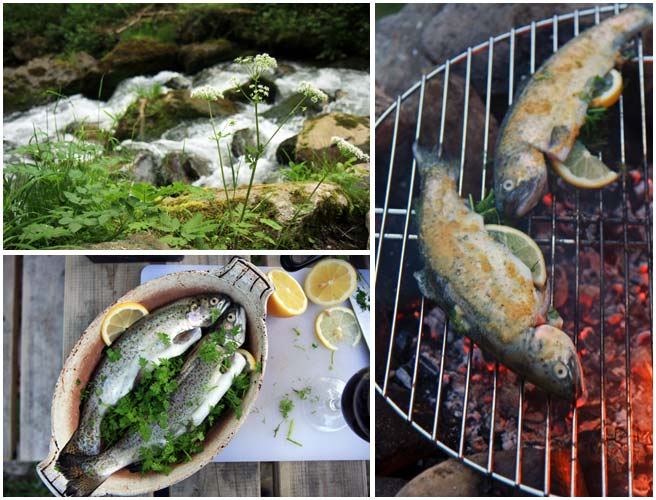
We celebrate Mother's Day later in France than we do in the States. It was this past weekend. It was my first Mother's Day! We had Alpine lake trout on the grill, stuffed with the proliferation of chervil that has to be cut back every week now to keep it from forming flowers and a good dose of dill weed, leftover from one of my herb ateliers with the Dartmouth College students.

Loic made good tasting pancakes with the levain we keep in the mountain kitchen, which seems to be doing well with some coddling every weekend. It still smells clean so we'll keep it going as long as it wants to keep playing house with us, it's been about a month now. It sits in one of the Russian soup pots I bought near that pickle market in St. Petersburg during our early years of marriage, by the stove. Once we get there and I get the fire going, it gets a good stir and a nice feeding and then warms up nice and toasty by the fire. It stays comfortably warm all weekend. When we leave for the week, the house cools down considerably, so it takes a nap for awhile. The kitchen is half underground, having been built into the mountain slope with 2 foot thick stone walls, so once it cools down it stays cool until we come back and pump up the fire again.


We just feed it on arrival (I toss in a sugar cube as a kind of repentance for nearly starving it to death and a couple of tablespoons of flour) and cover it loosely with foil. It gets fed flour again the next two days. Then we see how it looks the next weekend. So far so good, and the nice flavor reminds us both of the bread Loic used to make in Los Angeles when we were newlyweds, albeit much less scientifically recorded and monitored. I suspect that when the weather gets warm we might lose our levain, since it will most likely take on a sour aspect when the yeast population does begin to starve during the week. I'm just happy for the time we'll have with it. I won't worry about how long it's going to last. We like the bread we can buy up there just as much. But I like the kneading, and rising and all that. I like to plop a round loaf on the sheet, clip the top with scissors, and spray it with water every few minutes after it goes into the hot oven. The satisfying thing is that it comes out tasting like real bread each time, the kind we seek out, and the holes don't get too big.

I woke up on the morning of, and waited. I heard the baby making all kinds of conversation that eventually evolved to complaints. No coffee. I turned on my bedside light and broke out the almanac. Pages later, the morning birds started to change their song, baby continued to get into trouble, the sunshine began to creak and make sounds on the roof. I decided that it must be getting well into brunch time and made my way downstairs and he was still working on those lovely pancakes. They tasted very nice.


Here's a little film of our weekend levain.

Labels:


Share/Bookmark

Wednesday, May 26, 2010

Ramsons and Ribeye


While on a walk through the forest, I kept smelling garlic but could not place it exactly in my mind. It was not something I was expecting. "I smell something good, like an herb", I said to Brigitte. "Smells like a shish kebab roasting over a wood fire" she said. We laughed and took one anothers' arms and walked ahead of the men. After a while, the source of our amusement became clear and something different altogether. We were standing in a patch of ramsons in bloom. Ramsons are a European cousin to the ramp, a wild garlicky chive, called ail des ours in French because bears will dig up the ground to get to the roots. I wasn't aware of it at the time, but a little research upon return to the grid tells me wild boars also go crazy over ramsons. With the way they have been completely destroying the field behind the house in the mountains, I think now that maybe I shouldn't have transplanted a few of these into my shade garden.

We've seen the boars' damage over the last few months. Thankfully it stops at the electric fence put up by a farmer in the village. It wasn't until last week, now that sunset isn't until well after 9 pm, that I saw the whole clan.

I will describe the 10 second encounter as briefly as I can. I was in the garden at dusk, giving a few last admiring glances to the pampered residents of our potager, now at home in their beds, beginning to spread their wings. I clipped a bunch of herbs and headed back in. I heard some grunting but thought it was the Tarine cows that have been set regularly in the pasture these past few weeks. They call to one another at the end of the day.

There was a bit more grunting than usual, and it was bordering on a kind of growling, but I didn't pay it much mind. There are some young males in the herd that have begun to act up. So I went to the kitchen to continue my preparations for dinner, to stoke the fire in Bernadette, washing what I'd picked in the garden. Loic took his turn outside and while he was out waging war on slugs, I heard a particular sound that resembled an enormous cow loudly belching, and looked out to the field through the window of the kitchen door.

There, centered perfectly in the frame of the door at some distance, stood a magnificent specimen, jet black, silhouetted with a golden hue from the last vestiges of the setting sun. Large forward set ears perked high, she must have been about the size of one of these young cows, but with the classic beautiful heft that we know to be the wild boar. The light was magical, and my camera was just there, not far. I tried to move slowly and opened the door to compose my shot. She stood perfectly still, looking in my direction and suddenly let out a startling cross between a scream and a groan a nanosecond before bolting in the direction for the woods. At that moment I realized that there were two others, big fat teens about half her size but still fully grown, who had responded to the call and were galloping fast, their fat rumps jiggling, straight for cover. Gone.

I was reeling in the moment of having finally seen these creatures. I started to leave the house to ask Loic if he had seen them, and then I saw, on the hill from the woods, the big one galloping fast again back towards the house. There is a good distance between the kitchen door and the copse of trees where they sought cover, but I wondered why she was running with such purpose, and stepped back into the kitchen, ready to slam the door if necessary.

In quick movements, she performed what I can only describe as a 3 point turn in less than a second, gesturing with her entire body. It was almost human, like a toss of the head followed by a nimble, almost impossible turn for her sheer heft that said "this way!" Then, from under an apple tree quite close to the kitchen indeed, trotted seven sangliettes, in pairs at first and then a group of three, the size of large tom cats, all fawn colored and striped down their backs, flipping their tails and briskly trotting in single file to follow their mother back into the woods.


We only gathered a little of this wild garlic because I assumed the bounty was never ending from the heady scent we bathed in while we walked arm and arm in the woods. I'd said, "Come on, let's get it from the next patch.", only there wasn't a next patch. By the time we realized it, we were too far into our forest loop to turn back and still have time to get the fire started for dinner.

Flowers, stem and root are all edible and delicious, you can use it all. Since we had only collected a little bit, I carefully washed them while admiring the details of this plant. In retrospect, I valued its scarcity that night, it took on a special value in my mind, like a rare specimen. When you only have a little, your only solution is to be the minimalist and use it in as simple a way as possible. No real advice at my disposal, I followed my instinct, and sliced what we had on the diagonal and put it on the hothouse tomato halves they'd brought from down south, with some coarse sea salt. I wrapped each half in double foil to make sure the herb stayed moist and not too hot, to very lightly steam and soften at the edge of the hickory fire while the cote du boeuf roasted that evening in the garden. I kept reminding my guests to keep their eyes peeled for the sangliers, which I have not seen since our encounter. Add this to my list of foraged herbs in my mountain notebook. It was delicious. We did not need a bushel of ramsons, just a few. Best left in the wild, I think. I know where the patch is.

Labels:


Share/Bookmark

Thursday, May 20, 2010

Infusing Herbs and Flowers: Acacia Flower Syrup


Edible flowers can have an allure that extends beyond their perfume. If only I could capture the pleasure somehow to enjoy beyond the short window in which they bloom. Acacia is out in the Lyonnais region at the moment, and we're seeing their delicate cascading blooms in bundles on market tables.

I have been doing a series of workshops on herbs in French cooking, and one of the things we do is a simple herb infused syrup to use in your house kir. A kir is Champagne or white wine with a bit of a flavored syrup or a liqueur like crème de cassis, a typical apéritif served in many French homes. Making your own herb infused syrup can lift a very common French before-dinner drink to something memorable for your guests. What they don't know is that it takes no more than five minutes of hands on work to create your own quick syrups in advance. What they will remember is that you turned an old classic standby into something creative and unusual.

The main idea about infusing herbs is to know what part of the plant contains the oils that give them their flavor, and at what point in the plant's development these oils are most concentrated in the plant. I love to use verbena leaves in this type of syrup infusion, and we do this before it blooms. But yesterday at the market the little baskets of acacia flowers' beautiful aroma drew me in even before I saw them. It's the blooms of this plant that harbor the flavor and aroma. I'd bought a bundle of them for a euro before even thinking about what to do with them.

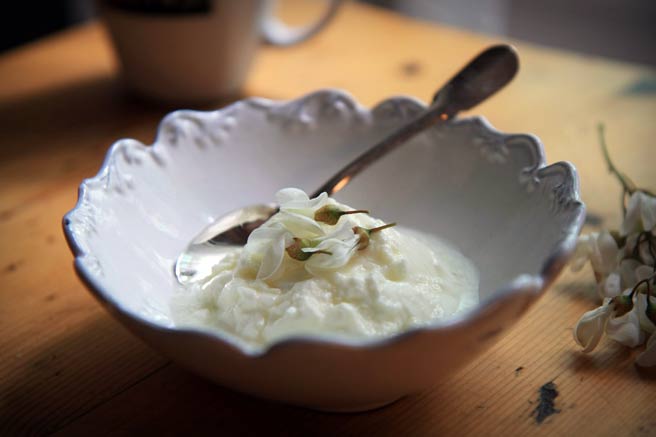
Just in the way things meld together from my various projects, I knew what I wanted to do with these flowers. I coaxed the beautiful perfume out into a syrup, which I served simply over fromage blanc en faiselle after dinner last night. Magic. When my guests had been fed breakfast and sent to the Musée des Beaux Arts this morning, out came the syrup again for me to enjoy with breakfast. Here is the recipe.

Acacia Flower Syrup

1 cup water
1 cup plain table sugar
6 stems of faux acacia flowers

Bring the sugar and water to a full rolling boil, and let it boil, without stirring, for 5 minutes. While the sugar boils, inspect the flowers to insure they are clean and free of any wind blown debris or critters. Remove the flowers from the stems by simply plucking them off with your fingers. Put the flowers into the hot sugar syrup. Stir lightly to saturate the flowers. Let them infuse in the syrup until it cools to room temperature. Strain and transfer the syrup to a jar or bottle, and chill. It will keep several weeks. Serve over fromage blanc en faiselle or yogurt, or make a kir with a couple of tablespoons of this syrup in a flute of Champagne or white wine. Float a flower or two in the glass, or put it on the dessert. You can eat the flowers.

Labels: ,


Share/Bookmark

Tuesday, May 18, 2010

The Poet's Fennel and Smoked Fish Salad


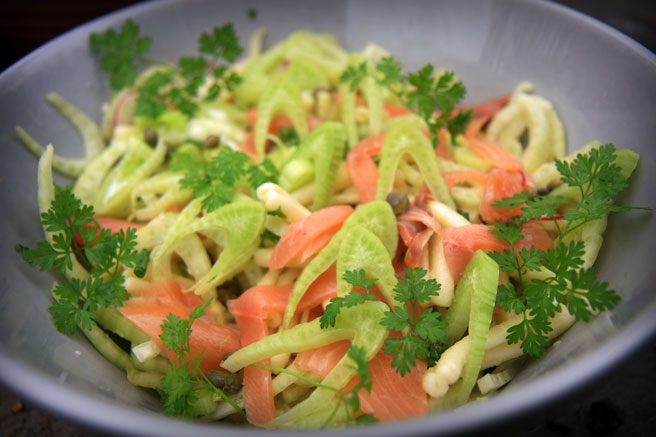
Despite the last week being cold and dreary, we are ahead of season in the Rhone Valley this year. The plump little baby fennel bulbs are no longer coming to Lyon's markets, the window only having lasted a few days here. No matter, since fennel, no matter what the size, in addition to being braised or steamed and served with any number of sauces, is wonderful raw in salads. I love the crunch of it raw and the way the hint of anise flavor harmonizes with smoked fish of any kind, be it smoked trout, salmon, or herring.

This salad was inspired by a poet friend of mine, created one early spring morning while she sat upstairs in the mountain house shuffling cards. I put it together thinking of her courage to pass wholeheartedly through the door into being the artist she is. I respect that. Instead of trying to find something otherwise busy or acceptably useful to distract herself from the constant pull that would eventually win anyway, she ducked her head, went through that door, and embraced her vocation with humility and grace. Whenever I make this salad now, I think of her.

The Poet's Fennel and Smoked Fish Salad


The ingredients listed here are suggestions for the salad - apart from the fennel bulbs, smoked fish, chervil and capers, you can mix or match according to what you've got at any given time. If you do use kippers (smoked herring), be sure to soak them in milk first before rinsing and slicing them, to remove as much salt as you can.

1/4 pound (250 grams) smoked salmon, trout, or herring, sliced
a pound (500 grams) of small spring fennel bulbs, the younger and smaller the better
the leaves and soft young stems from a bunch of fresh chervil
a half head of crisp lettuce, shredded
2 tablespoons pickled capers
3 white spring onions, sliced into thin rings plus their greens, chopped
1 shallot, sliced into thin rings
6 plump red radishes or radis noir if they have them where you live, sliced thin
1 small red bell pepper, slivered
8 small french cornichons, cut into little pieces
1 bunch flat-leafed parsley, washed, rolled and sliced into fine chiffonade
cracked walnuts or toasted pine nuts as desired
a nice idea: a handful of fiddle heads, if you have them, or edible flowers in season
you can also add rice or cold pasta.

Sauce vinaigrette:
1 shallot, minced
1/3 cup good olive oil
a generous pinch of ground sea salt
1 teaspoon Burgundy mustard or Dijon if you don't have that kind
1 tablespoon walnut oil
1 teaspoon brined green peppercorns, finely minced
2 tablespoons wine vinegar (not balsamic) or lemon juice, your choice

Put the ingredients for the sauce in a small bowl and, whisk them until milky, or give them a blast with the stick blender. Layer the rest of the ingredients in the bowl, composing it as you would like it to be presented, and toss the lot with a pair of salad tongs once the bowl is presented at the table. You can serve with with garlic toast or make croutons as well, or simply make composed individual salads on single plates, on a day that you're serving this as part of a sit down lunch with guests. This salad goes very well with a crisp Apremont from the Savoie.

Labels:


Share/Bookmark

Wednesday, May 05, 2010

This with Morning Coffee


Just to let you know that having the man from the forestry service come and remove the old apple tree's mistletoe this winter did very good things. She bloomed all over last weekend, not just a spray of flowers like last year. Now we know we'll get a whole lot more apples this year. The sound of the bees swarming all over her was a joyous sound indeed.

Labels:


Share/Bookmark

Friday, April 30, 2010

Your Way With Pâte


Little tartelettes don't have to be an exercise in logistics. In fact, they're the easiest things in the world once you have laid claim to your crust. I don't mean once you have decided on a recipe, I mean once you have pinched together cold butter and flour enough times that it is one of the tasks you consider as basic as chopping a couple of onions. Part of your way in the kitchen.


A couple of years ago, I found a little book on one of the riverside booksellers' tables. It was from the 1960s, full of your average French housewife's recipes for basic tarte crusts, cakes and home made creations. I wanted a glimpse into what the average French person 50 years ago put together on their kitchen tables. These recipes were not the ones that we have gotten used to these days, you know, the ones that strutt their stuff, expanding the technique and ingredient list to include every possible variation, noting every movement of the cook, adding skimming and sifting and doing things in clockwork fashion, not to clarify or instruct, but to stress, in a kind of patronizing way that yes, you really do need this recipe, you need to buy this book. I admit I never had much patience for these enormously self important kinds of recipes.


This little paperback handbook claiming on the back to have "really, we mean really, every pastry recipe you will ever need" that cost me a 50 centime piece was in my hands, and I was flipping through it, looking at a different kind of recipe style. A nice easy fast feulletage came out of that one, and a wealth of knowledge. First of all, something that struck me, while I read through these very simple recipes, was that for the crusts, they were all variations on one basic formula: flour, butter, salt, water. Second, the ratios were quite varied. You mean, there isn't just one way to make a tarte crust?


Here is the method that is currently my way in the kitchen for making a shell for a tarte, quiche, tartelette, etc. Start with impeccably clean hands and take a smallish piece of good butter from the refrigerator and weigh it, put it into a bowl. Add twice the butter's weight amount in flour and a sprinkling of salt. Use a fork to mash it together until you have little lumps. Get an ice cube and hold it in your hands, until it starts to melt. Then work the melting cold water lightly into the dough with your fingers just until you can pat it into a rough ball. Little lumps of butter are ok. If you're making more than you can comfortably melt ice in your hand for, go ahead and use ice water. Let your ball of dough rest in the refrigerator. Don't ever knead it, it will get tough that way. When you're ready, you can roll it out and use it. Voila. 1:2 butter:flour, plus a pinch of salt, add cold water. Once you have that down, you have just added a lot of options for apero, appetizer at the table, main course, and dessert.  Especially useful when you haven't planned anything in particular and you have bits and scraps of vegetables, meats, cheeses, and fruits you need to use up.

Labels:


Share/Bookmark

Friday, April 23, 2010

Jean-Jacques Bernachon


With great sadness I open the kitchen notebook today to tell you that Jean-Jacques Bernachon passed away during early morning hours yesterday.   It is no secret in the kitchens of Bernachon that he was not just the patron, but a father figure to each and every one of the staff there.  He was well loved and maintained a presence in the kitchens and chocolate works until illness took him.  He was 65.

Jean-Jacques is the a second generation of his family to be in the family business.  At the age of 17, it was clear that he wanted to go into chocolate, like his father, Maurice. His father had started the business in the family name at their current site in Lyon's 6th arrondissement when Jean-Jacques was five years old. Maurice insisted that his teenage son Jean-Jacques learn the grueling work of producing chocolate from someone else, in order to develop a true appreciation for this often difficult trade before coming home to work in the family business.  Maurice sent him to work for an old colleague in Bourgoin, and it was there that he cut his teeth, working 14 hour days. After a stage in Amsterdam, Jean-Jacques joined his father at Bernachon. After decades of working for his father, he took full leadership over the operation in 1998, when his father Maurice passed away.


Jean-Jacques Bernachon was married to Paul Bocuse's daughter Françoise in 1969, and is survived by her and their 3 children. He oversaw the artisanal torrefaction and chocolate and pastry making activities, and Françoise continues management of the tea room attached to the chocolate shop. Two of their children are involved with the family business. His son Phillipe plays a role in the artisan chocolate production, and daughter Stephanie runs the chocolate boutique.

Our deep and heartfelt condolences to the Bernachon family, including every member of their staff. Thank you, Jean-Jacques, for your kindness in allowing us in to catch a glimpse of the passion that is Bernachon. I maintain my fond memories and have implicit trust in your wife and children to carry on in the family name.

Other posts about Bernachon in Lucy's Kitchen Notebook:

Bernachon - Chocolatier Extraordinaire

Backstage at Bernachon

How Chocolate Came to Save Fran

Labels:


Share/Bookmark

Tuesday, April 20, 2010

Le Potager: Chervil


A good way to remember the French term le jardin potager is to think of it as a garden that grows everything a good French cook will want to throw into the soup pot. A potager always has space reserved for herbs and aromatics. The seeds we started in the window sill in Lyon have been transplanted to the beds we made in our garden in the mountains. There are sunny beds, and beds that get partial shade. One of my goals is for my guests to have salads from my garden as a special memory of their visit with us, and the shade beds will be devoted to the typical salad greens and herbs that thrive when protected from the sun.

Chervil, known in French as cerfeuille, is an important herb in French cooking. One of the fines herbes, it is readily available at French markets in thick handfuls ranging in price by vendor. Taste the chervil from several of the vendors you have identified as producers, and decide which you like best. They all taste different because they each use their own seed. When I first started market shopping in Lyon, I was drawn to chervil beccause of the beautiful dainty leaf that seems to glow in almost any light. It quickly became a regular addition to my basket. I use it fresh in salads, chopped into vinaigrettes, in fish fumet and to season seafood, eggs, and any dish that won't hide this herb's interesting flavor.

Rub it between your fingers, and take in the aroma. It has a fresh slightly licorice scent, one that will quickly fade when cooked. Chervil is best used at the very end of your cooking process or kept raw in cold dishes, because the flavor comes through the best that way.

The photo above is from our garden's first batch of chervil. It is growing in one of the shade beds. The oblong leaves are the first ones to come out when it sprouts, long and slender to take in as much of the sun's nutrients as possible.  After about 10 days, the true chervil leaves began to come out.  The sprout leaves will die off when the plant doesn't need them anymore.  I will also scatter seeds in a space I have reserved for that, to keep chervil going in our garden as long as I can in the season.  One advantage to planting chervil in your garden is that you can also use the roots, which I look forward to doing this summer.

Some recipes in Lucy's Kitchen Notebook using chervil:

Petite Tarte aux Poireaux
Bouquet Breadsticks
Soupe au Fenouil avec sa Truit de Petit Pecheur
Saint Antoine Market
Fleurs de Courgette Farcies
Greens and Game
Cold Cucumber Velouté
Fumet de Sparassis

Labels: ,


Share/Bookmark

Monday, April 19, 2010

Congee

In the middle of last week, my husband, who is generally the kind of person who will work whenever he has a chance, changed his tune and came home early. I was surprised to see him sitting in the dim quiet living room when the baby and I got home, with a plastic sack in his hand. He was waiting for us to come in on him, sitting in the dark. He does things like this from time to time. It's part of living with a scientist. Although he communicates in very direct and explicit language to convey the results of his research, his regular communication to me is less direct. On rare occasions, he does things like sit in the dark, signals that I have come to understand like a code over the years of our marriage. The baby was caught up in the moment of seeing papa unexpectedly and threw himself onto his lap. "It's a stomach virus." he said, and handed me the sack, full of medicine fresh from the pharmacy. I knew that his waiting for us like that meant that he needed to be babied himself. After settling him on the sofa with a blanket and fixing him a cup of herbal tea, I went to the kitchen to get supper on.

Congee came to mind as the best choice for him. It is one of those dishes I have carried to France with me, collected during my years in China. It always brings up complex emotions, because it is a kind of genre food, one of those things that in the lives of the people in China I knew and loved, carried symbol and meaning. You know, it's typically a breakfast food in that country. But beyond that, when you start delving into soul searching with a Chinese person, you'll probably find congee there in very tender places. In a very intense time in my life, congee sprang up a lot. The little pickles and preserves people add to the savory ones came in different shapes and consistencies. I am not Chinese, but my senses awakened in China. I speak Mandarin Chinese. I fell in love in Beijing, a story that's still simmering, trying to find a way to organize itself. That story did not have a happy ending, and I am not sure that there was a life lesson. I should not be afraid of congee, although, like I said, when it pops into my head in this innocent way, something mild and nourishing to soothe the love of my life, I can't help but take a breath, with a start.

On the way to a distant poor province to visit Haibo's parents, we shared an old sedan from a place near Shanghai, rented by his sister and her Hong Kong sugar daddy. The sedan bounced like a boat above the pitted road. The landscape was empty.

They are in the front seat. She reaches up, pretending to adjust the rear view mirror, and turns her hand to and fro to make her diamond sparkle. Hai Bo receives this like a signal. He and I had a quarrel the night before. We will never know each others' secret codes. He has bought a can of congee to eat for breakfast and he offers me a taste. We are bouncing against light blue velour, my sight is drawn to the blemishes, a couple of gum stains and the occasional cigarette burn. I can feel the springs. I take a sip from the can. It is sweet, light, and silky. Nothing like this moment, but very much like it too. He smiles.

I prefer my congee on the savory side. This recipe is the congee Ayi used to prepare for me from time to time in Beijing. There is no secret or technique. It just takes awhile. It is very soothing and filling, but easy on the stomach, so if you're feeling a little under the weather, it can be just the thing.

Basic Congee

2 tablespoons plump white rice
4 cups of water
2 1/2 teaspoons light soy sauce
1 thin slice of ginger
1 teaspoon sesame oil
1/4 teaspoon salt
1 tree ear mushroom, soaked and cut into slivers
3 scallions, chopped
Pickles of choice for garnish

Rinse the rice until the water flows clean. Soak it in enough warm water to cover it for awhile, 15 to 20 minutes. Add the rice and its soaking liquid to the 4 cups water that you've brought to a boil. Lower the heat and simmer it for an hour or two, until the grains dissolve completely. Stir every 10 to 15 minutes to keep it circulating. It should form a gruel. At this point, add the remaining ingredients except for the scallions and pickles, which you can add to the individual bowls just before serving. Simmer, stirring occasionally, for another 20 minutes.

A more rich variation on this recipe is to use unsalted chicken stock in place of the water and add lean chicken meat cut with the grain into very thin slivers at the very end of cooking.

Labels:


Share/Bookmark

Friday, April 16, 2010

Apéro Season Opens in Lyon - Seared Foie de Volaille


The sun's come out after work in Lyon and the whole city collectively sighs "Et si on allait prendre un verre?" Place Sathonay and Place de Terreaux are crowded with gones basking in the evening sun. The cherries are in full bloom in front of Café des Negotiants and Café Perl. Every bar in between with a square foot of sidewalk has set up their own personal street-side terrace. You can find a spot if you just keep walking. We open the windows and let the early evening in. This time of year we always keep a cool bottle of something in the frigo to have ready when friends stop by.

Isn't it better to have a warm little mouthful or two to savor instead of the typical potato chips with apéro? Chicken livers, when prepared just so, are a surprisingly delicious way to start an evening. Even though les foies de volailles are about as cheap as you can get, running at about 50 cents a pound in these parts, these little morsels always make people feel special.

Simple Seared Foie de Volaille

250 grams or a half pound of fresh chicken livers
3 tablespoons butter
a heaping 1/2 teaspoon each of coriander seed, cayenne, dried garlic, anise seed, black peppercorns, pink peppercorns, and juniper berries
2 teaspoons of paprika
2 teaspoons coarse sea salt (I use sel de Guerlande but you can just use what you have on hand)


*about mixing the seasonings: My "dirty coffee grinder" is one I use to grind spices just before cooking with them. I have found that using the whole spices instead of buying pre-ground powders really adds something to the flavors. It has become a habit in my kitchen. Sometimes I toast the grains in a dry hot pan just before grinding, sometimes not. It depends on my mood. After each use, I wash the cap, take a stiff brush to the blade and bowl, and put it away for next time. Inevitably, there's always some residue around the blade, so it's kind of a work in progress at all times. I use my dirty coffee grinder for grinding vanilla beans with sugar from time to time for sweets, and I've never had my sweet cookies, bars, cakes or ice creams come out corrupted in any bad way by whispers of savory spices past.

- Mix the seasonings: The coriander seed, anise seed, juniper berries, the paprika and cayenne, dried garlic, mixed peppercorns, (black and pink) go into the grinder with the spoonful of coarse sel de Guérande. Blitz until it turns to powder. If you don't have a coffee grinder devoted to spices and you don't see doing it just now, know that you can do this in a mortar & pestle easily enough. Just a dusting is sufficient for the livers before they hit the hot pan, so you might have some leftover.
- Remove the fibrous strands that connect the lobes of the chicken livers together by holding them in your fingers at the center part where they come together, pinching them gently with your fingers, and pulling out, sliding the tender meaty parts off the strands.
- Dust the prepared livers on all sides with your freshly ground seasoning powder.
- Heat a shallow frying pan and add 1/2 the butter, letting it spread across the pan and foam.
- When the foam subsides, spread the seasoned chicken livers around the pan, giving them plenty of room. The pan should be hot. If you crowd too many in the pan, they'll steam and you won't get the crispy brown crust.
- Gently nudge them to see when they release from the pan. They'll release when they're done on that side.
- Flip them over and sear them on the other side. Serve the first batch right away and put the other ones on to sear. Let them cook just until crispy on the outside, and they begin to seep their juices.

Serve these babies hot on a pretty plate with toothpicks or little forks. They go very well with most apéretifs: Pineau des Charantes, Muscat, a splash of Lillet, a house kir (for example with your verbena syrup), or even just a naked sparkling wine like Crémant de Bourgogne or Clairette de Die.

Labels: ,


Share/Bookmark

Tuesday, March 30, 2010

Lyonnais Producer: Black Pigs from the Bugey

..

Here in Lyon on the St. Antoine Market on Sundays and at the Producer's Market on Place Carnot on Wednesday evenings, there is a pork producer who sells his version of a figatelli and various sausages ranging from a saucisse à cuire to exquisitely à point saucisson sec for slicing thin and enjoying with l'apéro.

In addition to charcuterie, they supply us with quality pork and lamb at reasonable prices. This meat is so much better than anything you can get from the butcher who sells meat from the wholesale markets, and the price is equivalent. The secret to their success is that these farmers raise their animals traditionally and make their living direct from their product, selling retail only. The quality really comes through.

On their farm, apart from traditionally raised pigs, they have Iberian type black pigs that they allow to roam free in herds. These pigs are nourished by feed but foraging behaviors that are natural to this breed's tradition are honored as well. They munch on wild acorns and chestnuts and roots of various kinds to fatten up for winter in the forest and pasture on the farm, and since they are constantly moving animals, their meat is a deep dark red color, certainly not "the other white meat". Availability of this special type of pork is limited, since they follow traditional cyclical breeding and slaughter practices. We won't see these succulent pork cuts again until late next fall. Sigh. Remind me to show you this meat stand when you come to visit.

Labels: ,


Share/Bookmark

Saturday, March 27, 2010

Companionship and Capucine


Our fourth grade teacher, that would be when we were nine years old, instructed us each to stand up tell the class what we wanted to be when we grew up. I had absolutely no idea and was panicked at the thought that I would have to just choose something off the cuff like that when there was so little I knew about being a grownup. I was completely at a loss. My turn was coming up. I reached down within, the kind of reaching I used to do when I had to read sheet music to play the viola (which I wasn't very good at), and sought a word, a sign, anything from me to tell me what I was going to be. "A Botanist", I stated, surprising myself.

What was a botanist? I had absolutely no idea. "Very good, Lucy." I was off the hook. "A botanist is a scientist that studies plants." She moved on to the next person, and I pondered that thought. My mother always claimed to have a black thumb. Most plants died at our house, although there was a tangle of greens sprouting from dry prickly clumps of dead things in a perpetual state of thin survival on the second floor landing.

At recess, some different girls invited me to play with them, and one of them confided to me that she also wanted to be a botanist. She was new at the school, and I was happy to be her friend. In the years that followed, we ended up starting a secret picnic group together. This entailed getting permission from our parents to eat at each others' houses for lunch (for which you had to bring a note to school) and then taking off hand in hand into the woods near the watertower by the school, to eat a picnic we'd stashed there and look at plants. We felt so free and rebellious, sprawled on the blanket, sipping alternately from the jug of kool-aid and eating our bagged lunches, magnifying glasses tucked in our pockets.

The garden has still got me fascinated. Bed by bed, I put the plants in varying configurations. I don't like rows. Will this get me into trouble? I will plant groups of things. There is so much to learn. As always, when I am not there, I think about what I'm going to do when I get there. The seeds have all sprouted and it's interesting to see what baby this and baby that look like. The little rhubarb chard sprouts are bright fuchsia, the lettuce sprouts look like ethereal leaflets and the aromatics all look like little white worms squirming their way up into the light. The kohlrabi looked like a four leaf clover for awhile, then stretched out to more of an elongated shape. The beans, coriander and chervil were the last to make their appearance, each seed taking its own allotted time to open and for the shoots to push forth. The vegetable seeds, protected and warm in their little plugs in the city apartment window, have all taken much less time to sprout than the seeds we spread directly on the ground in the mountains last year.

I am focused on companionship. Garlic is something I should plant around the base of the apple tree, a good place too because it can also protect the picnic table from ants. Plants in useful places. I am putting an herb and salad clippings bed on top of a stacked flagstone platform in an awkward place for nibblers. I hope we'll get a chance to have at least a few fresh clipped salads. Herbs in the garden beds help the vegetables to grow and develop their best flavor. I plan to do some triangular beds and some kind of paddy like beds that will make use of a hill. That's where the cucurbits (my gourds and cucumbers) will hopefully cascade down from one platform to the next. There's a pretty flower called Capucine in French, Nasturtium in English, that when planted with my squash plants, will protect them from bugs that eat their stems. It doesn't hurt that the colorful red flowers and beautiful flat round eight segmented leaves are just my style. They'll also be a good addition to summer salads, a spicy cress. A pretty, lucky, spicy cress.

Labels: ,


Share/Bookmark

Tuesday, March 23, 2010

The Growing Season


The ground up there was ready to turn this weekend. I say this like I know what I’m doing. There are some things you simply cannot assimilate from books. I delve into a garden book and there’s so much jargon I can’t last very long before my eyes glaze over. So many questions, so many terms to set aside in my mind if I plan to slog on through and get to the meat of the subject. This rides on that, that depends on something else, another factor to consider is this, and that all depends on where you are in relation to the sun, stars and moon. I'm feeling like it is going to take forever to do anything more than scratch the surface.  Time in the garden changes this idea.  I just have to get started and do it and learn. We learned some things from our neighbor last year, mainly that if you put plants in the ground, they might produce very nice tasting vegetables and fruit. And that if you give said fruit to your neighbors, it is good. It is a beginning.

Such luxury to sit and plot out how the garden will grow. I learned last year that things don’t sprout and bloom faster if you stare at them, so while my seeds are tucked and sprinkled appropriately into little starter plugs, I am free to dream a little bit. Like most of my projects, the story begins with my ultimate fantasy. I spend pleasurable hours working on drawings and imagining scenarios, working out my little garden wonderland down to the very last butterfly and chirping cricket, stories unwinding about what could happen as a matter of course if we planted things this way or that way, if we got the correct nutrients, companion plants balanced just so, etc. What I love about this part is the empty page of it, the infinite possibilities.

My dream was cut down to size this past weekend, with cold hard budgetary restraints, lack of physical resources, and lack of stock in the gardening shops. But seeds came from all directions. I took them last summer from things I loved and tucked them dried into envelopes along the way. It seems everyone in the town has seeds for this and that.  Mme Martinet sends cuttings from a bush I admired last spring, delivered by her son.  We have tons of these stone tiles we can use for paths and borders. From this we have plenty to do.

We are in this together. I hope Mother Nature shows us clemency. I feel that our garden is taking on more meaning with each wedge of earth I loosen, and each clod of roots that he shakes out, one step behind me, back and forth, as we remove last year’s field of flowers, remembering. The baby sleeps in the warmth of the pine paneled room at the top of the house while we work. We are preparing the land for the growing season.

Labels: ,


Share/Bookmark