Friday, October 05, 2007

Breaking up the Crust

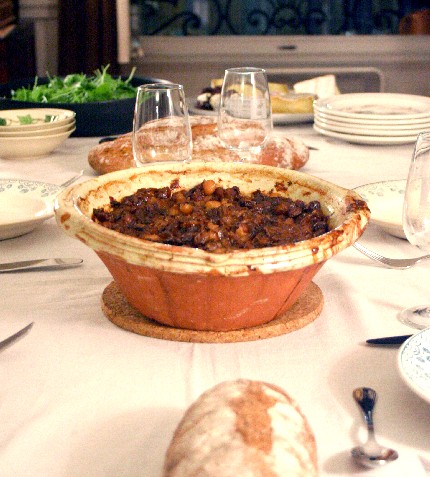
This photo was taken at night but I wanted to
give you an idea of what it looked like when it was done.

With an afternoon spent doing other things, I turned the oven down to 300 and just let the thing bake, uncovered, for another 3 hours. Every hour I brought it out and pushed the crusty top layer into the juice. When I was getting ready to take it out to the table, with 5 people waiting, I took a taste and almost fell over backwards. The crust, which behaved itself and stayed just on top, was delcious and chewy and tasted like duck cracklings, and had a balance and a tang that went perfectly with the beans. There was plenty of juice left in the part underneath, and I spooned each person a part of the crust, some beans and meat, and then made another pass to add some juices. The couenne had dissolved and had mingled with the beans and meat. It was heavenly. Luckily we had five people there, otherwise we would have all eaten more of our share and felt guilty. We served a St. Emillion 2005 with it and followed it with a salad, local cheeses, and then dessert with a 2006 Bourgogne Aligote. It was really a very nice dinner.

One thing that really made a difference was that I used that mushroom stock. The mushroom stock began as duck stock, was reduced quite a bit, then went through the transformation with the wild mushrooms, reducing it a bit further. It was quite a concntrated stock to begin with. It gave a wonderful flavor to the beans. I will use the couenne again for this type of dish.

Labels: ,


Share/Bookmark

Thursday, October 04, 2007

A First Pass - Bean Ragout

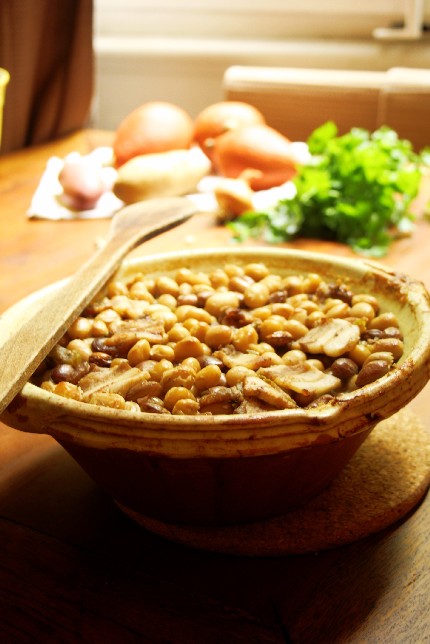
This has only had one first pass in the oven, and will spend
a few more hours there before Marie-Annick arrives.

In France, there are some regional dishes that possess a certain inviolable sanctity, and with some time here, you begin to realize which ones they are. Cassoulet is one of those dishes. You can tell by the way people argue about it. In practice, while the whole world gets away with plays on words and ideas when they prepare a Parmentier, sometimes omitting the potato altogether, or a Tatin, using everything from endives to foie gras and still calling it a Tatin, or a mille-feuille, where anything stacked is fair game, people don't mess with the Cassoulet. They may be inspired by it, but then they change the name.

I went back to read Paula Wolfert's wonderful story of how she came to uncover the many nuances of this dish the Cassoulet, on a delicious treasure hunt through Southwest France. She is driven on an oddysey through the region that has her talking to chefs and home cooks, tasting all along the way. In her book The Cooking of Southwest France, as a preface to a few different recipes, she animatedly recounts the vehement opinions and taboos, still reminding us that the ones who insisted so strongly can also change their minds over time if effectively convinced. This, in my opinion, is the beauty in France's resilience in their quest for the truth on many matters, and what makes arguing so fun here. Paula's way of getting to the crux of the matter at best and the elements that she reveals from that search is hands down one of my favorite stories, and I can read it again and again. I was happy to see that there is a recipe using fresh beans in Paula's book, and like I often do, I read it carefully, keeping in mind the mention of duck gizzards in her story, something I had just picked up from my volailler. The great thing about Paula's recipes is that I can visualize each step. The recipe for André Daguin's fava bean Cassoulet is fresh in my mind.

Kate and I have just got off the phone. She grew her own beans, of course. She told me about how this is a dish that began as one of those where the women of the town would bring it from home to the baker's oven and leave it to cook there. She surmized that the crust itself, that thing that is broken however many times during the process of cooking, is actually the process ot taking the back of a spoon and pushing the beans at the top back down into the liquid to ensure that they stay moist.

Since Loic's aunt is coming, I want to make good use of these beans, and gesture in the direction of a Cassoulet. I won't even pretend to come close, my friends. With Paula and her beautiful story and recipe as inspiration and Kate's reassuring voice over the line as a guide, last night I put my beans in to bake, and have pulled them out again, having been convinced by Kate that I must bake it much longer, to build up the crust, it just tastes so much better that way.

First Pass Bean Ragout - I won't even pretend this is a cassoulet
to be served to Loic’s Aunt Marie-Annick tonight, and to Christen the Cassole from Kate.

About 2 cups (shelled) (Kate said with the Fresh beans about 2/3 up the side of the Cassole is good)
One onion
Two shallots
1 clove of garlic
1 Tbs. Duck fat
1 pound of confit duck gizzards
One Lyonnais saucisse de couenne (which contains mostly ground pork skin, a little bit like the Gascon loafs they call gratons)
A bay leaf
A branch of celery, diced
Parsley
Thyme
About 3 ounces of fresh pork belly
3 cups of any stock you have on hand. (I am using my excellent mushroom stock from the other day)

- Take a tablespoon of the duck from from your gizzards confit, and heat it in a pan.
- Remove the remaining fat in your way (what I do is remove what I can and reserve that in my duck fat jar for another use, and then I run them under warm water to remove the rest of the fat, then let them dry in the colander). Return to a cool place to wait for the next step.
- Sauté the onion, shallots, and garlic in the duck fat until transparent.
- Add the fresh pork belly, and sauté for another 5 minutes.
- Add the mushroom fumet, the beans, the celery and the bouquet, and simmer for 30 minutes, adding water if necessary.
- Heat the oven to 300/160.
- Remove the skin form the couenne and spread the contents of the sausage onto the bottom of your cassole.
- Arrange the gizzards over the couenne.
- Remove the bouquet from the beans and transfer the beans and pork belly to the cassole over the gizzards with a skimmer or slotted spoon, saving the liqueur.
- Pour the liqueur from the beans over the gizzards and beans to cover.
- Cover the cassole with foil and bake, for one hour, ensuring that there is enough liquid to cover the beans from time to time.
- Remove from heat and let cool to room temperature. Refrigerate over night.
- The next day, return it to the oven for several hours, pusing the hardened beans at the top down into the juice with a spoon. Top off the juice if it reduces too much.
Labels: ,


Share/Bookmark

Wednesday, October 03, 2007

The Beans I Found

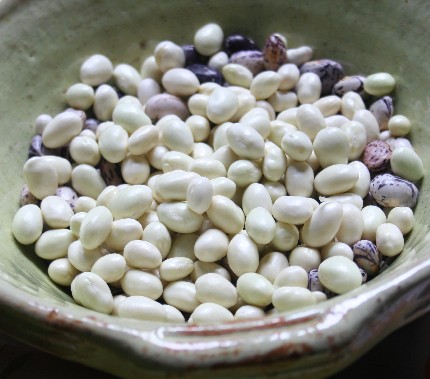
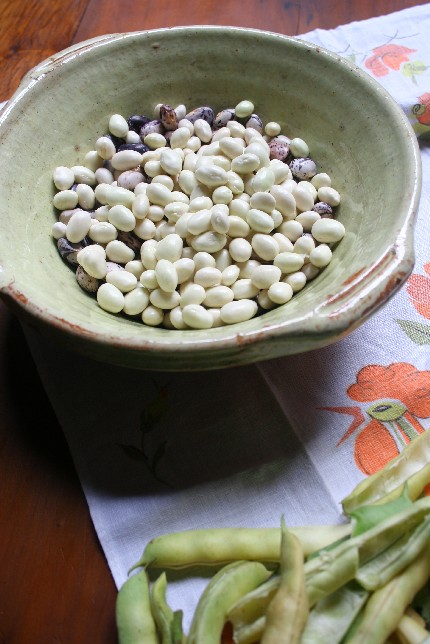
Alas the beans I found are not all white, like those we imagine to be in a cassoulet. Some of my beans are marbled with purple or creamy cocoa colored streaks. Such are the pickings on a Wednesday near noon in Lyon. After a morning of writing I suddenly bolted from the house and ran down to the market with a mission. Pascal, the man who supplies us with the best cherries and dried nuts, had a two handfuls of beans for me. Will my little cassoulet for two be good with two kinds of beans?

I have prepared a Cassoulet about a half dozen times. It became a pre-Christmas tradition at our house, because every year we go down south and Brigitte, my mother-in-law, has reign in the kitchen. I don’t get a chance to cook at all for Christmas.

I needed to make a tradition of my own, to take place here at home before we go down for the oysters and capon. I quickly became a devotee to Paula Wolfert’s recipe for Cassoulet in the style of Toulouse, and prepared it in a stock pot, a recipe I follow carefully every year. You can find me, combing Les Halles for just the right things to go into it, two weeks before Christmas, every year. It takes the better part of a week to prepare when you include going all of the places to get everything.

Kate is encouraging me to find fresh beans, and it's a wonderful opportunity to learn.

When Aude and Sebastien were students preparing for their teacher’s examinations and were just beginning their journey together, they came kind of on a date together to our house to have the cassoulet with us before they separated for the holidays. Sebastien appreciated it immensely. I still remember his having his mouth full and letting out a low moan that expressed everything and nothing at once, something that endeared me to him immediately. He certainly knows how to compliment a woman’s cooking. They shared a dream of one day moving out into France profond and giving something back to the people there, as teachers. Seb was born and raised in the Auvergne, and his mother has a sheep and horse farm. He came to Lyon beginning in high school, staying with his grandmother in town.

We go to Sebastien’s mother’s farm to visit from time to time, staying in the guest house, with the startling trumpet of peacocks to wake us in the morning. We watch the birthing of lambs, and stare into goats alien eyes, tromp through the trails to visit the horses while they are out, and watch the goings on in the stable. This year, Aude and Seb finally made the move out to the country. Aude is expecting her second child, with the first nearly two, and they wanted to get settled out there before the oldest begins school.

Since they are not nearby anymore, we won’t be having them for Cassoulet this year. Perhaps I could do one and take it out to them. Nearby is such a relative term. For me, being an American, three hours by car is really quite easy and I envision visiting often. But for the French, who tend to stay put, it seems an eternity, and they can’t imagine such a long trip, maybe doing something like that once a year. Alas, grandparents that live near the beach trump Lyonnais aunties and uncles.

Cassoulet being a winter thing for us, I have always used dried beans. Now that I am preparing it with Kate, I am following her advice and got fresh ones today, still in their husks, the plump shiny beans that will humbly christen my little cassole. I suppose I have about a pound of fresh beans here.

Kate, are these beans ok?

Labels: ,


Share/Bookmark

Monday, October 01, 2007

The Cassole


Last winter, I took the train down south. They do sausage very well down there. Just before I left, Kate put a little cassole in my hands. It is an itty bitty version of the heirloom vessel she writes about on her blog today. Today I noticed that she has begun, with the knowledge she has gathered over the years, to address the singular elements of the cassoulet, one by one. She begins with the cassole. I respond by bringing the one she gave me out from the cupboard, preparing to follow her lead.

Labels: ,


Share/Bookmark