Thursday, January 22, 2009

Pain de Sucre - Sugarloaf Chicory


This time of year, pain de sucre is found in bins amid the winter varietal greens, spinach, the many strains of radicchio chicory, nestled between the squash and pumpkins. Tender looking elongated tightly packed loaves, in English called Sugarloaf Chicory, tumble gladly into my market basket. While it's still dark in the early evenings, I walk down to the Wednesday night market at Place Carnot where the local farmers come once a week and keep an eye out for it.

I like to cook my pain de sucre by slicing it into chunks, rinsing the leaves, and lightly poaching them in a billowy herbal broth that's been simmered with a big winter bouquet and a ham bone. Chicory goes with pork. I float the poached leaves with the meat and herbs, sometimes adding wedges of pumpkin or topping the soup with shavings of good hard cheeses. A spritz of lemon juice, a drizzle of olive oil, and a grind of rose peppercorns or sichuan pepper acts like a little taste ladle that captures the bitter goodness and lifts it up for a second boost of winter satisfaction. Wrap yourself in a sweater, sip this soup in a chair by the window, slurp the bitter greens, and settle in for an afternoon soaking up some prose.

It somehow seems like spring is around the corner this week.

Labels: ,


Share/Bookmark

Wednesday, April 23, 2008

Lyon 2ème: Marché Fermier at Place Carnot


On Wednesday evenings starting at four o'clock
and going until 7:30 PM, there's a market that sets up at Place Carnot, in front of the Perrache train station, quite special in two ways. Being a night market where people can go after work gives it a special draw, and stands run strictly by producers makes the level of quality of the Marché Fermier at Place Carnot one of the best in town.


The mean freshness quotient of the products offered at the Wednesday night market is far above any of the others, which makes it very hard to keep from buying more than you can carry. It's one of those markets where you can trust everything there and you want to buy a little of everything.


Local things are found cheaply that are only offered at much higher prices elsewhere. Even though the quality here is excellent and the prices low, it's like a little secret, discreetly setting up and taking down at the end of the day in the middle of the week, without fanfare or crowds.


There are only a few stands, but the quality at each one makes this market definitely worth penciling in on your agenda. In fact, meeting friends and turning your errand into a pleasant apéro is a great idea, since the northern end of Place Carnot is surrounded by outdoor cafés with lots of seating, people to watch, and evening sun.


At the Marché Fermier, we very rarely ever hear anyone calling out to sell their wares. In fact it might be called a silent market. Every single stand is run by farmers, who don't have a habit of raising their voices. Their selling point is the terroir, and with this as your product, there is no song and dance necessary. We are content to listen to the evening birds singing in the trees above the square. If you speak French, you'll also be rewarded with a special kind of friendly chit chat from the farmers, who are proud of their product, know everything about it, and are happy to answer a hundred questions shot off at them city style in rat tat tat fashion. Ahem.


In addition to ultra fresh produce, I come here for poultry, with not only an AOC Bresse Chicken producer on site, but also a steady supply of small flock farm raised birds - one taste of the soup from an old hen from one of the little stands that sells baked goods and preserves and you'll dream about the next time you can make it to this market. Some interesting charcuterie can be found here as well. Very much steeped in local tradition, there is a man who does a very nice couenne, a sausage made from ground pork skin, that you can spread along the bottom of a baking dish below any kind of bean or lentil before putting it in the oven, rendering wonderful flavor to a leguminous slow braise.


Bresse also hands us her delicious galette, a kind of thin sweet creamy cheese tart, a specialty to the region, and from south of the city we're offered a good selection of Coteaux des Lyonnais. Lamb from the Bugey, cheese from Mont d'Or, and a steady supply of herbs and vegetables from all directions make this market a treasure trove.


Marché Fermier
Location: North end of Place Carnot, Metro A or Navette 91, stop Perrache or Victor Hugo
Days: Wednesday evenings until 19h30
No. of Vendors: 20

Labels: , , ,


Share/Bookmark

Wednesday, April 16, 2008

Lyon 4ème, Marché de la Croix Rousse


Years ago, when I did my initial exploring of the neighborhoods, I found myself particularly in love with the lore of La Croix Rousse. The area was not urbanized until rather late in Lyon's history, during the first half of the 1800s. Originating as private church property, after the Revolution, green rolling orchards, vineyards and walled monestary vegetable gardens were transformed into a concentrated public urban center for the newly industrialized burgeoning silk production in Lyon. Over a period of 50 years the construction of homes and workshops for 28,000 master craftsmen, workers, and their families was completed. The silk working industry, which had been segmented and dispersed throughout the city for centuries, centralized to form a community.

This enclave of master surface pattern artists, thread workers, technicians specializing in loom maintenance, the weavers themselves, came to live and work together in a rather contained community. With new technology invented by a Lyonnais named Jacquard, Lyon produced silk was the official supplier to Napoleon's public palace works and to the courts. This dense community of interdependent like-minded craftsmen and their eventual organization to look out for each other, fight for their rights, ability to unionize under difficult conditions and live a co-op centered lifestyle, not only gave birth to one of the most progressive social movements in Europe at the time, but would also institutionalize a unique style of cuisine - one that made an important statement - and leave a lasting mark on Lyon's gastronomic identity.

In a genre of dishes unique to Lyon, ones that had their own histories with the people but came to be staples in the workers canteens, the cuisine embodied an allegiance to the working class by remaining simple, rustic and firmly based in the local economy. This style of charcuterie production and cooking would eventually co-exist and intermingle with La Cuisine Bourgeois, which had its own parallel establishment in Lyon. The dense new urban working class community and their tastes made it easy for the establishment to embrace a conduit, a special environment where the upper crust could enjoy, even if precariously, the earthly delights of the best of both worlds. This marriage would eventually be served forth pat and parcel by Les Mères Lyonnaises; their offering added a layer of dimension to the gastronomic landscape quite unique to this city. One that would open doors, if only in principle, for a flowering of ideas that was destined, through events here in Lyon, to change the face of French cuisine forever.

View on the way up the hill to the Marché de la Croix Rousse.

The first time I went up to La Croix Rousse on the bus number 18, as we climbed the hill to reach the plateau that is the center of activity there, I glanced over to the left, and was astounded. I saw the most beautiful, mysterious, sublime cityscape unfold south of Croix Rousse Hill. Its panoramic splendor unfolded with each turn of the bus along the line of the towering cliff side road above the Saone. I glanced around the bus, grandmothers minding their business, people facing forward, waiting for their stop. I wondered - does anyone else see what I see?! Having made the climb now on foot and by bus many times, I can tell you that it is especially gorgeous in the morning when humidity makes the silhouettes of the black cathedrals pop out and it's all a gauzy curtain of sublime historical mystique. It is really impossible to take it in in one glance, you have walk down to the little park at the end of the boulevard after going to the market at La Croix Rousse. If you can find the time, find yourself a park bench, and try and wrap your mind around it.


The Marché de la Croix Rousse is the largest market in Lyon on its heavy traffic days. Although the market does set up every day except Monday, Tuesdays and Saturdays are really the best day to visit this market. It is positively enormous, with 122 official food vendors and many more setting up in the periphery. The market has a distinct flavor, one that represents Lyon's proud working class heritage with a vivacious zest for life.


The vendors cry louder at la Croix Rousse. The merchandise moves faster, quickly moving pre-weighed pans of fruits and vegetables, enough to serve large families. Butchers, charcutiers, bakers, producers, dry goods sellers, international products, and re-sellers galore. They line up for nearly half a mile along the avenue, spanning a good three quarters of the Croix Rousse plateau. I have witnessed some pretty striking things at this market. One vendor brings one whole pig on weekends and carves it, offering the cuts for sale as the come off the animal. On Tuesdays, the opposite side of the street sells manufactured items: mostly imported clothing, sundries, sewing supplies, some crafts, etc.


The clientèle of this market is diverse as its offerings. You're likely as not to see the Pinder circus trucks circulate through the area, adding to the spectacle with their canned music coming from a loudspeaker and trailers of sculptured circus animals, stylized to catch the attention of the children. Thursdays, an area near the Metro end of the market is devoted solely to organic vendors. The town crier is present on Saturdays, reading spicy proclamations from the people, something you don't want to miss, especially if you speak French.


A friend of ours who lives nearby tells me he likes to hit the market on Saturday mornings, and then sidle up to one of the seafood places over along near the east end to enjoy a dozen oysters when they are in season, with a pot of local wine. Indeed by the time you've worked your way through this market, it can be nearly lunchtime.

Marché de la Croix Rousse
Location: Boulevard de la Croix Rousse, 69004
Days: Every day except Monday (manufactured items on Tuesdays)
No. of Vendors: 122

(a note: I will be updating this post with more photos of this market in the next few days so please stop back again! - L)

Labels: , , ,


Share/Bookmark

Tuesday, March 04, 2008
Central 3ème: Marché Guichard


I adore the mosaic modeled after a 1934 work by Ferdinand Fargeot.

If there's one place that's easy to get to in the 3rd arrondissement, it's Place Guichard. The market is right above the metro stop on line B. The tram T1 stops there, and two buses stop within close proximity. The two-lane dedicated bike path that cuts east west across the city runs right next to the market, and there's a VeloV station just next door. If you are a budget traveler, in fact, this neighborhood being super accessible by public transport, is a smart choice for a pied-à-terre if you can't afford the choice digs on the presqu'ile.


This market is an easy excursion by bike from centre ville.


If you plan to visit Les Halles, Place Guichard would be nice start to a discovery tour of the neighborhood. The square is at one and of a pedestrian walkway lined with outdoor cafés, with Les Halles at the other. It's a nice place for inexpensive local produce, and Les Halles of course is the place to get just about everything else you can think of.


Ultra-fresh local produce and an organic bread baker coming in from the region
are succulent draws to Marché Guichard.


The market at Place Guichard on Tuesdays and Saturdays is small, with only 8 official vendors, but features some quality local produce that is clearly popular with the neighborhood peeps. So popular in fact, that you have to take a number!


There's a raw milk vendor that also has pasteurized and fermented milk products, 2 fromagères, four vegetable stands, and an organic bread baker bringing in his loaves from Gringny. The vendors here know their clients, call to them by name, share their news, but don't hesitate to also talk to strangers. There is a lot of good natured fun and smiles at this market, they don't get big crowds and nobody's in a hurry. The hustle and bustle and circus atmosphere we sometimes see at the larger markets is left aside here, no hollering sellers, no pushy salespeople, just honest selling going on here, where people take the time to talk. In addition to the produce, cheese, and bread, there is a florist and stands selling prefab goods like knives, cooking pots, and electronic items, which can vary, depending on the day. There are no ready to eat meals, but if the weather is nice, you can easily have a cold picnic with purchases from this market and enjoy them in the amphitheater on site.


Marché Guichard

Location: Place Guichard, 69003
Days: Tuesday and Saturday
No. of Vendors: 8

Labels: , ,


Share/Bookmark

Thursday, February 28, 2008

South of Perrache: Marché Bayard


Poulet Basque to go at the Marché Bayard

A few years ago a man struck up a conversation with me
in what was a rather down and out area just south of Perrache station. I was visiting a poor starving just-promoted-to-saucier friend renting out a studio there by the prison. The man I met on the street outside my friend's place boasted that he was purchasing everything he could get his hands on in the neighborhood. This propriétaire from Paris was brimming with optimism that property value in the area was really going to explode just as soon as they turned the prison into a public garden.


Whiting, which is excellent braised in sparkling wine, looked excellent and was priced quite well.

From the way things looked at the time, I thought he was suffering from delusions, but the truth is that now, 7 years later, it is clear that the city has stepped up to the plate and is cleaning up the area. Our current leadership has made a whole lot of progress and the best is yet to come. The Confluences neighborhood, where the Saone and the Rhone rivers meet, is up for a complete overhaul that will include the building of not only a public garden, but apartment complexes, shopping villages, floating restaurants, an athletic field, and a protected harbor for small boats.


What state is the area in now? A couple of years ago Cours Charlemagne was a mess, because they had dug up the entire avenue to extend the no. 1 tram line down through the area. The Best Western on the street hosted international guests for the World Pastry Cup in 2005 and some of the international team members were stuck there in what seemed to be a post-apocalyptic waste land, forced to pick their way through 4 blocks of road work to get to any public transportation. The fact that they didn't inform the people making reservations from abroad about the work in progress was embarrassing. It was not a very nice introduction to the city of Lyon. But that work is done now, and there is a hint of life back to normal.


The tram line work is done.


A producer's stand at Marché Bayard.

The Marché Bayard is a neighborhood meeting place, where residents come to talk. Knowing this, canvassers for mayoral candidates were out shaking hands this morning. The development project of course is on everyone's mind. What's in it for the people who live here? Improvements to the area have been high profile, for example last year's decision to go in and remove the trucks and campers that had slowly begun to take over the entire riverside on the left bank of the Saone - you know, those trucks with candles burning in the windows... But the extensive work to come also has some residents concerned about their quality of life.


From the smiles at the market, it seems that for now people in the neighborhood are holding on and are enjoying what's good. The market is located just past the church named after the Lyonnaise Sainte Blandine, the early Christian martyr who was fed to the lions in the year 177. The story goes that instead of devouring her as the crowd of Romans expected, the lions sat around her, as if to protect her. The scene is represented in a beautiful bas relief above the doors of the 19th century edifice, something you should check out on the way there, when you get off the tram.

A block down the road, the Marché Bayard sets up on Thursdays and Sundays. This market provides everything the neighborhood needs, with 22 vendors, including a fish monger, two butchers, two sellers specializing in charcuterie, two fromagers with excellent examples of the goodness from neighborhing regions, plus one actual cheese producer from the Savoie selling two unique artisan goat cheeses you won't find elsewhere: a semi-soft bleu and a unique herb infused tomme. In addition to several fresh produce stands, a farmer and his wife sell their fare and free range eggs direct.


Labels: , , ,


Share/Bookmark

Monday, February 25, 2008

Lyon's Outdoor Markets


There are 43 official outdoor markets within the city limits of Lyon.
Many many more when you count the suburbs and neighboring towns, which are well connected by metro, bus, and tram to the city center. No matter where you live, there is a regular market within a few minutes on foot where local fresh fare is available for sale, if not every day, at least a few times a week.

Each market has its own draw, sometimes as simple as the goal to provide fresh fare to a neighborhood on a regular basis. Some markets feature only organically grown goods, some restrict their stalls' criteria to be open to farmers only, some spanning for blocks, some as small as three vendors, but each meeting the neighborhood's needs. Some markets welcome sellers of manufactured items on one day of the week, and I plan to document what kinds of gems they have tucked in here and there.

As a chapter in my project to bring the food and wine of Lyon to you, I am visiting every single one of Lyon's outdoor markets during these next few months. I am noting the best way to get to each one, soaking in the vibes, talking to the vendors, observing what similarities the markets share, and noting what each one claims as their own. As Spring unfolds, the pages fill, noting particular attractions, bus lines and metros, schedules and stories, so that the task of choosing will be easier for a traveler or newcomer to Lyon. Of course I'll be taking photos, and each has its own history and clientele.

Labels: , ,


Share/Bookmark

Sunday, January 13, 2008

The Basket

Did you ever think of scaling down your basket size? I recently did just that. I used to carry an over the shoulder tote-like market basket, and sometimes my back hurt if it got too heavy. Not only that, but sometimes we'd buy that kilo of this or that at a special price on a whim and then have to figure out what to do with it. I have changed to a small one, and it suits our needs well. I can carry it without hefting my weight to one side, saving my back. My thought is, if it doesn't all fit in the little basket, I'm overdoing it.

Just 1 or 2.

They are well prepared for the Sunday rush.

Early is better. If you go even as early as 9am, you can be reasonably sure to have elbow room, a good choice, and time to chat with the vendors.

After last weeks capricious blustery weather that brought rain and fog, the sun is out and the air is brisk. The church bells sound here and again. The book sellers are setting up. Just walking down the quai gets me in the mood to make a soup.


You can buy one leek. Just ask.

I should knock on wood when I think nobody will see me. A friend I met just the other day at a social gathering came up and said hello. I got a strange vibe from her for a second. Then I remembered my hair was up in a bun held with a chopstick, I had no makeup, and I had wrinkled turquoise colored yoga pants sticking out from the bottom of my coat. Please note: When you go to the market, you should probably look presentable. You never know who you might meet!


Specialty shops sell soissons, and man, they cost a pretty penny. They contain enough beans to last about a year! You don't need to buy very many of these beans because they swell up to nearly 4 times their size and remain extremely flavorful. One small handful, taking me back less than a buck, will provide enough Soisson power for a glorious soup for four.

Loic's only request this morning was clementines.
I didn't buy these particular ones, but they were pretty.

There are certain things I buy from the same person all the time, people I have gotten to know. Each producer has his own product, sometimes several that vary throughout the year.


There was a man from Dieulefit, Mr. Vidal, up to sell truffles today. He isn't at the market but a couple of times a year. He may not even be back next week. I have a special guest coming on Thursday so I indulged in a little one. Wow, do they smell great. A 20 gram whole truffle took me back 12 euros. That was the indulgence of the week, it took more than 30% of my budget!

More common fresh mushrooms are for sale, shitake and oyster, both freshly cut this morning, and flavorful. I bought a couple hundred grams of oyster mushrooms that I will use to finish the soup today.


This gets sealed up tight with the eggs.
Over the next few days, the eggs will absorb the flavor of the truffle.

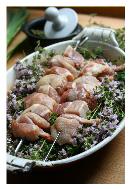
The basket was nice and full when I got home with eggs, fresh oyster mushrooms, 4 clementines for Loic, winter greens, a leek, a truffle, a small bundle of radicchio, bunches of fresh sage, chervil and sorrel, a handful of soissons, 2 small turnips, a small fresh celeriac, a rutabaga, two potatoes, 80 cents worth of guinea hen necks for stock, and a couple of quail to flatten and roast for Sunday's supper.

Some special things to see us through the week.

I will slip out in the neighborhood with the same basket throughout the week to supplement what I got today with fresh bread, maybe fresh greens here and there, a lump of bacon, dry goods when I don't have them in the pantry. I don't ever need to buy more than I can easily carry back home on foot. Why should I?

Labels: ,


Share/Bookmark