



Wednesday, September 20, 2006

Conejo en Chile de Senora Maria Elena Lara


Oh it must have been about Thanksgiving time 1996. I went shopping for ‘western stuff’ in one of the specialty shops in the mall in the basement level of the China World Hotel in Beijing. Baking powder, poultry seasoning, you know, that kind of thing. There I saw a desperate woman. She was lurching most unattractively at the cake mixes, and packets of fake gravy and "stuffing mix" and grappling and stumbling and filling her shopping cart with these convenience foods, literally clearing the shelves as if a tornado was on the way and she was desperately seeking provisions to feed her family. What struck me was her desperation and the relative violence she incorporated into her actions – I didn’t see that kind of desperation ever again until I was in Paris 8 years later at the derniere démarque of a designer shoe sale in January. I admit, back in the 90s in Beijing, it was really hard to find ‘western things’. Having been taken under wing by a wonderful Chinese Ayi, I had already given up on the concept of eating western at the time, and didn’t have any real need for cake mixes, it struck me as doubly freaky to see this woman in such violent need. Being in a foreign country hits some people that way.

Ah, being in a foreign country. "Do you like living in France"? The most common question from strangers. Of course people who pose this question are just making small talk. I always come back pleasantly and briefly with a smile in return. It is my policy, on the whole. Once at a party a handsome young man thought he was being clever and asked "What's the one thing you hate most about France?" I cooly replied: "Fromage fort." And he didn't believe me, and said so and was very persistent, but didn't know him. I suppose he expected that I'd start crying and put my head on his shoulder and complain about having to re-take the drivers test or something. I stood my ground. "In fact", I added, "I think that Fromage fort is the only thing I don't like about living in France."

I learned, the first time living in a foreign country, that if you relax and allow yourself to experience the local culture instead of trying to create a little country of your own at home, things go much more smoothly. Second, if you really miss something, as in craving, you should go ahead and find a way to fulfill it in a relatively stress free context. For example, don’t promise someone a pecan pie for their birthday before you have the pecans, don’t try to create a completely American Thanksgiving, just keep a little list in your mind that you are looking for pecans or whatever and send out your feelers, and don’t put any sense of urgency in the matter. You will be suprised at how long you can harbor a craving without it destroying you. And learn how to make things yourself from scratch. It eventually comes.

Loïc went to Mexico for a conference, and brought me back all kinds of lovely staples for cooking Mexican because he has heard me mention on several occasions that I miss real Mexican food here in France. Especially out west where I have lived both in Monterey and Los Angeles, you can eat some really sublime Mexican food. But here in France, sadly I must say that something is dreadfully missing from what they are peddling as Mexican food. There is one restaurant in Vieux Lyon which is run by a chef coming from Mexico who also went through the Institut Paul Bocuse, but it is sadly very expensive, the Margaritas are rather small, and they serve only flour tortillas, most probably due to the unavailability of the proper ingredients for masa. So when I do have a craving, which happens every so often, I look in my compendium by Diana Kennedy, a woman who has lived and researched the local home cooking all over Mexico since 1959 and who has produced an incredibly complete opus that opens our world to the rich possibility of cooking delicious and authentic Mexican food at home.

This week I decided to prepare Conejo en Chile from Senora Maria Elena Lara which is I think most likely how a good Mexican housewife might prepare her rabbit, the Mexican version of Lapin Bonne Femme. It is beautiful and simple as a recipe. I used dried chili peppers, including guajillo peppers and those nice complex smoked chili peppers called the Pasilla de Oaxaca. We are rationing peppers, so we did not use as many as were called for in the recipe. If you are in France and have been harboring a serious craving, and are willing to plead your case, I might send you a few of these peppers, which Loïc brought to me from Mexico.

Conejo en Chile
de Senora Maria Elena Lara

The recipe that Madame Kennedy recounts in her book calls for a first rather long (45 minutes) stewing of the rabbit in a vinegar brine with a bouquet including oregano and thyme, but only if you are using a big old tough wild rabbit. If the rabbit is tender, she suggests that we omit the first step, or the rabbit will turn out too soft. I am all for omitting the first step, although when game season is in full swing, perhaps I will try it with a wild rabbit.

Ingredients:
One rabbit, young and tender.
A morsel of pork fat (I used a morsel from a side of foraging black pig raised by a friend in the Ain, but you can use plain fat back)
2 large white onions, sliced thin

chile sauce:
15 guajillo chiles, wiped clean (due to rationing measures, we only used 7)
10 pasilla chiles (we used only 2, and we used the Pasilla de Oaxaca)
1 1/4 pounds or 500 grams tomatoes
Salt to taste
2 cups broth or water

garlic seasoning:
2 large garlic cloves
1/4 tsp cumin seeds
1/2 teaspoon dried Mexican oregano (we used fresh oregano since we didn't have Mexican)
6 sprigs fresh marjoram
6 sprigs fresh thyme
2 Mexican bay leaves
1/2 teaspoon salt
2 tablespoons water

Make the Chile sauce

– wash your tomatoes and fit them whole into a pan that holds them nice and snug and put into a hot oven for awhile to roast. Once they turn brown on top, take them out again.
- Transfer the whole roasted tomatoes, peels and all, into a high-sided bowl if you have a hand held blender, or a blender jar.
- Wipe off the chiles, cut them open and remove the seeds and veins, and cut them in pieces over the roasted tomatoes.
- Blend the chiles and tomatoes together with salt into a smooth sauce adding just enough water to keep it from getting too thick.

This is your sauce. You will add the broth to it later.

Brown the rabbit:
- Carve the rabbit into 6 or 8 pieces.
- Render the lard from the piece of pork in a heavy stewing pot.
- Once the fat is rendered, add the rabbit pieces and brown them in the pork fat.

While they are browning, make the garlic seasoning paste.
- Ground the garlic, cumin, oregano, fresh marjoram, fresh thyme, bay, and salt in a heavy mortar until it is a paste. (I used cumin powder and fresh local oregano since I didn’t have any Mexican).

Finish up, 1,2,3!

- Remove the meat from the hot pan, and stir in the seasoning paste letting it fry for a minute or two. Add the onions, and fry them for a minute or two. Use water in the mortar to get the last of the paste into the pan.
- Add the tomato chile sauce and continue to fry, and scrape up the bits from the bottom of the pan.
- Add the browned rabbit and the 2 cups stock back into the sauce, lower the heat, and stew for 20-40 minutes.


Fill that little hollow in your heart with it while it's hot. Serve with fresh hot corn tortillas. If you are in France, a very good wine to serve with this dish is Gigondas.

Labels: ,


Share/Bookmark

Saturday, September 16, 2006

Chèvre Chaud


My friend is waiting for me, looking into a gift shop window. We kiss each other’s cheeks and silently admire the flourishing ivy growing in boxes in front of the teahouse. In the somber passage where the light always falls as if we are in a forest, the vines quietly and thoughtfully climb. Before we enter the teahouse, we unwrap our scarves together and check to see through the window that our regular table is ready. The handle pulls down, the door pushes in, and a bell quietly chimes. The lady who sits at the desk in the afternoons waits for us to shed our outdoor clothing, ushers us to our seats, and we are ready. I glance through the stone arched door with the curtain in the back and see a quiet movement against the creamy yellow cabinets of the kitchen. This place is not really a place for small talk. It is a place where we must discuss. Something in the stones demands it. Our salad and dessert will be followed by pot after pot of hot nourishing tea.

Salade de Chèvre Chaud avec sa Vinaigrette au Poivre Vert

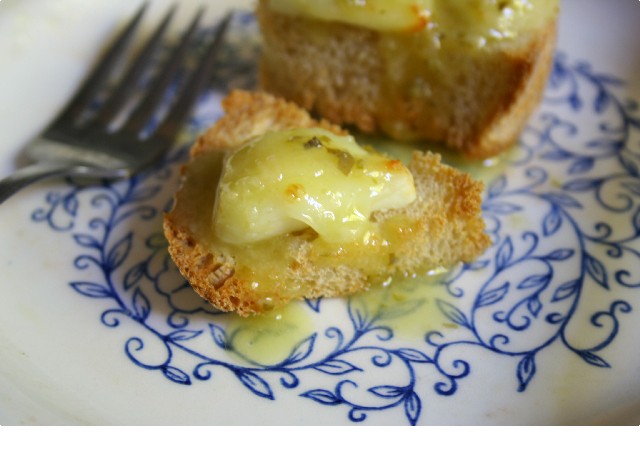
Take a flavorful chèvre like the Picodon or Pélardon, and slice it into 6 wedges. Split each of the wedges in half along the center. Choose a quarter of a good round loaf of substantial bread, like Richard’s pain ligerien, pain de campagne, or a pain au noix. Slice it into flat triangles and toast the bread triangles briefly in the oven to make them crisp but not too brown. Wash & dry your lettuce or mixed greens, herbs of your choosing, wedge some garden tomatoes, thinly slice an onion, peel a shallot, and crack 8 walnuts. Make a sauce vinaigrette with the blender using one whole shallot, a rounded teaspoon of brined green peppercorns, ½ a teaspoon of salt, olive sunflower and walnut oil, and plain simple cider vinegar to taste. Place the wedges of cheese on the toast with the crust of the cheese facing up. Put them in the hot oven to slightly melt and brown the cheese. Arrange the salad ingredients in a bowl. Give the salad a first drizzle of vinaigrette. When the cheese is adequately soft on the toasts, place them on the salad, drizzle again with vinaigrette plus a light dusting of sea salt or fleur de sel, and serve.

If you have any cheese toasts leftover, offer them to your companion with a little more green peppercorn vinaigrette on top as a gesture of friendship.


Labels: , ,


Share/Bookmark

Thursday, September 14, 2006

Best of Both Worlds - Lyon Martinière


I live in a little quartier in the 1ere arrondissement, the neighborhood number one, in an area sometimes called St. Vincent, which is the name of the church on the riverside nearby, or sometimes called La Martinière, which is the name of the guy and the name of the halle, the school, and an avenue.


There is a geriatric population who quietly peer through crooked shutters in gorgeous belle-epoque buildings and who will pass their apartments to their sockless dock-sider wearing grandsons.


Then there is the side that wants to call the neighborhood the lower Pentes de la Croix Rousse, which means in the lower slopes of the hilly neighborhood known for voluminous headscarves, dangly earrings, loft living, budding seamstresses, yoga classes with discount for the unemployed, and a bio market by the metro stop every Saturday.

It is a very interesting mix.


In a nutshell, my neighborhood is suffering from a severe identity crisis. This can actually be a boon because such diversity breeds creativity - rich territory for good eats, and some great restaurants are really thriving here. If you’re not eating at my house, there are lots to choose from in the restaurants of my neighborhood.


For Apéro: When the weather is good, head directly to Place Sathonay. The Ambiance there can't be beat for a nice relaxed drink on one of the many outdoor café terraces surrounding the square. le Café de la Mairie is the most fashionable and those who know who is who might just be impressed.


Otherwise, any of the cafés will do, actually. You’re there to watch the pétanque matches, and just soak in the atmosphere. When it's raining or snowing, meet friends at Voxx, on the corner of quai Pecherie & rue Algerie, where they play 1980s LPs on the record player during the day and in the early evenings. It picks up after about 8. If you’re a non-smoker or looking for an older crowd you might be better off during apéro hour at the Café Bistrot Pêcherie, a block and a half down, which has a better ventilation system, more wood paneling, and the music is a bit less stylized.

For dinner
, here's the scoop. First of all, there have been some changes in the past few months.

Le Potager des Halles
, 3 rue de la Martinière, Lyon 1e, 04.72.00.24.84
News: The previous owner packed up his rubber chickens and the restaurant is now owned and run by chef Franck Delhoum, previously the head chef at Paul Bocuse's Brasserie de l'Ouest. Lets see how he does for 30 covers instead of 300. Sounds promising, yes?
Key Words: Petit bistrot de quartier, semi-open kitchen, open Tuesday to Saturday. Formule midi 12€, soir 28€.

Entre Mets et Vins
, 6 rue Hippolyte Flandrin, Lyon 1e, 04.78.28.32.26
News: That pizza place near place Sathonay has been replaced by a real restaurant. They tore off the whole front of the place and just built on the rocks. It turned out really pretty.
Key Words: Mediterranean food, Provencale, olive oil & garlic with a twist, chilled soups, crawfish, millefeuille de sardines au poivron rouge, interesting speculos tiramisu, spacious. Open Monday to Saturday. Midi: 13€, Soir 26€

Magali et Martin
: 11 rue des Augustins, Lyon 1e, 04.72.00.88.01
News: Magali & Martin Schmidt own and run the new restaurant which caters in a secretive way to a demanding fashionable clientele. Very chic and mysterious.
Key Words: Gorgeous small dining room. 20 covers. Cuisine du Marché. (a bit hard to find, as they have no sign, and are shuttered tight oustide business hours, as if the place is being kept secret. Effectively this draws lots of curiosity and adds to the desirability quotient. Locate the Nardonne ice cream shop and proceed down the alley across the street between the drum shop and the butcher.) Open all week except Saturday and Sunday lunch. Formule midi, 14€, dinner ??

Some things have not changed.

La Table de Hippolyte, 22 rue Hippolyte Flandrin, Lyon 1e, 04 78 27 75 59
Cuisine du Marché catering to food loving clientele with a taste for Lyonnais tradition (Magali et Martin also strive to garner this crowd), but they are have been an institution here in this neighborhood for the last 15 years. Great wine, warm but at the same time discreet service by the owners. When I go there, I am at once enveloped by a feeling of admiration for the chef, while at the same time just being coddled by the great service. It's a real mood booster, every single time. 18€ midi, 31€ soir

Sapori e Colori, 4 rue Martinière, Lyon 1e, 04.78.29.45.99
News: Still serving traditional Italian to discriminating palates.
Key Words: Traditional (and real) Italian featuring seasonal Italian imports, octopus linguine, carpaccio brésaola, constantly changing antipasti. Just next to the Fresque. If you’ve never been to Italy, eating here might just make you realize what real Italian food tastes like. Open Tuesdays to Saturday, menus 22€ to 25€.

Albert: 10 place Fernand Rey, Lyon 1e, 04.78.27.95.56. This place is located in the little nook you find when you take the road towards the quai from the Café de la Mairie on Place Sathonay. For good French food, pass by the 'bouchons' and head for Albert. Pretty brocante finds line the walls. It kind of makes you sad for all of the terrine sets they must have destroyed to amass their collection, but once you taste the food everyting is alright. They serve refined traditional French, and very rarely disappoint. Magret de Canard, Carpaccio de bœuf, wine in proper glasses, correct service, a good rapport quality/price.

Bottomless terrines at Albert. Boo hoo.

If you’re on a serious budget or want a fill in between fine French meals:

La Koutoubia, 13 rue Hippolyte Flandrin, Lyon 1e, 04.78.39.06.57
A visit to France isn’t complete without trying couscous. Since 1985, first for couscous, the best out of 5 or 6 choices. Make the effort to locate this one. The restaurants on the same street take the spill-off from this one and aren't as good.
Open Monday to Saturday. Menu items from 4 to 17€.


Comptoir du Tandoori
, 6 r Ste Catherine, Lyon 1e. 04.78.28.07.48 A serious hole in the wall. They turn out great sandwiches to go for 3.50€. Their plated dishes are ok but I am sending you to this place because of their sandwiches. Gorgeously spiced meats and vegetarian delights wrapped in hot thick freshly traditionally baked nan. Delicious. Better than any of the others on the street. A good picnic is to get sandwiches there to go, and then take them back out across Place des Terreaux (get off rue St. Catherine, quick, before someone asks you for a cigarette!), and go into the courtyard outside of the Musee des Beaux Artes. Listen to the birds, watch the people, and enjoy this great Indian sandwich.


Balmoral. 14 rue Lanterne, Lyon 1e, 04 78 28 72 53. Best pizza in the neighborhood. Wood fired stone oven, hand tossed crust by a serious expert. This place was a legend for decades, dark with velvet booths, candles in Chianti bottles, old Italian men playing cards at the back tables, black & white photos of the owner with movie stars and moguls. The old dudes that owned it passed it on to some young 'uns who did something horrible - they painted the place hot flourescent orange and put in Ikea lightbulbs, got some mopeds for delivery, and just messed up all of the food including the pizza. Business plummeted. Within a year, the godfathers took the restaurant back and have changed the lighting, put the original guy back by the wood stove, and got their old customers back but the electric orange paint has yet to be covered up. Don't be fooled. It's the pizza we're there for. They also do an excellent antipasti platter and the veal kidney and house tiramisu are also very good. If you do go for dessert though, you must try the house crème caramel. I think whoever prepares that dish must have sold her soul to the devil. A film crew overtook the neighborhood last month to shoot a few scenes in this restaurant.

Voila, my places to go.

Labels: , ,


Share/Bookmark

Wednesday, September 13, 2006

Tarte au Citron


It has been particularly rough and tumble this week. Today I decided to take the lemons that have filled my ace of cups and try and transform this into something good.

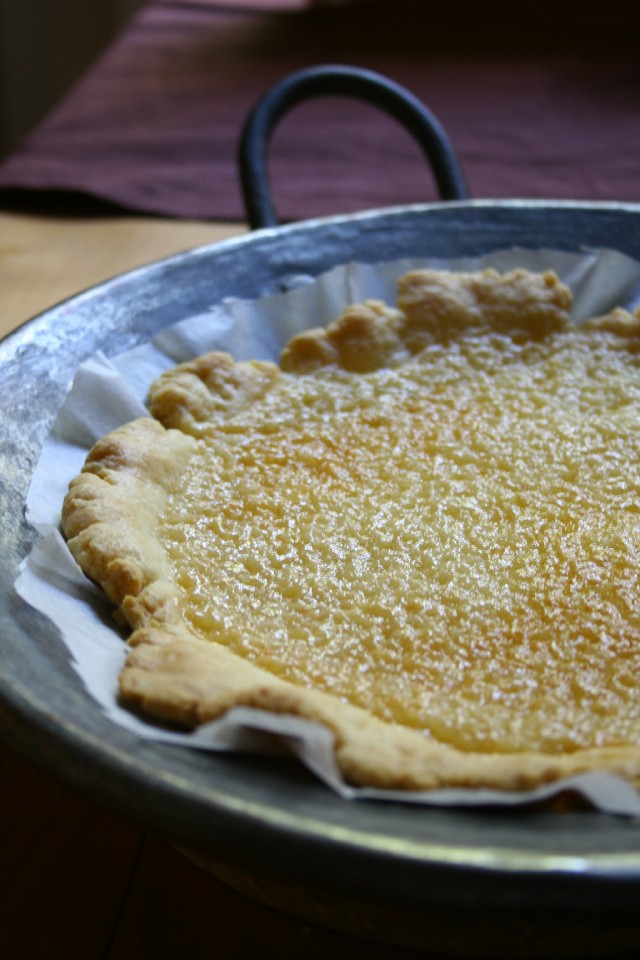
We helped some old school friends of Loic move house not too long back, and we sat down to a nice satisfying meal prepared by Elisabeth and her mother at the end of the day. Naturally curious to see what goes on in the kitchen, I nosed my way back and saw, out on the table on the back porch where the sun was beaming in at an angle that would only last an instant, that they were making a pie. She had a kind of bowl shaped pan that looked deliciously old and had thick handles bolted on either side. Like many of the kitchen table tartes I've seen, she had rolled out the pâte rather roughly and thickly. What made it really nice was that she just placed the dough in the cradle of this rounded pan, and there seemed to be a kind of harmony and humbleness about it. She made a custard and haphazardly cut some fruits. It struck me as a very successful pie mainly because all razzle dazzle had been completely omitted from it. What was left was pure and honest. Elisabeth and her family come from the mountains. We enjoyed this pie while they talked about skiing hors piste and braving mountain dangers. The closest thing I have to the pan that Elisabeth had is a wok, but one of my old tourtieres will also do just fine. It was a nice little pan that summed up simple pleasures. I'd like to find one like it.


Tarte au Citron

This recipe was gleaned in part from a clipping from an old French magazine called Raymond Oliver's Chez Vous, dated from December 1960. I was suprised to see that they did have immersion blenders back in the early 60s. It was called a "mixer-baby Moulinex" in those days. One big difference was that in this recipe he used some kind of centrifuge strainer called the "Spiromix" to strain the zeste, but it seems an accessory to the recipe itself. I have done this recipe many times and it works well with a simple wire mesh strainer. I think initially this recipe was adapted from an old grandmother's classic to serve as an advertising promotion for the "Spiromix".

1 batch Basic Pâte Brisée
1 lemon
300 grams or 1 1/2 cups sugar
60 grams or 2 1/2 tablespoons butter
one egg
1.5 cups of water

- Prepare your Basic Pâte Brisée and set it in a cool place to rest.

- Thoroughly wash the lemon under cool running water. Cut it into slices and then those slices into quarters, and remove the seeds. Put the entire lemon complete with its peel, 50 grams (1/4 cup) of the sugar, and 1.5 cups of water into a bowl or pint sized cup with high sides that the blender will fit into. Pulverize the lemon sugar water mixture to a puree. (you can also do this with any counter-top blender.)

- Strain the pureed lemon, sugar, and water through a wire strainer and into a cup, pushing it down to remove as much liquid from the pulp as you can. Set aside the liquid that comes from it for use in lemonade.

- Place the lemon pulp, the rest of the sugar, and the butter into the upper part of the bain marie, and let it cook over soft heat, stirring it gently with a wooden spoon for 5 minutes.

- Remove the bain marie from the heat and add the egg. Incorporate it quickly with the blender.

-Roll out one large or two small tarte shells rather thickly, pierce them to avoid bubbling, and pour the resulting custard into the shells. Cook for 25-30 minutes, in a moderate (350F/170C degrees) oven, until the custard sets. Let it cool to room temp before serving.

Labels: ,


Share/Bookmark

Friday, September 08, 2006

Vin de Noix update


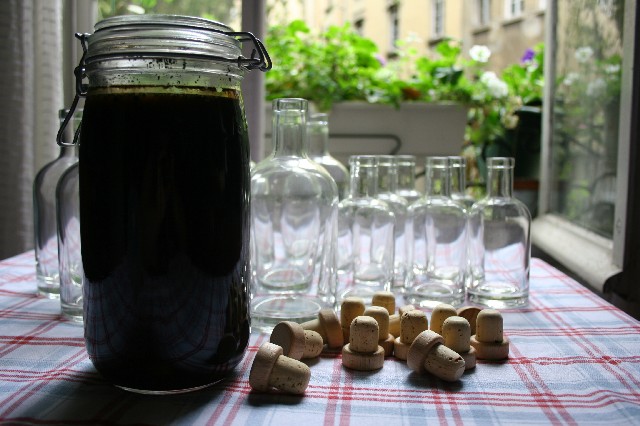
The house smells like nuts this afternoon. We've bottled the vin de noix. If I were a mouse, I'd have already waddled up to the little hole in the neighbors' kitchen fireplace upstairs and stuck my nose out far enough to get a good whiff and then plunged headlong down into the darkness to land in our fireplace. This happened one year, and luckily, Sister captured the mouse that fell. She does not have any teeth, being an old cat. She's not a predator, in fact she's afraid of anything that moves, but she knows when another animal does not belong in our house. She tries very hard to do what is expected of her. She caught him, he was just a baby mouse, gave him enough of a scare to keep him from running away, and called for us to come and take care of the situation. Good kitty.


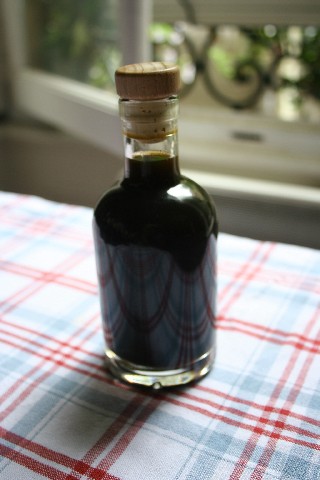
Weeks of bottle watching are over. They had good bottles cheap at the olive oil store. I finally settled on those. They'll do very well as gifts once I spruce them up with a label and maybe some raffia. The shape reminds me of those old time elixer bottles we used to find at the fleamarket back home. For the vin de noix, my first choice would have been pots lyonnais. But they were just too expensive. What's the use of making your own holiday gifts if you're not going to save any money?

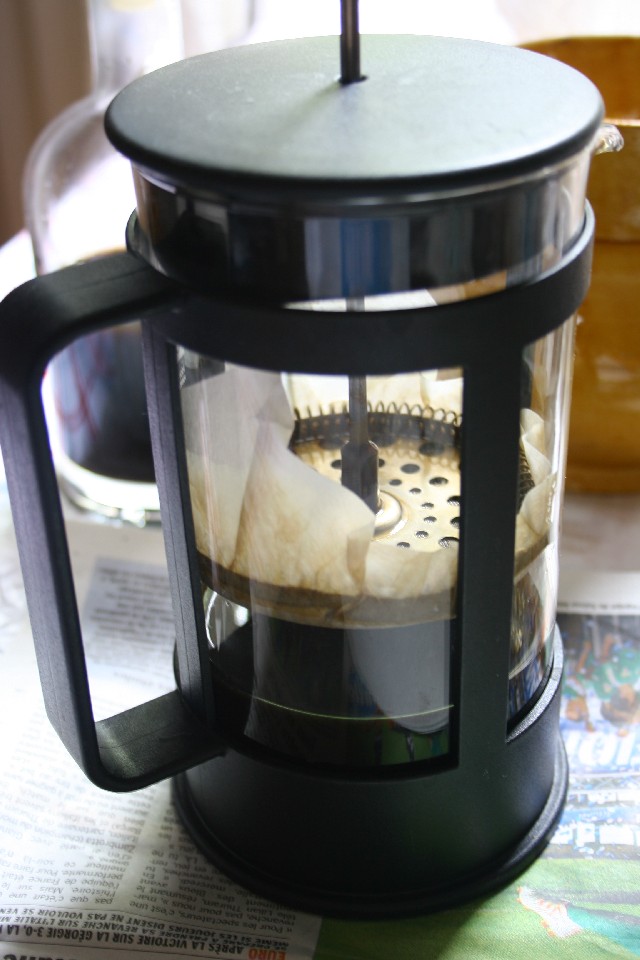
The vin de noix has turned as black as tar in the two months it's been resting. In an attempt to remove as much sediment as possible from the final jars, I strained it through a French press lined with a coffee filter to even further filter it.

The French press was further lined with coffee filter to bottle the vin de noix. The result was still completely opaque and black. It smells and tastes wonderful, with a slight bitterness that will mellow within a month. An amazing legendary home aperetif enthusiast named Foodman in the eGullet Vin de Noix thread managed to get his vin de noix to take on a deep amber color that catches the light. Maybe his nut ratio was different, I'll have to ask him.


Even though I used wine in the mix this year, it is just as dark as it was last year. The flavor, however, is lighter. Still excellent, and in many ways I'll say a much better aperetif wine. What will I do for the packaging? So many possibilities. A cloth pouch with a graphic? Some kind of special paper? A booklet with recipes for drinks? Maybe even recipes for use in cooking and for aperetif treats that go well with the vin de noix? Just a plain white label with calligraphy? A box? Maybe a trio of three different apero drinks for the small bottles. I think the olive oil store has wooden cases that hold 3 bottles. Maybe.

I will try and think of just the thing to bring out the special beauty of these bottles with the packaging.

Labels: , ,


Share/Bookmark

Thursday, September 07, 2006

What's in a Civet? Part III


Today is the day. Civet de canard pour deux day. So far I have spent about 10 minutes preparing the marinade on the first day, braised the meat on the second day which took about 20 minutes actually in the kitchen but three hours in the oven, and then today, which is also another 40 minutes. If you have guests coming, prep everything before they arrive, and then you can spend more time with them as you finish.

--------------------------------------------------------------
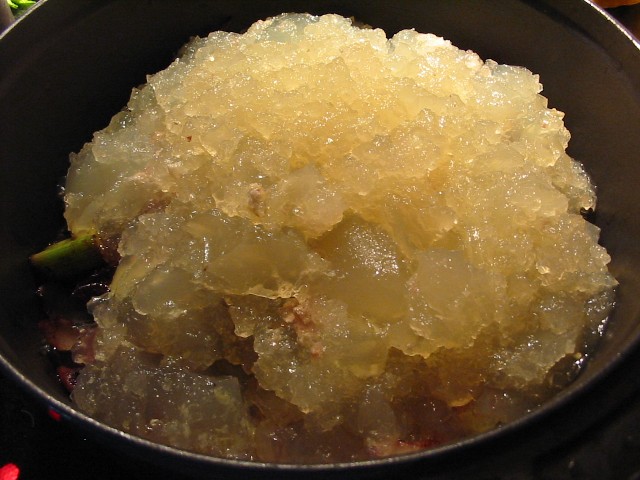
- Remove the casserole from the refrigerator. Note that the fat has risen to the top and congealed there. Take a small spoon and remove the congealed fat. Defatting your civet de canard will make it more digestible and the sauce more silky at the end. Don't skip this step.

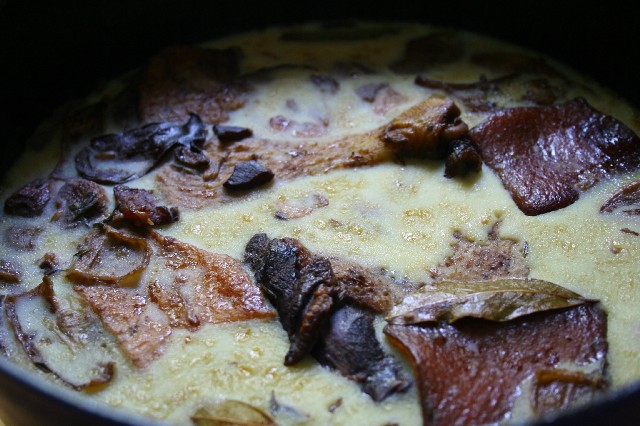
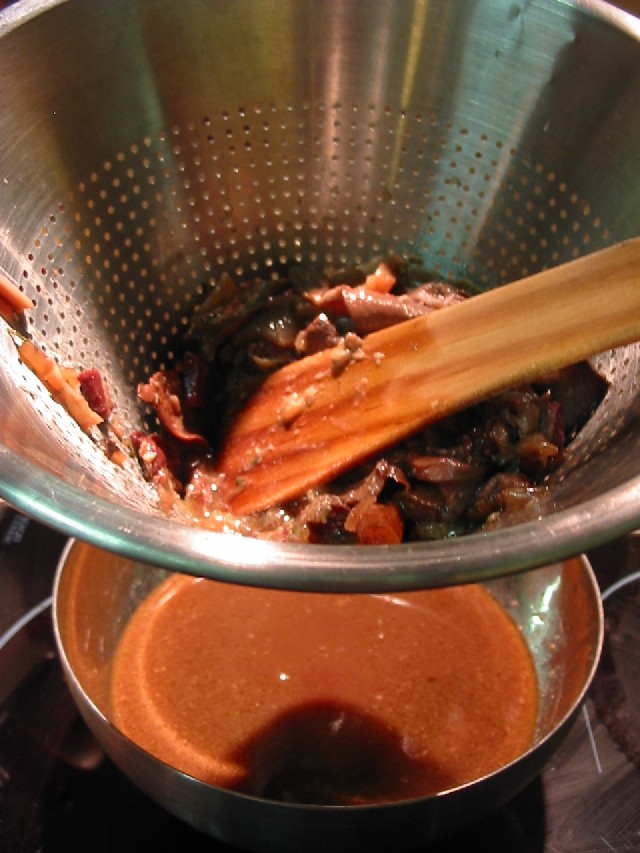
- Slowly heat the stew until all of the gelatinized parts have liquified, remove the duck and reserve. Using a chinois, strain the sauce into a bowl, and push down on the roasted vegetable to extract all of the juice. Transfer the sauce to a small saucepan, you should have about 2 1/2 cups. The vegetables in the chinois which have roasted with the duck should at this point take a bow and leave the stage. They will no longer play a role in this dish. (you decide what becomes of them...)


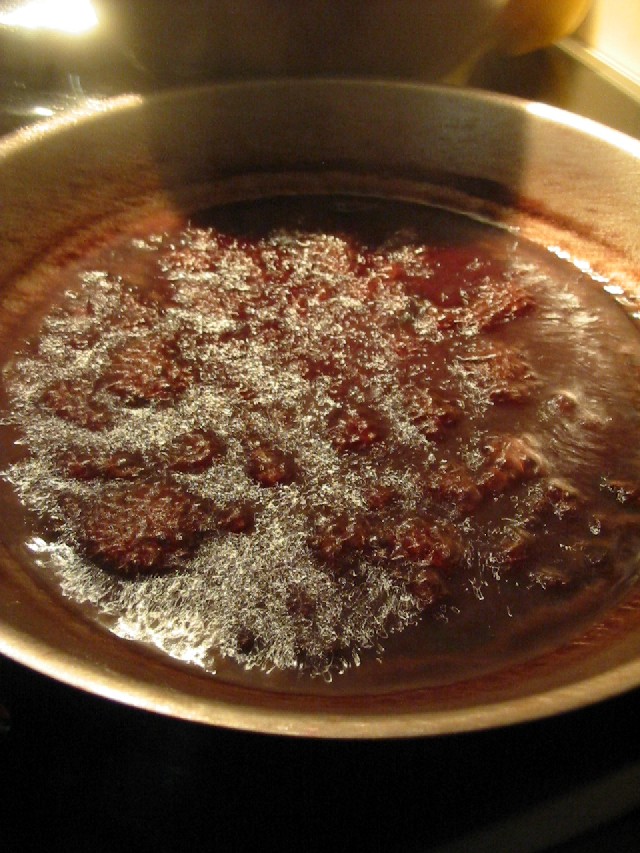
Return the casserole containing the sauce to the hot burner, and then pull it halfway off so that the heat only hits one side of the pan. This will allow any impurities circulate and rise to one area of the sauce as it boils. Skim the top regularly for 5 minutes. Your sauce should reduce in this time to about 2 cups.

- While your sauce is reducing, as you periodically skim the sauce, clean the rest of your cepes, cut them into rather large chunks and cut the quetsche plums in half. You can work up to this point in advance of your guests arriving.

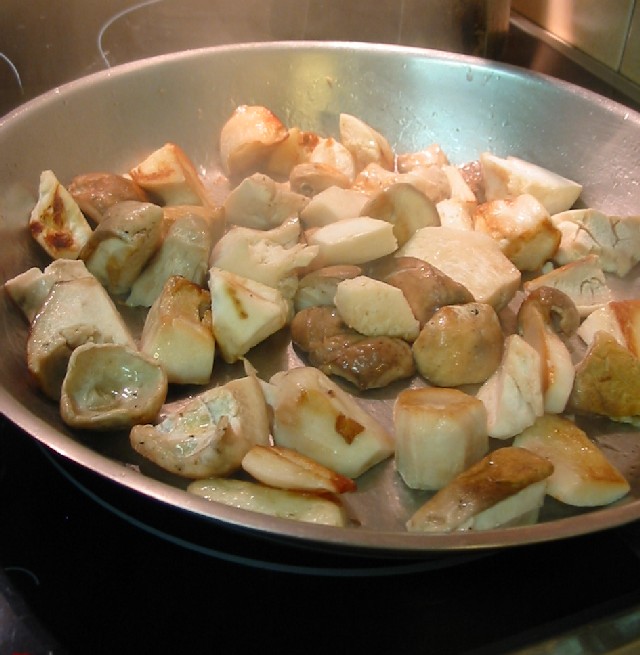
- 20 minutes before serving time, heat up a little bit of duck fat or butter in a skillet over medium high heat and add the cepe mushrooms, tossing and pushing them around turning the edges brown until they soften and release their juice. This will take about 3 minutes.


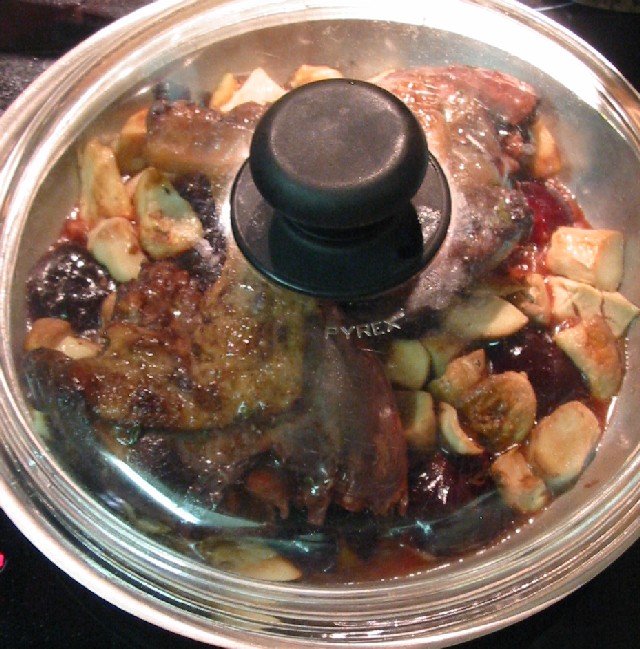
- Press the plums, flesh side down, into the skillet in between the mushrooms. Cover the skillet, turn the heat to low, and let them cook without disturbing for about 5 minutes. (have a martini!)


after 5 minutes of steaming

- Place the duck legs onto the mushrooms and plums, and let them steam in the plum juice for 15 minutes over low heat. (in 15 minutes, you will serve this dish.)

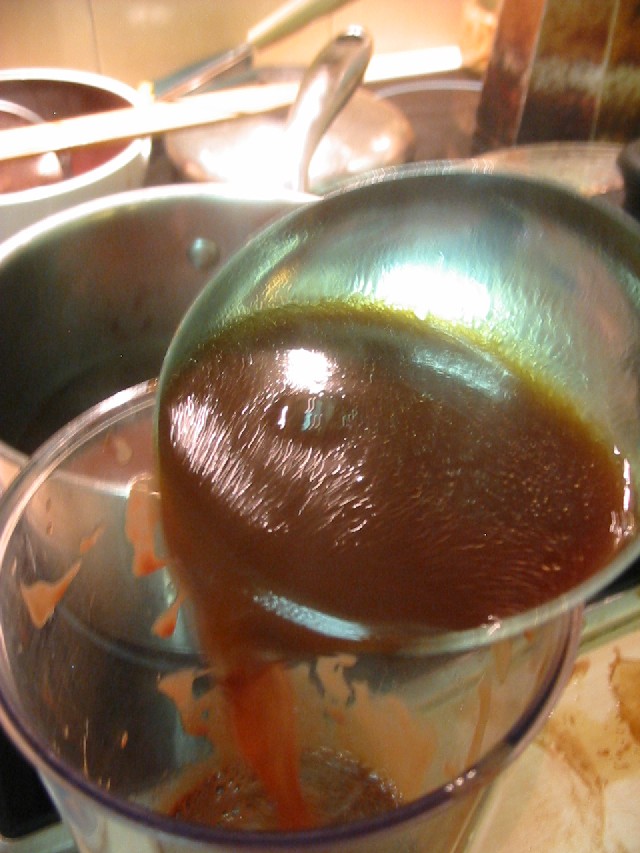
- Heat up the sauce again to a simmer, and give it one last skim. With a hand blender, puree the duck liver with 1 tablespoon of Armagnac. Add a ladle of hot sauce to the liver, blend again, and repeat.


Transfer the duck liver/armagnac blend to the sauce. You want to heat it up without boiling it, because if it boils, the liver will coagulate and the sauce will seperate. Think of it as a sauce hollanaise. Very gentle heat and lots of stirring, take it off just as it begins to steam and thicken. Adjust seasoning and add salt only if necessary, remember, you braised the duck legs with cured ham, you most likely won't need any salt. Add lemon juice to brighten the flavor.

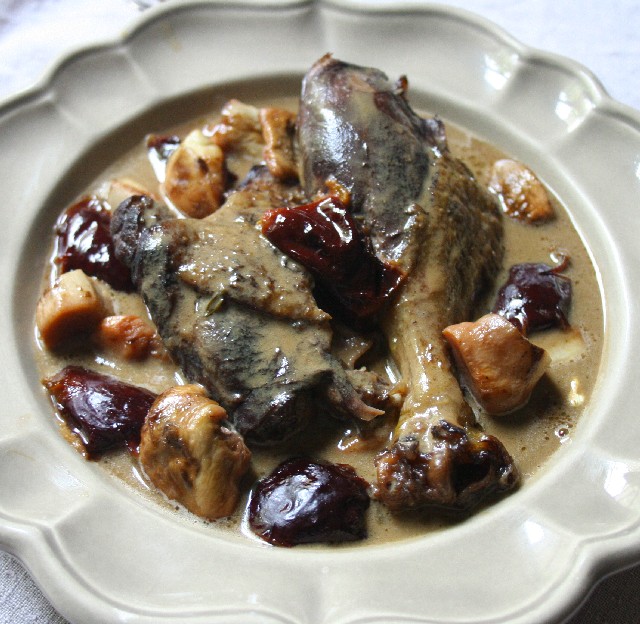
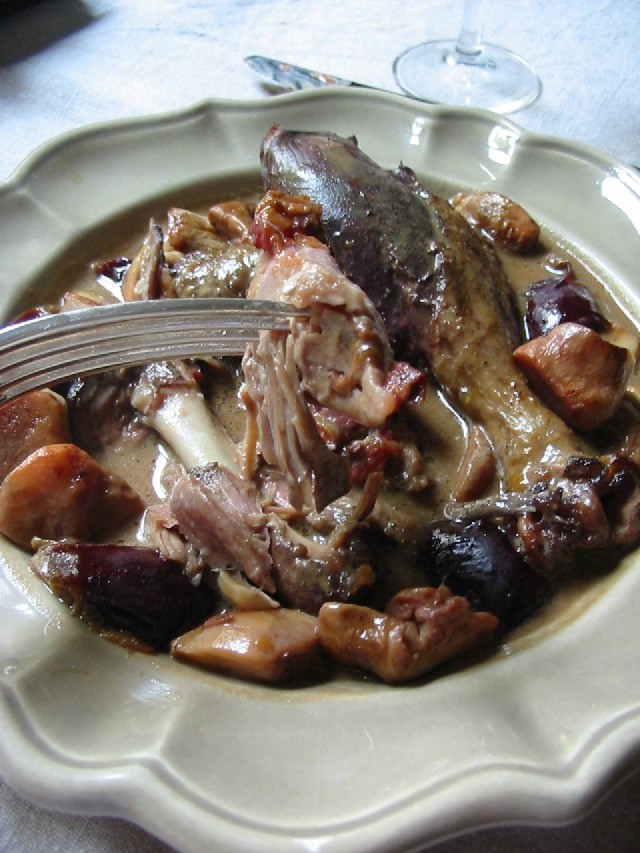
- Arrange mushrooms, plums, and duck legs on heated plates, nappe generously with the sauce, and serve immediately.


This dish is worth the wait for sure. People won't know what hit them.

Labels: , , ,


Share/Bookmark

Wednesday, September 06, 2006

What's in a Civet? -Part II

Taking up where I left off yesterday, the civet de cuisses de canard for two is in the making.

The civet is a French dish that many cooks simply overlook
because they see all the recipes and treatises on how it just isn't a Civet unless you enrich the sauce with the blood of the animal in the dish. Such purism is truly unfortunate, because it can be a really succulent and rich way of treating whatever game or poultry is available to you, and this dish should not be cast aside just because our customs and market practices have pretty much ruled out the idea of being able to purchase the fresh game blood to enrich the sauce. Any recipe calling the cook drain the blood of freshly slaughtered game into a recipient to set aside for later use harkens to another time, I'm afraid. That is just not going to happen unless you are a hunter. But even though I live in the city, I did not let that stop me, nor should it stop you.

I appreciate the quality and richness on the palate that such an enrichment brings, recalling something from dishes like boudin noir or figatelli - by all means we should try our best to achieve something like it when we prepare this dish. But I will stick to my guns and say that the animal's blood is not the actual ingredient that makes this dish what it is. Onions are. Otherwise it would not be named a Civet! It is certainly fine to use pureed poultry livers at the end. It will be delicious. We will enjoy it.

So - where were we?

Note about salt: I don't add any salt to this dish until it is ready to serve for two reasons. The first reason is that I will be braising the duck legs with salt cured ham, which will render a salty flavor to the dish, and the second is that roughly 2 quarts of stock and wine are reduced down to about 1 1/2 cups for the final sauce before enrichment. Therefore, it's really best to wait, and don't give in to the reflex to add salt at any step until the end.

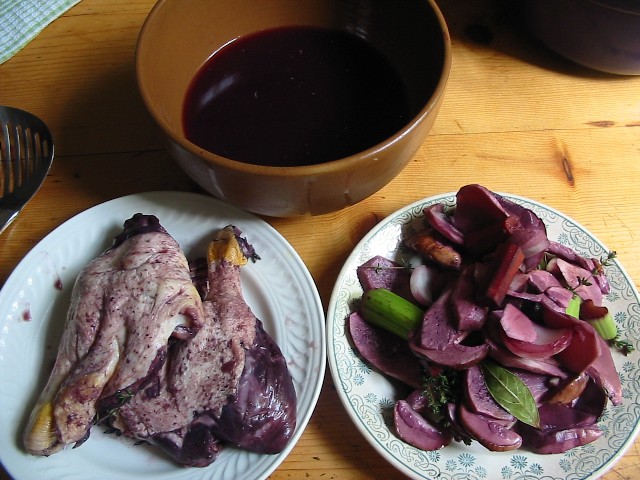
The duck has marinated with the mushrooms, onions and garlic, carrots, celery, etc. in red wine overnight. It is now time to prepare for the braising.

Remove the duck and the vegetables and herbs from the marinade, putting the duck on one plate and the vegetables in the other. Save everything, because it will all go into the pot.


Heat up the duck fat in a skillet over medium high heat, and put the duck pieces in, skin side down. Things will sizzle and pop.


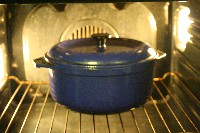
Reduce the heat to about medium and leave them to brown for at least 5 minutes. Don't flip them, don't hover, don't bother them for at least those 5 minutes. The skin side will brown to a nice deep golden brown and the pan will release them cleanly when they're ready to flip. Flip them to the other side, and leave them again. When the meat has properly browned, the sizzling sound will not be as loud and noisy, it will quiet down. Transfer the duck legs to a heavy casserole, a heavy enamel covered cast iron pot. If you don't have one, use your heaviest covered braising dish.


Don't turn off the heat under the skillet. Chop the cured country ham or jambon de pays into little pieces and brown them in the same skillet. Transfer them to the casserole.


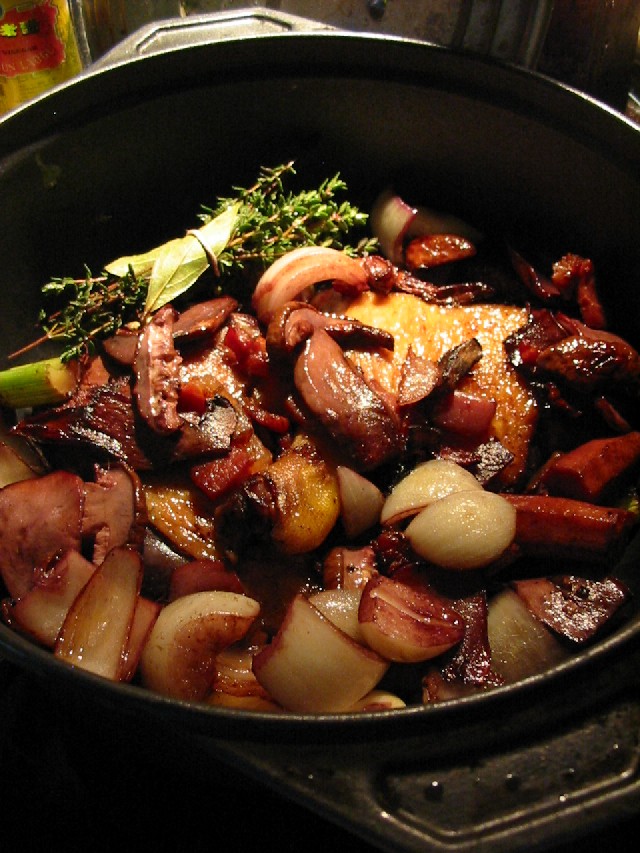
Tie the herbs which were in the marinade into a bouquet and add to the cooking pot. Put half of the marinade vegetables into the skillet in one layer and brown them in the hot fat. Transfer them to the casserole, and brown the remaining half as you did the first one.

- Open the oven and prepare the rack inside to receive your casserole- the rack must be low enough to take it. Heat the oven to 160C. or 325F. While the oven is heating, pour off whatever hot fat remains in your skillet, and return it to the burner. Pour the wine into the skillet. While it bubbles, with a wooden spoon or spatula, scrape up anything that's stuck to the bottom, and then reduce the wine to about 1 cup.


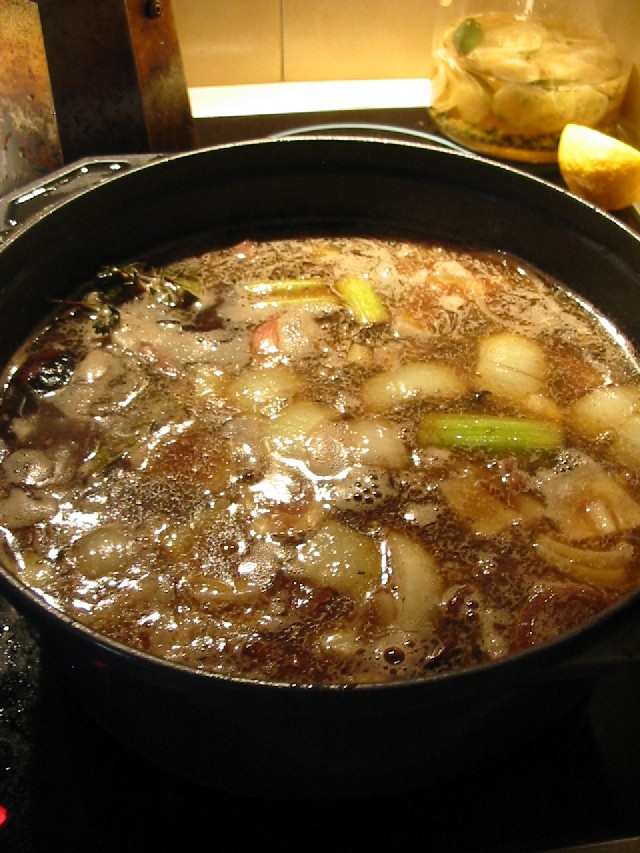
Add the reduced wine to the cooking pot with the duck, ham, veggies, etc. Cut the remaining onions, into 8 pieces and add them to the cooking pot. Add the couenne. Peel the remaining shallots and garlic and add them whole to the pot. Add about three cups of rich poultry broth to the pot, and bring to a slow boil.

My weekly poultry stock is normally made with chicken wings, duck wings, and guinea hen necks, plus whatever carcasses I have around. It turns to jelly when it's cold but melts at room temperature. If you need help preparing a basic stock, let me know. I'll help you.

Skim for 5 minutes, cover, and place the casserole in the oven. Let it cook for 2 and a half hours without disturbing it.


Normally what the good cook will do at this point is clean the kitchen and take care of other kitchen tasks. Once the dishwasher's loaded, the knives clean, dried and put on their rack, and you've got your hands deep a bowl of boiled duck wings leftover from your weekly broth, removing the rich dark meat for rilettes or dumplings, a certain perfume will overtake you and your special sense will be stirred with the rare song of pure gourmandise. You haven't even put one bite of this civet in your mouth but the sensation caused by the luscious perfume will take you to that higher plane. You will move to the buffet in the hall with a sense of satisfied purpose, straightening dishes and replacing some that you used. The neighbors may slow their step by your door as they pass your apartment on the way upstairs, and dwell for a moment. Outside your window on the street, several more people than usual will pause at the window of the Bang Olufson boutique, pretending to be contemplating the newest wireless speaker system.

When the timer says so, remove the casserole from the oven and check to see if the duck legs have relaxed. The meat will seperate from the bone when coaxed, but not falling off. If it is not ready yet, return it to the oven for another 1/2 hour. When it does come out and the meat checks done, set it on the stove to cool to room temperature. When it's cool enough, transfer it to the refrigerator.

Tomorrow: We get to eat it!

Labels: , , ,


Share/Bookmark

Tuesday, September 05, 2006

What's in a Civet? - Part I


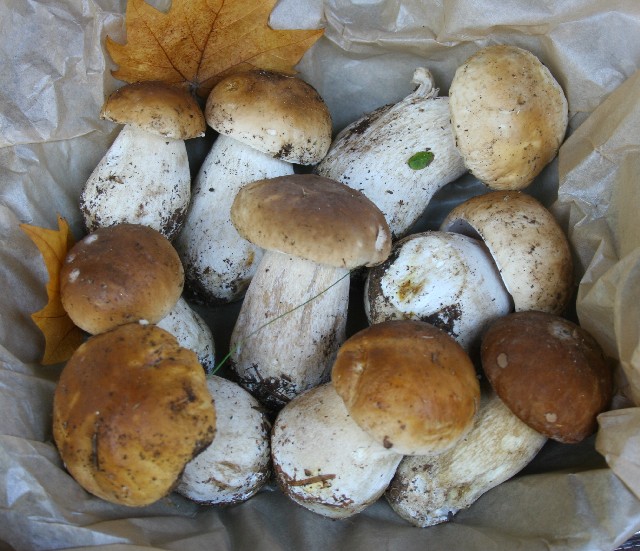
This morning the traffic was not too bad and I enjoyed a bike ride down the Quai to get some fixings. I had in mind a Civet using the beautiful cepes and plums available, but I would not be sure which kind until I reached my volailler. I detached my basket, and worked my way down, purchasing nothing, just to get a good look at everything on the market this morning.

Absoluement feerique!

My first stop with the intention to buy was at my Volailler. Aside from the Poulet de Bresse man who gets a visit from me from time to time, she is generally the only place I go to purchase my poultry. This lady makes a ton of money from me. She sells quail, pigeon, 3 kinds of chickens, 2 types of cannetons, regular duck, guinea hen, fresh magret de canard, fresh duck and goose fat by the pot, her own duck gizzard confit (well her mother prepares it), fresh gizzards, livers, and hearts, chicken wings, duck wings, necks of all the birds, various poultry and game carved and placed on brochettes for grilling, stuffed and tied rotis and galettes, rabbits - whole and parts, and in season, small wild game of every kind you can imagine.


She's a strong woman. When we buy a rabbit, she asks me if I want it carved. If she carves it (I sometimes do it myself, when I'm in the mood, dpending on what I'm doing with it), she asks me if I want the head, and when I say 'yes', she whacks it with her cleaver before including it with the rest. In a word, she understands. Every week, I purchase two kilos of whatever wings and necks she's got to make my stock, which costs me very little. Even if I spend 3 euros in a week from her, she still smiles and treats me warmly. Almost every savory dish coming out of my kitchen contains the stock in some form, and she appreciates it. From regular broth to consommé, to thick glazed reductions, the stock enriches and fills out my cuisine. I have recently discovered that the duck wings yield excellent meat for rilettes after having played their part in the broth.

Today I asked for chicken breasts on the bone for something else, which she cut from a chicken for me while I looked at her other offerings. I decided after all that a little civet de cuisses de canard for two would be just the thing to set off the flavor of the beautiful cepes, and the plums are in full season. I had copied two seperate shopping lists this morning, and made my decision for which one to follow depending on what looked best. I also purchased thyme, parsley, some tarragon just because it's been awhile, 2 stalks of celery, 3 carrots, a few more cepes because they are so gorgeous, a lemon, and 3 potatoes from the man I think sold me the good ones a couple of weeks ago.

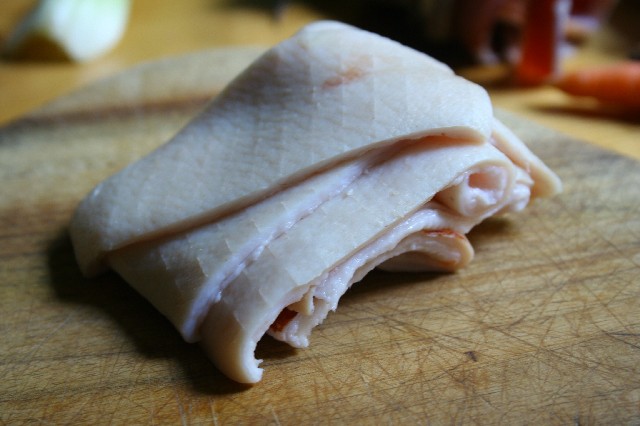
Couenne, or pork rind for the civet.

On the way home I stopped by the butcher and got a bit of pig skin which in French is called couenne, and a thick slice of jambon cru. I can tell him I want a piece that weighs a hundred grams and he cuts it without even a blink. He then pops it on the scale. 101 grams. Will that do, madame? Perfect. Voila. Keys in hand, I took a little detour down to the cave and pulled a bottle of some co-op vin de pays on the way in.

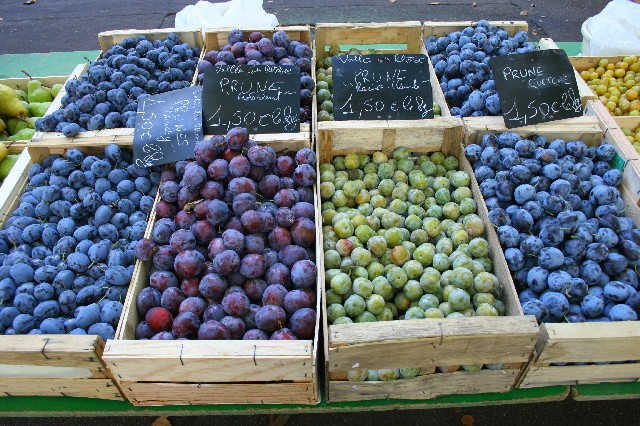
What's in a Civet? Well, basically, it's a braise, with lots of bulbs from the onion family. The name comes from the old word for onion - cive. Often we see that the wild hare, or the lièvre has been given the place of honor in this braise, although one can certainly argue for any gibier or flavorful volaille. Recipes involving sauces enriched and developed to gourmet perfection from Paris bistrots abound. This time I will prepare a recipe that is firmly set in the countryside. Actually the onions are what gives a civet its name, so it goes to follow that a "civet de lièvre" is a wild hare & onion stew, a civet de cuisse de canard for two, being stewed duck legs & onions. I suppose you could make a civet of just about anything, given what you've got, as long as you have onions and wine, and someting that will hold up to the flavors. At the finish of this dish, I am going to take advantage of something special we have at the market right now and include several firm quetsche plums, which are cheap and plentiful at the moment.

Where did this recipe come from? Hmmm. Having basically memorized every recipe in the 1983 edition to Paula Wolfert's The Cooking of Southwest France long before I ever knew I would ever have the chance to ever correspond with her, you can pretty much say that I come from the Wolfert School when it comes to cooking in that style. I followed her style based on that SW cooking book for a long time, and now it comes by instinct, having learned her methods and attention to detail. There are some books you go to for recipes, and some you read from cover to cover and ponder. Madame Wolfert's rich evokative writing and well worked recipes have given me lots to ponder over the years.

With the second edition of this book being issued last year, after I'd lived in France and been cooking French of all different styles for a good while, and having led the Spotlight Conversation with her on that topic over at eGullet, I paid extra close attention to the recipes that she added to her book this time. There is one recipe in the new edition (it's on page 261), for a Beef Daube, a beautiful generous recipe, which Paula attributes to chef Laurent Manrique, working in San Fransisco. He adapted his grandmother's favorite duck leg recipe into a beef daube. I looked at the ingredients carefully and saw the elements of a civet all through it, and thought that this is most likely what his Grandmother's recipe originated as, so I tried it that way. Delicious. That's where it began. I've reduced the garlic, added shallots, and used fresh plums instead of prunes to hone it to duck. Home and back again. I think it is a winner. I hope you do.
Civet de Canard for Two

Ingredients:

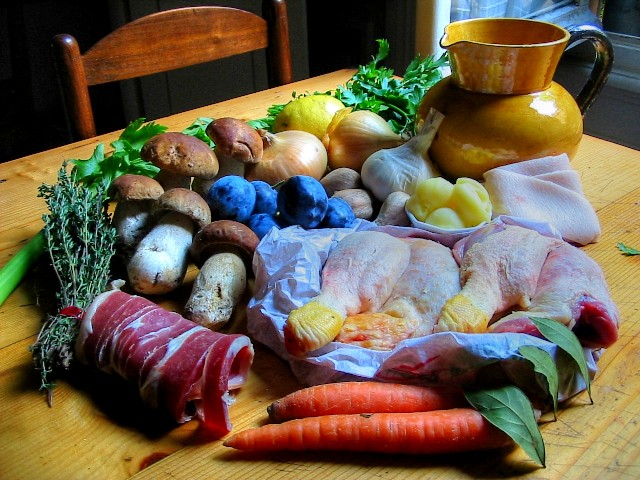
Just about everything is pictured here.
3 Onions
2 Shallots
1/2 head of Garlic
125 grams or about a 1/4 pound of Cèpes
2 whole duck legs, cut at the joint
Carrots cut into 2cm lengths
Celery cut into 2cm lengths
Red vin du pays, a sturdy full bodied wine
Herbs: a few sprigs of thyme, 3 French bay leaves, and parsley
-- and tomorrow, the addition of:
Salt and pepper
4 Tablespoons of Duck fat
About 3 oz. or 100 grams Couenne, or pork skin
Mixed duck, chicken, and guinea hen poultry stock
125 grams or 1/4 pound more cepes
100 grams or 3 oz. Country ham or Jambon de Pays
a half dozen Quetsche plums (plus one for eating!)
100 grams duck liver, or chicken liver if you can't get any
Armagnac to enrich the sauce as a final step

Day one: set the duck to marinate, this takes about 10 minutes.
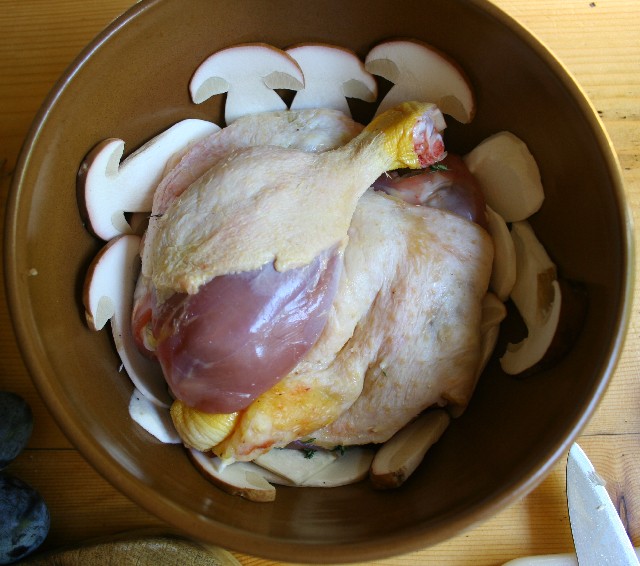
Line the bowl with sliced cèpes, to allow the flavor of the mushrooms to better permeate during the marination process.
Place the duck on top of the cepes.
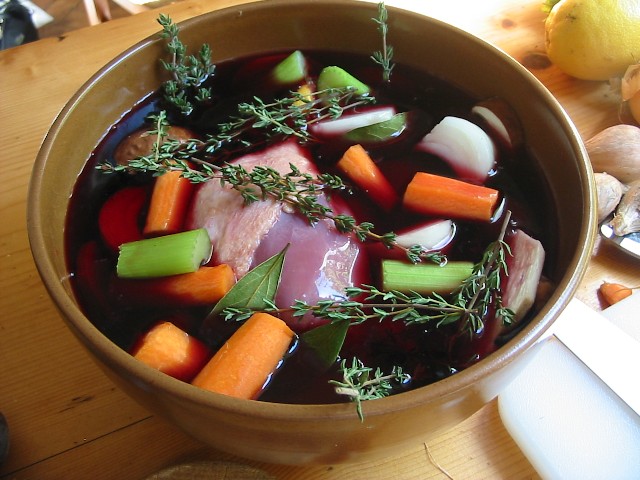
Add chopped onion, 5 cloves of garlic, 2 carrots cut into chunks, a stalk of celery cut the same way, a few sprigs of thyme and 3 bay leaves.
Pour the entire bottle of wine over it.

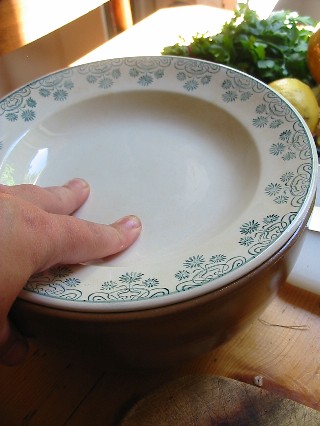
This will marinate, refrigerated, until tomorrow. I will turn the contents with a spoon to refresh the mix tonight before I go to bed.

See you tomorrow!

Labels: , , ,


Share/Bookmark