Wednesday, February 20, 2008

Seville Oranges: Vin d'Orange


One of the first home infused aperetifs I experienced in France was Vin d'Orange. My mother-in-law Brigitte does it every year, as did her mother. Where they live, Seville oranges, otherwise known as bitter oranges, grow in a whole lot of people's gardens and the fruit gets passed from hand to hand, distributed out from one person to another throughout the month of January and February. Certain towns in the Var have them growing in the streets. A lot of grocery stores in the cities have them when they come into season, and they turn up at the market as well.

You can ask just about any French person you know if someone in their family does Vin d'Orange, and almost invariably the answer comes back yes. You won't normally find this apéro for sale, people just give bottles of it to each other. The apérétif is strained into bottles after only one month of maceration time. It lasts a really long time, but we usually use up our bottle within a few months after Brigitte gives it to us.

I had been married to Loic for about 2 1/2 years when Brigitte opened up her kitchen notebook to me. She was cooking dinner and I was looking for something to do. I settled in at the kitchen table and began translating my favorites from her own handwritten book. We had a glass of wine together and talked, and I asked questions about this or that recipe. I have since passed this particular recipe on and continue to get letters and notes of thanks from as far away as San Fransisco for it. It originates from Mireille Durandeau of Toulon in the Var, with a few notes from her daughter Brigitte.


My notes on this recipe:
- A kilo of Seville oranges is about 6 or 7 oranges.
- If you don't have eau de vie, you can use any good vodka or anything with 40% alcohol or 80 proof. 1/2 liter is about 2 cups. Remember that this is a simple recipe so try and use something neutral.
- If you don't want to break out the grinder or cringe at the thought of cleaning it, give it a few pulses in the food processor. That's what I do.
- Since Brigitte gets her wine from the co-op at St. Cecile de Vignes, she measures out 2 liters exactly, but for those of us who buy our wine in bottles, you have to use 3 bottles of wine, minus 2 glasses. That means open 3 bottles, pour one glass for yourself and someone else, and use the rest of the wine.
- Use granulated sugar. 750 grams is equal to about 3 1/3 cups.

I post this recipe as an idea for this talented card designer and blogger who shares with us the story of her quest for the Seville orange (her holy grail of the moment) in Vancouver, wherein she finally finds some.

Labels: , ,


Share/Bookmark

Sunday, June 24, 2007

Vin de Noix, thème Caramel et Chocolat 2007

Last year's vin de noix ended up exceeding my expectations. I found that by not making a liqueur and making more of an aperitif drink, and using a local white wine in the mix along with the alcohol, the result was actually much better than a thick and highly alcoholic liqueur. It is just fantastic on ice as an early summer drink this time of year. Light enough to be pleasant and airy, the taste of the nuts having come through nicely, and still packs a nice punch.

Thank you Lolo, for taking this picture

We had a nice big stock of good grade B maple syrup (gift from afar) to flavor the vin de noix last year, but this year we didn't have any. I began to think about alternatives. We went to pick up the vodka and saw that maple syrup of dodgy origins in an imitation Aunt Jemima bottle was nearly 6 euros for a little bottle. Seeing this detail, and doing a quick calculation about what that would cost us, my decision was made instantly to make a caramel syrup instead for this years batch. Loic was there in the store still clutching to the bottle of maple syrup, he loves that it is my secret ingredient in vin de noix, and I said - "Just forget the maple syrup! Forget the whole idea this time!"

But he wouldn't let go of the idea and he pestered me about it for a while. "Are you sure? Are you sure?" he kept asking me, and I said - "Loic, when was the last time you had something with both nuts and caramel, and you didn't like it?" He thought about it for a few minutes and decided that he did finally agree. So we went ahead with the caramel syrup, which I made just before we began cutting the nuts. The caramel syrup for putting up fortified wines and liqueurs is easy and is outlined in my recipe for Punch Mirabelle façon Ile de la Réunion.

We went to get the nuts this morning, and the lady went back to her car, came back with a sack full of freshly picked green nuts which she presented to me as a gift, one which I accepted gladly. She said that she and her husband already drank the whole bottle of the vin de noix I gave her last week and although I know she was probably greatly exaggerating, I thought it was a nice gesture when she told me that they think mine was better than hers. I seriously doubt it! I shared my recipe with her and she raised her eyes with a cryptic little smile when I got to the part about the Burgundy white wine being added, and she raised her finger as if to say 'aha!' when I told her it contained no cane sugar, but was sweetened with maple syrup.

Since I was moving in another direction with the caramel this year, I also decided to do away with the Szechuan pepper corns. I can always go back to them next year. Nuts, caramel, what's missing? Chocolate! I had a little stash of simply roasted raw cocoa beans which I picked up at Michel Chaudun last time I was through Paris for a quick visit, so I brought them out and divied them up among the jars.

This years addition to go with the caramel theme, roasted coca beans

So this year the proportions were as follows:

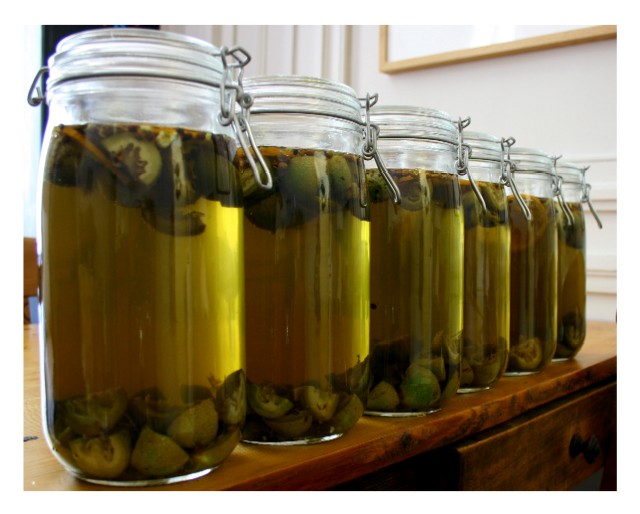
I put up six 1.5 liter jars, and put in each jar:

10 quartered green nuts per jar (up from 8 since they're good karma and all)
9 roasted cocoa beans
1/2 of a vanilla bean
2 cloves
a piece of dried orange peel
1/2 cup or 125 ml caramel syrup as prepared here
50cl vodka
After all of the above are in the jars top them off with this years choice of a local dry Macon instead of a full bodied white Burgundy.

In some of the jars, I crushed the cocoa beans, and in some of the jars I left them whole. I'll let you know which turns out better. The jars are in the safe and in three months I'll be posting about it again when the wine is ready to strain and bottle.

On va voir ce que cela donne.

Labels: , ,


Share/Bookmark

Sunday, June 17, 2007

A Gift for the Green Walnut Lady

Before we went to the market this morning

Every weekend for months now I have been meaning to drop off a bottle of vin de noix with the lady who supplied me with the nuts last year. Throughout the year she sells a variety of things from her farm in Grenoble, but her principle specialty is walnuts, they must have a large orchard of walnut trees. Mushrooms in the fall, dried nuts offered throughout the winter, various veggies coming from her garden, always asparagus in the spring.

I inquired once in the past with a man who sometimes used to work her stand about getting some green ones, and he gruffly turned me away, but it was because he didn't get it. Last year in passing I noticed that this woman had a bunch of green walnuts back behind the table in a bucket, and she was a bit taken aback when I asked oh please could I buy some. She was a bit surprised that I make vin de noix, maybe because of my accent.

I was very glad to have found them without any effort whatsoever. In years past I have gone to great effort to get the green nuts and people always made a big deal about making me meet them at some particular place or come and pick up the order under constraining circumstances. Last year's vin de noix was made with this lady's walnuts, the ones that serendipitously fell into my lap.

Next Sunday is the festival of St. Jean, which is also the day that traditionally people pick the green walnuts in Grenoble. I have been told this by several producers over the years, and I am not exactly sure why they always choose this particular weekend, except that it's always around the beginning of summer. The Festival of St. Jean always falls on the third Sunday of June. The vin de noix is an extra that comes from these green nuts.

The festival itself has its roots in the pagan celebrations surrounding the summer solstice, but in the time of Clovis, our dear Burgundian newly converted king, the pagan festivals became the festival of St. Jean the Baptist. Many a festivity takes place on this day, especially in this region, where Clovis followed his bride the Burgundian princess Clothilde into Roman Catholicism. From a more local perspective, there is also the neighborhood in the 5th arrondissement of Lyon called St. Jean, named after the cathedral there, and they always have big parties involving lots of merrymaking the third weekend of June.

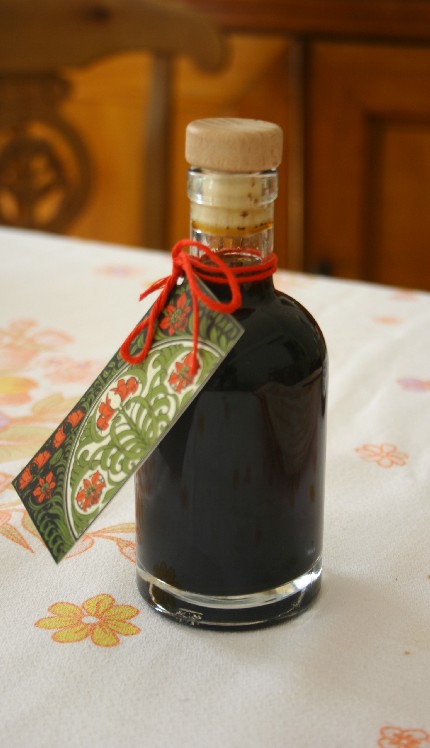
This morning I put my name, address and phone number on a card and tied it to the bottle with some red string that Callan gave me before she moved to New York. I thought it would be better than just giving the lady the unmarked bottle. That's fine for friends and family, but since I am merely a a familiar face to her, I thought it might be better to idenitfy myself with the gift and let her rest assured I wasn't some kind of crazy. Loic of course thought I was being silly even for giving her a bottle to begin with, since she is not someone we socialize with. But I had been meaning to do this since winter and every time I always forgot to take a bottle with me on the way out the door to market.

Today at the market, we went to her stand where she had some cherries out, and I presented her with the wine. I told her that last year the batch had turned out particularly well, and I wanted her to have a taste of the product of her own nuts. It was such a nice moment between us, and she promised to bring me more nuts next Sunday. Loic was amazed and mused aloud on our way home, wondering why she seemed so incredibly happy to have received the bottle of vin de noix from me, in fact more incredibly happy than anyone he had ever seen at receiving a bottle of one of our home made fortified wines, ever.

I explained to him that when you show to a producer that they mean something in your life, that their product is a part of your family tradition, and show to them that you appreciate their product and come to know them through connections like this, it warms their heart. A lot.

So you know what we'll be doing next Sunday. If you want to make Vin de Noix this year, here are two recipes from my kitchen notebook, one for a liqueur, and one for a lighter aperitif drink.

Labels: , , , , ,


Share/Bookmark

Friday, September 08, 2006
Vin de Noix update


The house smells like nuts this afternoon. We've bottled the vin de noix. If I were a mouse, I'd have already waddled up to the little hole in the neighbors' kitchen fireplace upstairs and stuck my nose out far enough to get a good whiff and then plunged headlong down into the darkness to land in our fireplace. This happened one year, and luckily, Sister captured the mouse that fell. She does not have any teeth, being an old cat. She's not a predator, in fact she's afraid of anything that moves, but she knows when another animal does not belong in our house. She tries very hard to do what is expected of her. She caught him, he was just a baby mouse, gave him enough of a scare to keep him from running away, and called for us to come and take care of the situation. Good kitty.


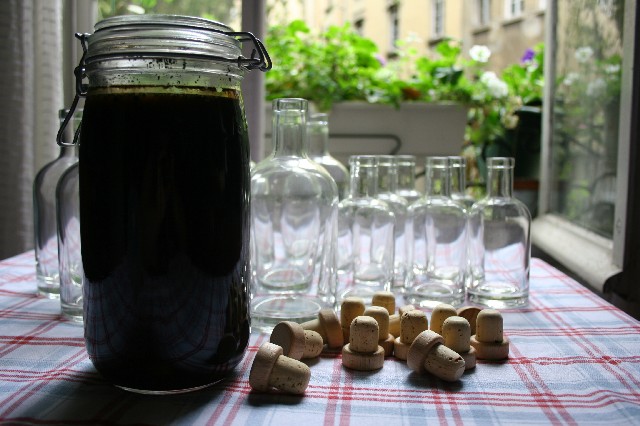
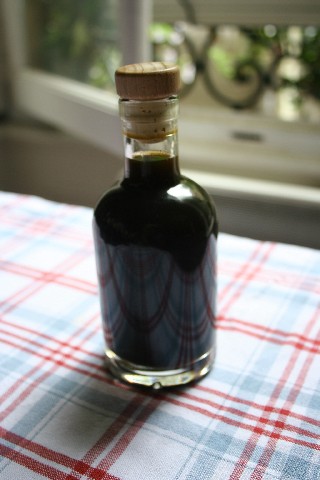
Weeks of bottle watching are over. They had good bottles cheap at the olive oil store. I finally settled on those. They'll do very well as gifts once I spruce them up with a label and maybe some raffia. The shape reminds me of those old time elixer bottles we used to find at the fleamarket back home. For the vin de noix, my first choice would have been pots lyonnais. But they were just too expensive. What's the use of making your own holiday gifts if you're not going to save any money?

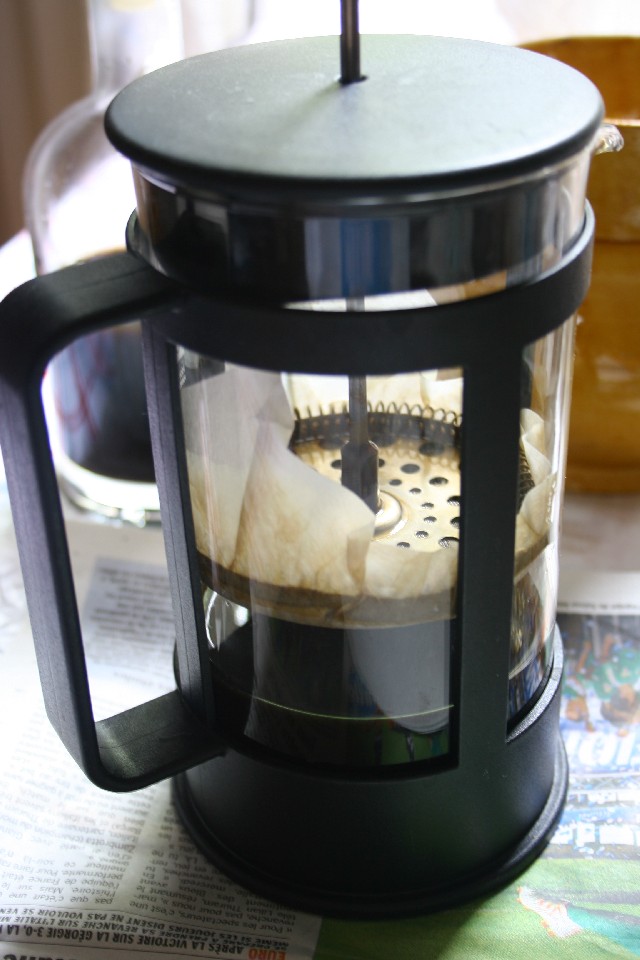
The vin de noix has turned as black as tar in the two months it's been resting. In an attempt to remove as much sediment as possible from the final jars, I strained it through a French press lined with a coffee filter to even further filter it.

The French press was further lined with coffee filter to bottle the vin de noix. The result was still completely opaque and black. It smells and tastes wonderful, with a slight bitterness that will mellow within a month. An amazing legendary home aperetif enthusiast named Foodman in the eGullet Vin de Noix thread managed to get his vin de noix to take on a deep amber color that catches the light. Maybe his nut ratio was different, I'll have to ask him.


Even though I used wine in the mix this year, it is just as dark as it was last year. The flavor, however, is lighter. Still excellent, and in many ways I'll say a much better aperetif wine. What will I do for the packaging? So many possibilities. A cloth pouch with a graphic? Some kind of special paper? A booklet with recipes for drinks? Maybe even recipes for use in cooking and for aperetif treats that go well with the vin de noix? Just a plain white label with calligraphy? A box? Maybe a trio of three different apero drinks for the small bottles. I think the olive oil store has wooden cases that hold 3 bottles. Maybe.

I will try and think of just the thing to bring out the special beauty of these bottles with the packaging.

Labels: , ,


Share/Bookmark

Saturday, August 26, 2006

Punch Mirabelle façon Ile de la Réunion


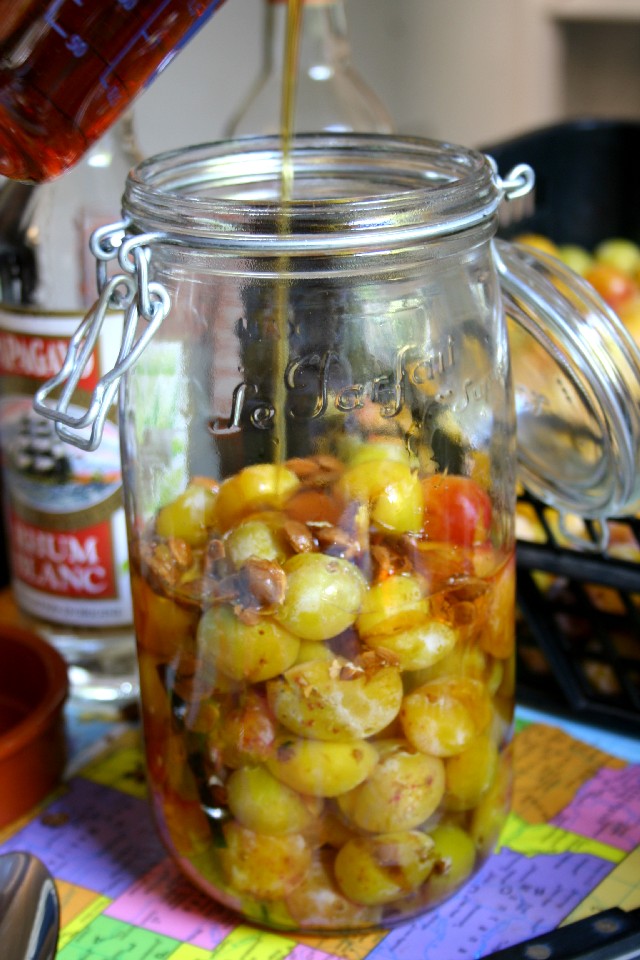
My friends from l'Ile de la Réunion gave me the formula for making what they call punch, but which is also called le rhum arrangé. It's a very simple but very delicious secret: fruit macerated for 2-3 months in rum, sweetened with sugar. 2 of our 10 kilos of mirabelles went into rum today, and we'll have nice punch maison to serve or give by the time sweater weather comes around again. I will never forget the one time we sampled one each of four different flavors of punch with Sonia and Olivier. We were bumping into lamp posts all the way home that night. Well not really, but we were simply glowing after sampling that punch. It's a miracle I remembered what Olivier said about burning the sugar to make the syrup.

Punch Mirabelle

special equipment: You'll need to crush some pits for this, so get a hammer or a nutcracker that will crack them.

2 kilos or 4 pounds mirabelles or small golden plums
4 bottles (.7 liters each bottle) of white rum
2 vanilla beans
1 kilo sugar
1 cup water
*four 1.5 litre/quart mason jars

Note on the jars: You don't need any specific sized jar, but the bigger the jar, the better. The total volume that your jars should hold for this recipes is 6 liters or a gallon and a half. Once you've strained them, this recipe yields about 4 liters of Punch. The jars must have an airtight seal.

Pit the mirabelles, keeping the pits aside, and distribute the fruit evenly between your jars. For each pound or 500 grams or pound of mirabelles, crush 20 mirabelle pits and sprinkle them into the jars over the fruit. The pits contain a little nut that smells like almond, but it is not almond so don't be tempted to eat it. Add 10 more unbroken pits for each pound of fruit. Cut the vanilla beans into pieces and distribute the pieces between the jars you are using.

Make the syrup: Put about 1/4 of your kilo of sugar into a heavy bottomed saucepan. Turn the heat to high, and watch carefully and stir as the sugar begins to turn brown and melt. Once the sugar has melted, (it will be brown and liquid, and very hot, watch out!) turn down the heat to low and pour in 1.5 cups or 250ml of water all at once, being careful to step back from the pan which will steam, because the sugar is incredibly hot! The sugar will crack and solidify instantly and be stuck to the bottom of the pan, but just be patient for a minute or two and stir and swish the water around with a wooden spoon to melt the sugar. The caramelized sugar will melt readily enough into the water. Stir it over the low heat until it finally all melts. It will take a few minutes, and the result will be a dark brown color with a deep red hue. Add the rest of the kilo of sugar and turn the heat up again, stirring to dissolve the rest of the white sugar in the dark fluid. Bring the syrup to a rolling boil and then remove it from heat. Pour it into a heat resistant large measuring cup, you should have about a quart of caramel syrup. If you don't have a liter or quart, add water to make it a liter/quart, and put it back on the heat, bring it to a full boil, then remove and let it cool a bit, about 5 minutes.

Once it is cool, you can taste it. But don't eat too much. Keep in mind that if you add some cream or butter to this sauce while it's warm, you have rich thick caramel sauce for ice cream stuffed profiteroles or any other dessert that can be served with caramel sauce. Keep in mind also that this sauce, if indulged in too heavily, will take an extra 20 minutes on the bike every day for as long as a week to work off. So keep your wits about you. And don't let your husband see you sampling the sauce, because inevitably he'll want some too and you might not have enough for the punch.

You have already added the fruit, the crushed and uncrushed pits, and the vanilla into the jars. Add rum to each jar until it is filled to about the halfway mark, and then divide your syrup accordingly for the jars you are using. For the four 1.5 liter jars I used, I put 1 cup of syrup into each one. (If you use three 2 quart jars, for instance, divide the syrup and put 1 1/3 cup syrup into each jar.) Top the jars off with rum, filling to the top, and close them with a hermetic seal. Gently agitate the jars to dissolve the caramel syrup. Put the macerating fruits away for two months, strain carefully through a coffee filter in the chinois, removing the fruits and crushed pits, and then seal the Punch into bottles for serving or giving.

If you are interested in maintaining the fruit for serving in desserts, when you crack the pits and remove the nut inside in tact, and don't let the shell get smashed. Once the fruit has been seperated from the pits after straining and bottling the punch, the fruit can be returned to a jar, covered with sugar syrup again, and saved for later use.

Labels: , ,


Share/Bookmark

Wednesday, July 19, 2006

Vin de Noix


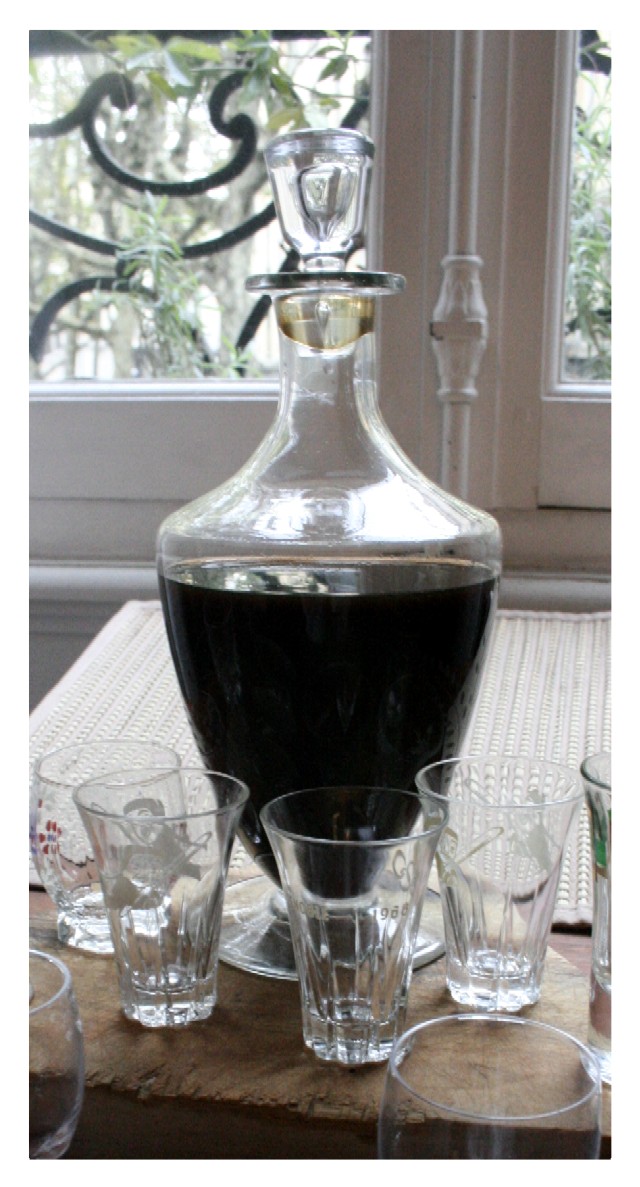
Last year I made a liqueur de noix with green walnuts that came out at the end of June. It was a wild ride into the unknown, and by September we were enjoying the fruits of that effort. I served it to the group at Thanksgiving and by the time mother came to visit in May we'd celebrated enough special occasions with friends that we tapped the last drop of our own vin maison from the decanter. My one big regret last year with the vin de noix was that I did not prepare a much bigger batch. The batch only yielded a bit more than a bottle, but certainly the quality of the elixer was magic. We put what we had into a fancy decanter and served it to enthusiastic friends little by little, using the small glasses, and I always sipped my share with a sad and guilty kind of bittersweet regret. Why oh why did we not make more?

My recipe was a kind of montage last year, with my knowledge of my mother-in-law Brigitte's Vin d'Orange and how she likes it strong, and some Italian recipes for nocino. Brigitte puts the Vin d'Orange away in bulk to macerate for several months every late winter. Images of her bottling activities, which take place in the summer, come to mind. Brigitte, wearing nothing but a bikini, in the kitchen with a couple of funnels rotating around into bottles which have been placed on every surface that will take one, and summoning Yves to come and add some muscle while they filter and decant it. For a long time afterward, the diligent sound of pounding comes from the kitchen as she inserts the corks and pounds them in one by one with a rubber mallet. She hands the bottles over to us with a kiss and a pat every time we need a new one, the elixer of her good cheer, reminding us of her sunny disposition (and her hair color as it was for a few years) to be taken whenever we need or even desire a little bit of Brigitte to fill our hearts with joy.

The idea to make the vin de noix actually came from Brigitte. I called her, asking her what I could do as a gift wine - she had given me the recipe for her Vin d'Orange once I had been married to Loic for a couple of years and although I definitely loved it and desired to make some of my own I didn't want to reproduce her family gift. She mused that I should be using something local - she gets her bitter oranges from the tree, they grow locally everywhere where she lives. 'Why not Vin de Noix? You are very close to Grenoble and they are famous for the walnuts.' So the idea was born, and I sat on it for awhile. I inquired when I might get some nuts for the vin de noix, and it was explained that they are ready to pick on the 3rd Sunday of June, the Fete de St. Jean, St. John the Baptist day.

The first year we missed the window, mainly because we didn't approach the right man. As everyone knows, sometimes the vendors at the market are not actually producers and don't understand their product. I approached a vendor who was selling nothing but walnuts from a very minimal operation and who looked somewhat like a walnut himself, in fact his entire being exuded the idea of walnut from the faded ash brown color of his hair to the suede boots he was wearing. You look at the fellow and are drawn into a long epic tale about the hardship and joys of walnuts. But it was just an act, one of those theatrical costumes that he had taken as far as living it out like one of those medieval actors you find at a theme park. We unfortunately find this at the markets here more and more often these days, and back then I was tricked. He quite knowlingly told me that green walnuts weren't ready yet. Those who are not in the know about their own product and what it's good for stubbornly deny the availability of such things as green walnuts. We glissed in perilous dismay through the window that year.

Then around mid-June during the next year, I identified and befriended an actual nut producer at the market on a Thursday and he confirmed and enthusiastically agreed to my plan. This one looked like a normal guy and after a bit of questioning it was clear he was the real deal. The nuts have to be used quickly after they're picked, and they have to be picked at just the right time. During the time when we had arranged for the pickup, I was in Paris with my niece, our last hurrah at the end of her stay with us before I deposited her on a plane at CDG bound for her home. We were just near the Sacre Coeur and overlooking the glorious city, I called and confirmed by portable phone that my authentic nut friend had the goods and then made another call to Loic to ensure that he hadn't forgotten his appointment to get them.

The first advice you'll see in any vin de noix recipe worth its weight is that you must wear gloves and not use a wooden cutting board when you make your vin de noix. This advice is not to be taken lightly. The immature nut pods exude a fluid that turns yellow, then brown, and then into an indelible black stain that is not unlike the semi-permanent henna tattoo. This staining liquid can seep into the tiniest crevices and take weeks to go away. Use gloves. Don't slice your walnuts on wood. Scrub your plastic cutting board with hot soapy water and a brush the moment you're finished cutting the nuts.

Last year's recipe did not use wine and experimented with spices, a liqueur. I had tasted the vin de noix and aperetif drinks on offer in the various tourist trap shops and wanted to shoot much higher. I knew that the taste of the nuts has a lot of character. The other thing was that I really wanted to avoid the sugar syrup flavor that grabs you like barba papa from the commercial versions. So my idea was to use another sweetening agent, something that harmonizes gracefully with nuts and won't just seem cheap and sweet. Grade B Maple syrup was my choice.

Liqueur de Noix

38 green walnuts, quartered
1 vanilla bean
2 star anise
2 long peppercorns
2 thick slices of lemon
1 cinnamon stick
1 cup grade B maple syrup
500ml or 2 cups Noilly Pratt Original Dry
1 bottle of vodka


I mixed this up in a large bowl, covered it, and let it sit for a few months. At 2 weeks I became afraid that the star anise was going to take over, so I removed it. The result at the 2 month mark was slightly bitter and maybe a bit medicinal, due to the high alcohol content. I bottled it and put it away for some more time, and at month 4, it had mellowed and rounded out, and something happened to the flavors that was extraordinary - it was clearly something special. Very special. I mean this stuff was so incredibly delicious it became kind of like a precious nectar we had to guard and treat with kid gloves. We began serving it to friends and also using it to prepare a special sauce for magret de canard and drop by drop it dissapeared.

This year I wanted to multiply my output by at least 10, but realized we could not afford all of the vodka that would take. I did some more research into what went into various traditional French vin de noix recipes, and settled on some changes to my recipe this time. This is for a less alcoholic drink but still something with some serious punch following in the family tradition. It will produce 12 gift bottles plus a little stash on the side for sipping and cooking here at home. This year I omitted the star anise, and introduced szchuan peppercorn, due to the pleasant things I've discovered during cooking about the light floral flavors it imparts. I replaced the lemon with orange, and used a bit more per volume because I enjoyed a nice warmed up glass of last year's wine on a cold late autumn day with an orange slice and it was a great compliment. I replaced the cinnamon with the traditional cloves. And last but not least, instead of dry vermouth, my vin de noix is topped with a hearty full bodied white Burgundy wine. Noted below, the ratios per 1.5 liter jar.

Vin de Noix

Per 1.5 liter jar:

About 8 nuts each jar
500ml vodka
1/2 cup grade B maple syrup
1/3 vanilla bean
2 cloves
1 t. szchuan peppercorns
2 slices of an orange
top off with a full bodied white burgundy (Bourgogne) wine (used 5 bottles to fill all 6 of the jars to the top).

Vin de noix, in order to turn it's beautiful deep dark color, needs contact with some air. This is why mason jars are perfect for this - because you can close them without using the rubber gasket and they'll have enough air circulating to allow the liquid to turn black. Once 2 months have gone by, filter and bottle your vin de noix. Seal the bottles tightly then, and allow it to mature for another month or two before giving it away. By all means, taste it at every step, to understand how it develops and what to expect. You'll be suprised at the many different stages it goes through. I'll report back when this is ready to bottle.

Labels: , ,


Share/Bookmark

Tuesday, January 31, 2006

Family Secrets: Vin Maison


In France, a vin maison is an aperetif or digestif consisting of either a wine, an eau de vie, or a mixture of both that has been infused over a period of several months with a special home mix of flavorings. Bitter oranges from the garden, green walnuts, local herbs, and wildflowers all find their way into home recipes. There is always a bit of anticipation when people bring out the unmarked bottle containing their vin maison.

Under normal circumstances, if you drink enough vin maison together with its maker, you’re bound to be offered a bottle. If you bring the empty bottle back for a refill and grease the works with adoring compliments, you might then ask for some enlightenment on the proportions and secret additions. This of course includes the few tips that always never seem to make it into a written recipe.

We’d been celebrating an aunt’s birthday all day, the horseplay by the pool was over, the children were sedated and staring into the candle flames, dessert dishes cleared. Mamie had already been delivered home, and out came the Genepi Maison.

I have had Genepi a hundred and one times. For some reason we’re always being offered commercially produced bottles of the stuff as gifts every time a friend goes up to the mountains. The times I tasted Genepi, I was less than impressed with its cloying sweetness that accosted my jaw and coated my throat, and that bitter aftertaste. It was the Genepi Maison that brought me to a catharsis of taste.

“Now,” I proclaimed to the table, “I understand Genepi.” It had been a long day. It had begun before noon with a huge glass bowl of what Genevieve calls "sangria" and cousin Seb's anchoiade to start us out nice and thirsty. Although my proclamation could have been considered to be exaggerated by anyone looking in from the outside, it was taken seriously by my after dinner companions, as it should have. I was serious.

The flavor was clear and complex, it had a life, it spelled out the mountains, air, soil, and flowers. I had never had real genepi before, I realized, the moment this elixer touched my lips.

It was the brother of the husband of the sister of the mother in law that warned – “Attention, these family secrets are closely guarded.” The table went silent, and I sat mesmerized as the candles burned down and I was drawn through the spiraling path into the tale of this family’s Genepi Maison.

Every year, the papi of the tired children at the table takes their fathers up to the secret places he knows in the Alps where the genepi flower grows. Mind you, picking genepi will get you thrown into prison, it’s illegal to gather because it is endangered. At one time, the tourists began to rip up and destroy all of the delicate flowers, which grows only at very high altitudes, above the clouds, in very shallow crevices in the rocks, with only a little bit of rocky soil and nothing for their roots to hold on to.

People would try and pull the blossoms and their stems off and rip out the whole plant, killing it. Today only a few plants are left, and they are protected. Papi, as he has all his life, knows how to gather the flowers in such a way that the plant is never damaged and it always grows back, and for that reason, he knows the secret places where they grow year after year, and this secret is never divulged to anyone except his sons.

The path is steep and treacherous, and far off the beaten hiking trails in the mountains, even a trained guide would find the way to be difficult. But each year Papi continues his tradition to take his sons up for a few days in the mountains, and they gather about 400 flowers with their stems over the course of about 3 days, leaving the plants to push forth again the next year where they can bloom again.

They don’t get their stems from one particular place, there is a whole list written in Papi’s mind, and according to the weather and the way the earth and vegetation has moved by landslides and the deep winter snow and so forth, he makes the decision to gather the stems in any particular area.

There are two types of Genepi plant: genepi jaune, and the genepi bleu; the bleu is more rare and flavorful than the jaune, and is not identifid by the color of the blossom, because the blossom for both types is still the color yellow. The genepi bleu has an argentine / silver tint to the stem and leaves. Bleu is the best and most flavorful kind, and is the kind Papi gathers.

They bring the cuttings home and dry them on paper outside, and when they are sufficiently dry, the blossoms with their stems are inserted whole one by one into the bottles, 40 blossoms with their stems to a bottle. The stems, once they are in the bottles, are covered with alcohol which has been diluted to 45 percent, and then the bottles are stopped up and the blossoms steep for 40 days. At the end of the 40 days, the Genepi is filtered and put back into the bottles. Sugar is added after filtering, to taste, and every year the batch requires a different amount of sugar.

You use just plain sugar from the sack, and begin the sugaring with 12 teaspoons of sugar in the bottle. Papi covers the mouth of the bottle with his thumb, shakes it well, and then takes a sip. If there’s enough sugar according to his taste, the bottle is re-corked and it is ready for storage. It will keep for years and years, although this family normally drinks their stock every year.

At that point I considered asking for another serving of this delicious Genepi, since hearing the story made the drink seem even more delectable than before, but I thought better of it. It was truly precious indeed.

I did ask a question – “If Genepi is a protected plant, how come we see the drink for sale everywhere in the Alpes?” Ah, very good question. “That Genepi is made from extracts of cultivated plants. They add lots of sugar to try and hide the taste.” It's terrible stuff.

The storyteller went on to tell the story of the year that they were caught by a terrible landslide when out gathering genepi, and their path back home was completely blocked. Luckily they were able to make their way down to a different town in two days and call his wife to pick them up there. It was a harrowing tale.

He finished with some sage advice: “Don’t even think about hunting genepi yourself. It’s dangerous. We go with Papi because he needs someone to accompany him in the mountain.”

Starry eyed, that evening I went home as if in a dream, and thoughts of home made Genepi filled me with hope and joy as I imagined myself adorned in an alpine traditional gown and carrying a hand woven basket from genepi patch to genepi patch. However the next day, when I was thinking about all of this, I realized that it was the Genepi that got to my head!

The tradition belongs to that family, and since they have done it for generations at home and in small quantities, with respect to the plant, they have a something very special. Please don’t try this one at home or on vacation, folks.

There are so many other wonderful recipes for home steeped vin maison, we can be happy with plants, fruits and nuts that grow locally which can become steadfast traditions linked to the land that nourishes us and that which we can pass to our children. Why not get some local nuts, fruits, or flowers and make your own tradition?

Labels: , ,


Share/Bookmark