

Thursday, March 16, 2006

Soupe de Soissons

The day after the dinner I prepared, in 23 minutes, the soup that my vain shot at soup one-upsmanship scorned the night before. Why oh why did I not prepare this soup? My gourmandise for expensive ingredients got in the way of what could have been the perfect meal.

The soup:


The beans for this soup were soaked and simmered over the weekend, and were actually leftovers from a white bean and lamb dinner. The bean, Le Haricot de Soissons, is the largest French white bean available while it also packs the most flavour. They cost quite a lot by weight but when they are soaked they multiply in size and then enlarge even more with cooking. I got them for a dinner with friends over the weekend, but not knowing that they would end up expanding to an enormous size, I ended up soaking and cooking way more than we could eat that evening. Le Haricot Soissons is protected under AOC rules. You can learn more about this lovely bean at the website of the co-op that grows them. If you don't have these beans in your home town, you can replace them with any kind of white bean you like, navy, coco, etc. Just use the most flavorful one you know.

200 grams broth cooked Haricots de Soissons (big white beans)
1 branch sage
1 clove garlic
1 European bay leaf or 1/3 to 1/2 of a California bay
water to cover
1 courgette
1 small onion
1 slice of leftover leg of lamb
2 tablespoons duck fat
salt and pepper
2 tablespoons veal demi-glace
the juice of ½ lemon
a drizzle of good olive oil

Make a bouquet with the sage and bay. Put the beans, the bouquet, and the clove of garlic of which you have peeled and removed the germ in a small pot and cover with water. Bring to a boil, and then turn the heat down to very low. Simmer for 15 minutes. Cube the courgette and mince the onion. Cut the slice of lamb into strips and heat the duck fat to very hot. Toss and turn the strips of lamb in the duck fat until they are browned and crisp. Remove the lamb from the pan, and add the courgettes and the onion. Put two soup bowls in the oven to warm. Turn the heat down on the courgettes and cook them slowly, stirring occasionally until soft, about 5 minutes. Remove the bouquet from the beans, leaving a leaf or two of the sage. Mix the beans and their liquor with the blender into a smooth puree. Add the demi-glace, stir, season with salt and pepper, and brighten with lemon juice. Taste and adjust seasoning. Bring the hot bowls from the oven and mound a spoonful of courgettes into the center of the bowl. Cover with soup, and then pile the crisped lamb strips in the center. Drizzle with fruity olive oil and serve immediately with dense crusty bread.

Labels: ,


Share/Bookmark

Friday, March 10, 2006

Blazing Through Bresse


Loic and I decided to ski in the Ain this past weekend, near Geneva. It was exceptionally cold and windy but there was a lot of sun and tons of snow so we were happy for that. The countryside is really beautiful. We saw lots of wild birds of all kinds near the marshes as we drove through the area close to Bourg-en-Bresse, and I felt sad about the news that's been focused on the region lately. One of the major questions is that analysts have been plotting normal bird migration patterns and say that the H5N1 virus outbreak patterns don't seem to match up with the path the birds are actually taking. It has raised questions about method of propogation of the virus. In any case, we feel fine eating chicken at this moment, since we have been following the facts closely and if there is any real danger to the consumer we'll know about it.

Labels:


Share/Bookmark

Thursday, March 02, 2006

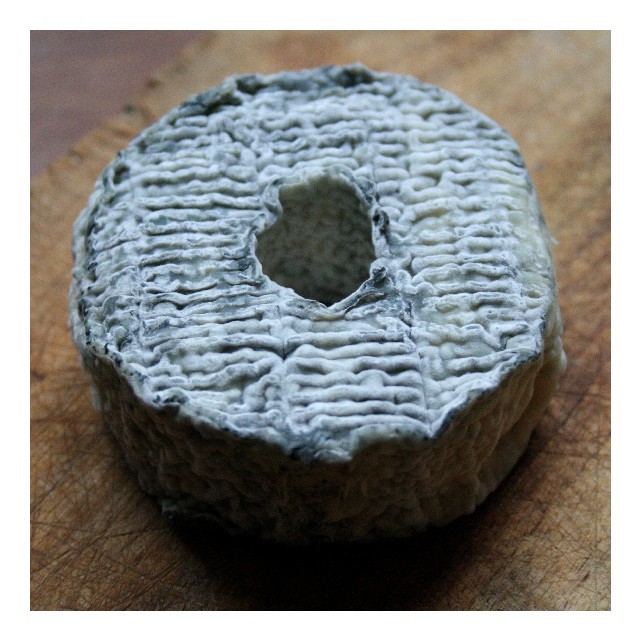
Rouelle Cendrée, je t'aime.


To get me through these last few cloudy days of the season, because it was raining and I lost twice to Loic at Geister, because the music we played had pushed me into a mood, I was destined to find the Rouelle. I looked for a long time at it, happily the fromagère was occupied. Staring for long periods of time at cheese is something that is easy to do but even easier when it is meant to be! Where have you been all my life? Finalement, j'ai trouvé mon bonheur.

Labels: ,


Share/Bookmark

Monday, February 27, 2006

Chaource Apéro Tarte

A certain wind is blowing in the valley and it makes us want to go up into the hills and just breathe in through our nose and hop out over the rocks in hopes to find a crocus pushing through the melting snow. It's not time yet. The cold is holding on but it won't forever. The outing has us in the mood for something easy and warm. In the fruitbowl we have some pears, and some cheese. Crack some hazelnuts. This will do.

Chaource Apéro Tarte
3 yellow pears
1 whole Chaource, or picodon, or some kind of tangy salty chevre
some pâte feuilletée or brisée whatever you have
30 grams shelled and crushed hazelnuts
2 Tablespoons honey
3 Tablespoons olive oil

-Wash the pears but don't peel them. Cut in half from stem down, remove the core, and slice each half into 6 lengthwise slices.
-Preheat oven to 200C/400F.
-Heat 2T. olive oil in a skillet with 2 T. honey. Put the pear slices on top, reduce heat, and let cook over low heat for 3-4 minutes.
-Slice the Chaource into very thin slices.
-Roll the pâte out 3-4 mm thick. Rollup the edges to make them look pretty, and prick with a fork all over. Put the circle of crust onto a flat oven proof pan.
-Arrange the pear slices in a wreath on the tart base, and lay the cheese between the slices of pear. All over the surface of the tart base. Sprinkle the crushed hazelnuts over all and drizzle the remaining 1 T. olive oil over the surface.
-Bake for 15 minutes.

Labels:


Share/Bookmark

Sunday, February 19, 2006

How to make a homespun soufflé


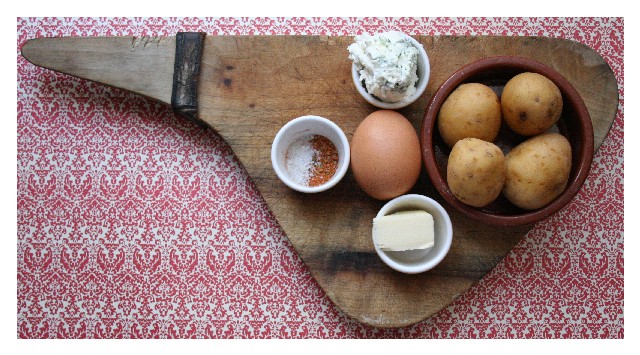
The consummate home economist, Madame St. Ange tells us how to make a potato soufflé for the family dinner table. I 'update' and divide the recipe by 3, mess it up and even then it tastes divine. It is a ramekin of breakfast goodness.

Breakfast Potato Soufflé

1 egg
twice its volume in old potatoes
2 teaspoons butter
1/4 teaspoon salt
1/2 teaspoon spice mix maison
2 teaspoons cream cheese or creme fraiche
a pinch cream of tartar

Preheat the oven to about 375F/175C. Separate your egg, putting the white in a medium sized mixing bowl and the yolk on a saucer. Set aside. Pierce the potatoes with a fork and nuke them until soft. Working while they're hot, remove the skin and mash with a fork in a saucepan. Over low heat to evaporate moisture, add the butter with a wooden spoon, vigorously working the potatoes and butter until their form a thick homogenous paste. Add the cream cheese one spoon at a time. Off heat, add the egg yolk and the seasonings, and fully incorporate them. Beat the egg white with the cream of tartar until it forms stiff peaks. Take 1/3 of the beaten egg white and incorporate it gently into the potato mixture. In turn, add the potato mixture to the bowl containing the remaining egg whites, and carefully fold it together. Transfer this to a ramekin, and smooth the top with a knife. Place in a medium oven for 15 to 20 minutes, or until the top is brown. It will puff up. Not really like a soufflé, but enough to be considered elegant and of a delectable nutritious consistency. Make note to double or triple this recipe the next time. Always eat your potato soufflé immediately, while hot and steamy. One more example of a dish where the result is an elegant 'much more than the sum of its parts'.

Labels: ,


Share/Bookmark

Wednesday, February 15, 2006

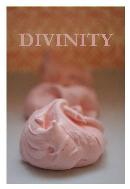
Divinity

Standing on a footstool beside my grandmother Cille in the kitchen when I was too small to see above the stovetop without it, I received the secrets of this notorious home made candy from the South. It is a candy that requires patience and watchful eye for time. Cille saw that my mind was growing, she taught me my left from right at about that same time, and how to tie my shoe, and she could see that like other children my age I was anxious and impatient and my life adventures were squeezing through the seconds and minutes without understanding how to get a grasp of them. I wasn’t ready to read a clock and a few minutes could seem like an hour, just like an hour could pass in the blink of an eye. I was lacking the constant meter that comes with rigor and habits, so she taught me, in her patient careful way, the stepping stones to Divinity.

Bright sunny days are divinity days. Crisp winter days were best where we grew up, because then there is a draw between playing outside or staying in to make divinity. Honestly, when Cille was visiting, I’d give up anything for some one on one time with her.

First you have to get the sugar boiling. Then when it is a syrup and it begins to bubble, the syrup moves through easily recognizable stages from a foamy rapid boil, through several swells and changes in appearance that rise and fall like predictable tides, and then finally reaches the point when it settles down and the bubbles grow and pop in a certain thoughtful kind of way. That’s the time to begin the testing. Every few minutes we’d drop a little bit of the hot syrup into ice water. After an agonizing wait the sugar finally acted right and became a hard ball. These landmarks are easy enough for a child to grasp.

As the beaters turned in the stiffly beaten egg whites, she poured the sugar syrup so excruciatingly slow that I thought I might just die from the suspense. She insisted that adding it in a thin almost hair-like stream was the secret to a successful divinity. When enough had been added to give it some body, the flavorings came, vanilla, or some brandy, and the color. When Cille and I made divinity together, she always let me choose the color. Then the rest of the syrup went in, ever so slowly but fast enough that it never hardened in the pan.

The end comes quickly when making Divinity. One minute you’re shuffling from one foot to the other wondering when it will ever end, and the next minute the sheen fades and you find yourself spooning it down on the waxed paper in rich voluptuous dollops. Cille often pushed a pecan into the center of each one just after spooning it down. The candy grips the buttery nut like the head of a sleepy child in the pillow at nap time.

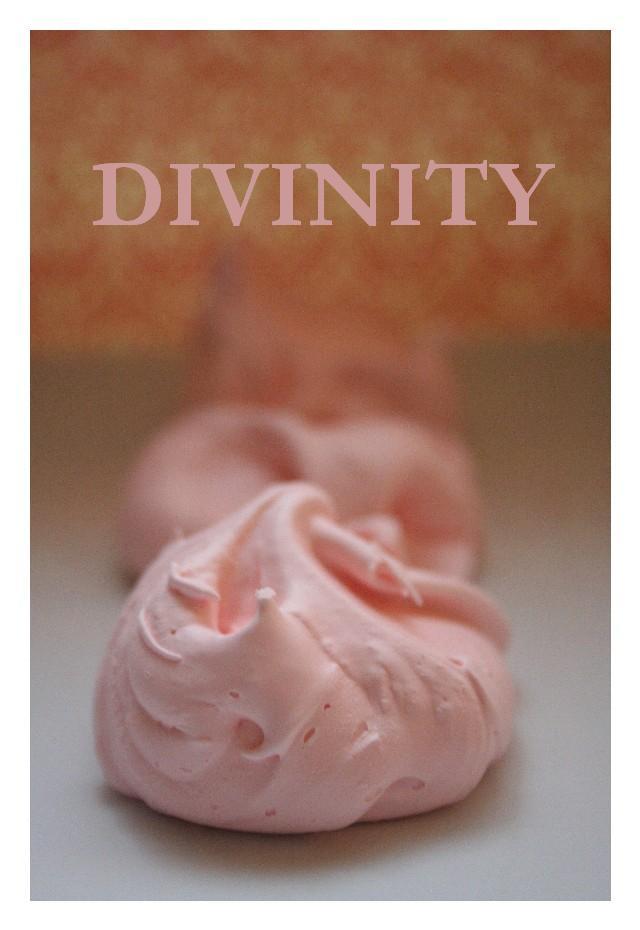
My mother reminisces about Cille's teaching days, and says she used to make pink divinity for her class every year on Valentines day. This year I decided to make pink divinity.

Labels:


Share/Bookmark

Monday, February 13, 2006

Weekend Guests


When weekend guests are coming, I certainly prepare in advance, but I don't like to plan exactly is going to be served at the table. Most of my preparations are things I do to make things easier for myself when the time comes to fix dinner. Trying to stick exactly to a menu and schedule doesn't work for me. Flexibility is important when you have guests that stay a few days, you never know what they're going to want to do. I love weekend guests because my house is clean, the fridge is stocked, and we've got great company to visit with! I've spent some quality time in advance to give myself lots of choices about what to serve.

Prepare a bunch of things halfway - I make sure I have fresh pastry crust chilled in the fridge, I have a pot of veal stock and a pot of chicken stock going, I have a nice herb bouquet, etc. So that we can look together at the market and choose something fresh to flesh out the larder. It's nice to include them in the meal planning, and I can ask them what they're in the mood for.

This weekend my sister-in-law had a baby, the first of her generation. The proud grandparents came to stay chez nous, and I served simple things like tartes, soups, and individual terrines which were a breeze to serve and I could use as a backup when I didn't have time. Of course I did my very best and served food that tasted just right, but I didn't try any fancy culinary feats nor did I make big messes in the kitchen while they were here either.

It's best, when you have family to visit, to give them your best but also make sure not to spend too much time or money. That way they not only feel welcome, but comfortable that you're enjoying them - they get good home cooked meals without feeling like the host is working too hard.

I did do some things to prepare in advance before they arrived so that the dishes they were served would have that extra touch. For example I made a rutabaga and smoked pork belly puree which was applied in a layer to the bottom of a quiche to give it that special something. I prepared a veal demi-glace to add that touch of home made richness to soups and purees, but I didn't spend too much time in the kitchen around mealtimes.

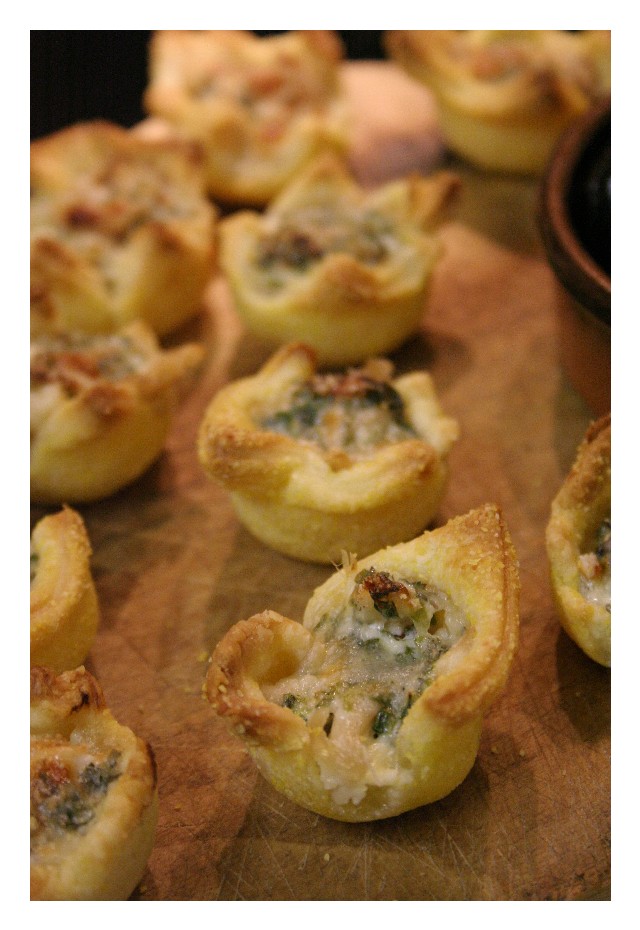
After a long afternoon visiting with Aude's new baby, we came home and it was easy to throw together a batch of little aperetif tartlettes to take the edge off while I prepared a nice chicken potato soup with that morning's market pickings.

Friday's dinner was a simple pork belly quiche, salad, and the cheese plate.
Saturday lunch we enjoyed a Parsnip salad, magret de canard with vin de noix / veal liaison sauce, cheese plate, and parsnip cake.

Saturday dinner were the little tartlettes above, potato and chicken soup, salad, and cheese.
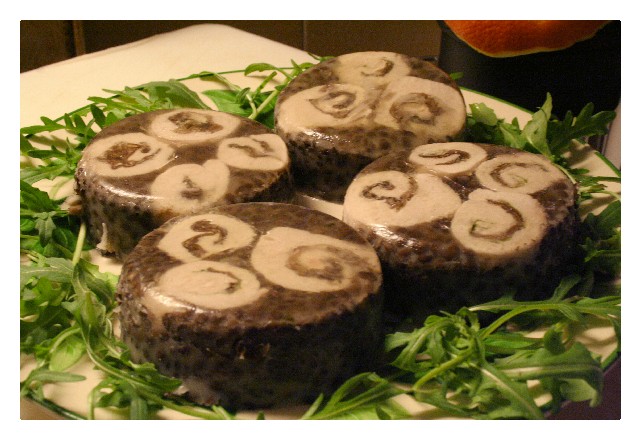
Sunday lunch were individual chicken and lentil terrines, cabillaud with a sabayon, salad, cheese plate, and birthday cake for Yves.

Labels:


Share/Bookmark

Friday, February 10, 2006

Moules Marinières


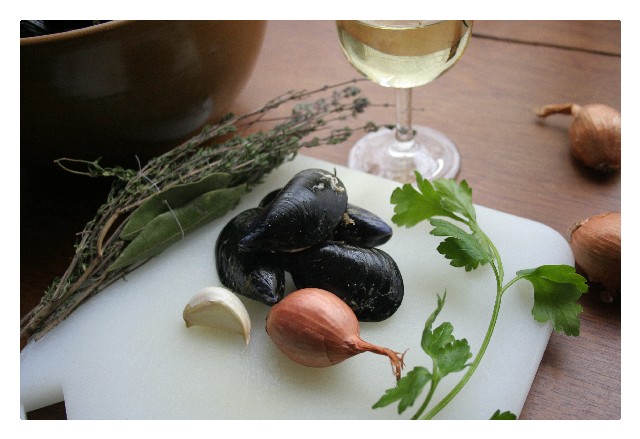
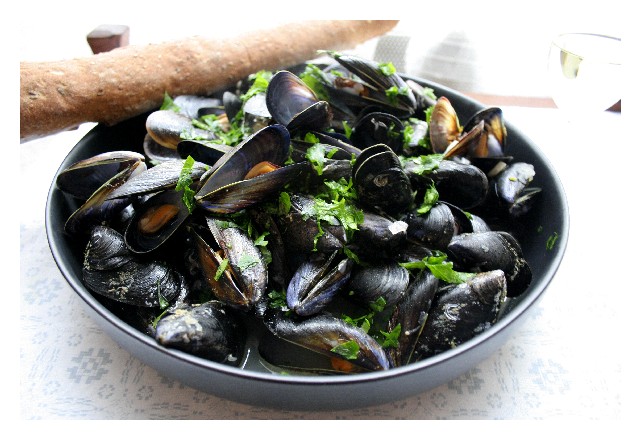
At the market Saturday morning, we'd been down and back up again, and the man who sells oysters gave us a super price on a couple of pounds of mussels - we took him up on it immediately because we know him well and eat his oysters all the time. Loic gave them a scrape and a scrub while I minced the shallots and prepared the ingredients, and in no time we were deep into a platter of steaming hot delicious mussels. For a batch of 3-4 pounds of mussels:

Moules Marinières

3-4 pounds of mussels
2 big shallots
1 clove of garlic (optional)
1 bouquet of thyme, bay leaf, and a sprig of tarragon
25 grams butter
freshly ground black pepper
25 cl (a glass) of dry white wine
juice of two lemons
1/2 a bunch of parsley

Brush and wash the mussels under running water, eliminate the mussels that don't close up during the process. Peel and mince the shallots and garlic, wash and mince the parsley.

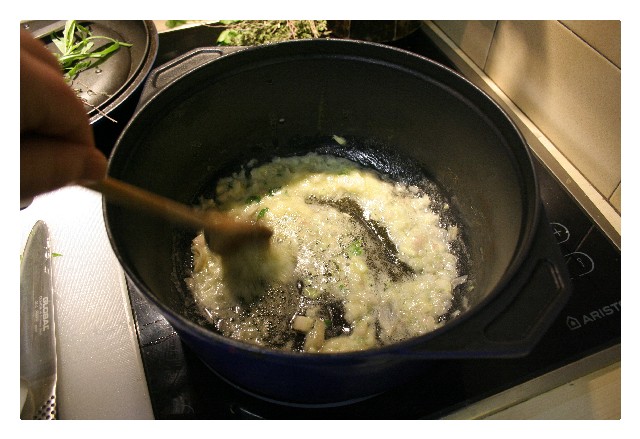
Melt the butter in the bottom of a pot that will eventually hold all of the mussels. Add the shallots and garlic, and saute it over medium heat until it's soft, without browning it. Add the white wine, the lemon juice, and plenty of pepper. Add the herb bouquet, bring to a rolling boil, and let boil for 3 minutes.

Toss the mussels into the boiling liquid, cover, and let cook for 4 minutes, shaking the pot to mix a few times. As soon as the moules have opened, remove from the heat.

Remove the bouquet garni, and with a large slotted spoon, transfer the mussels to a platter. Use a soup ladle to top them with the cooking liquid, , being careful not to stir up any sediment that may be on the bottom. Dust liberally with minced parsley and serve immediately. (don't leave out the parsley, it really adds to the experience!)

Labels:


Share/Bookmark

Friday, February 03, 2006

Piping Hot Gougères


Gougeres are easy. They are also delicious, and can be seasoned and stuffed in so many ways. The next time you have guests, whip up some gougeres to go with the aperetif. They are a great way to say you care and much less expensive than gourmet snacks or nuts! I estimate that making a batch of gougeres which yields about 3 dozen bite sized cheese puffs costs approximately €1,70, and you don't have to buy anything special in order to make them. Choux paste is seasoned with my house spices and whatever cheese I have on hand, to make a welcoming start to a meal. They go perfectly well with a Chablis, or a Clairette, Cremant, or Champagne.

Gougères (a small batch)

125 ml water
50g. butter or 40g. duck fat
1/2 teaspoon salt
75 g. flour
2 teaspoons spice mix maison
100g. fresh grated Parmesan or a mix of Parmesan and Emmenthal
a grate of fresh nutmeg
2 eggs

Mix your flour, spice mix, and nutmeg together and have it ready to use. Put the fat and salt into a saucepan with the water. Bring to a rolling boil. Add the flour mixture, all at once. Beat vigorously by hand with a wooden spoon over the heat until the dough begins to separate from the edge of the pan, having lost some moisture. Remove from the heat and incorporate the first egg fully with the wooden spoon, then the second. Mix in the grated cheese. Place rounded teaspoon-fulls on a cookie sheet lined with parchment. Bake at 210 C / 400 F until they turn golden brown. Turn off and open the oven slightly to keep them warm until service.

Note of thanks to the reader who kindly prompted me to keep my ml and cl's straight!

Labels: ,


Share/Bookmark

Wednesday, February 01, 2006

Uses of Parsnips


What I do know about them: We find them freshly harvested here at the markets starting in January. Their sweetness develops when they're cooked, and they are especially sweet when harvested after the first frost. The older a parsnip is, the more "woody" it's going to be, so beware of large parsnips. Choose parsnips as you would carrots, they should be crisp and firm. They're sweet. They're sold under the name Panais here in France.

Three experiments worth trying: Parsnip cake, like carrot cake. Confit de Panais to serve with liver pate. Parsnips grated into fruit salad.
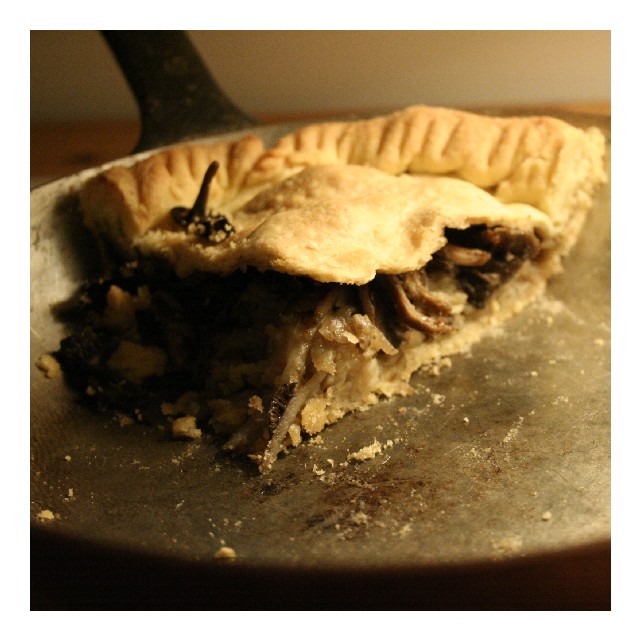

Parsnip salad:
Grated parsnips, mayonnaise, spice mix maison, and extra fresh ground black pepper.

Parsnip Cake (one layer, can be doubled):

1 cup cake flour (+2T. type 55 if you are in France)
1/2 teaspoon baking soda
1/2 teaspoon baking powder
1 teaspoon cinnamon
1/2 teaspoon salt
1/4 teaspoon fresh ground nutmeg
2 large eggs
90ml duck fat, at room temp
90 grams granulated sugar
1/2 cup packed brown sugar
1/4 cup milk
2 cups shredded parsnips

Mix dry ingredients together and set aside. In a mixing bowl, whisk together the eggs, duck fat, sugars, and milk until well blended. Stir in the dry ingredients until just combined. Fold in the parsnips. Put into a one layer pan or small loaf pan and bake at 175C/300F for about 30 minutes, or until a toothpick comes out clean.

Labels: ,


Share/Bookmark

Tuesday, January 31, 2006

Family Secrets: Vin Maison


In France, a vin maison is an aperetif or digestif consisting of either a wine, an eau de vie, or a mixture of both that has been infused over a period of several months with a special home mix of flavorings. Bitter oranges from the garden, green walnuts, local herbs, and wildflowers all find their way into home recipes. There is always a bit of anticipation when people bring out the unmarked bottle containing their vin maison.

Under normal circumstances, if you drink enough vin maison together with its maker, you’re bound to be offered a bottle. If you bring the empty bottle back for a refill and grease the works with adoring compliments, you might then ask for some enlightenment on the proportions and secret additions. This of course includes the few tips that always never seem to make it into a written recipe.

We’d been celebrating an aunt’s birthday all day, the horseplay by the pool was over, the children were sedated and staring into the candle flames, dessert dishes cleared. Mamie had already been delivered home, and out came the Genepi Maison.

I have had Genepi a hundred and one times. For some reason we’re always being offered commercially produced bottles of the stuff as gifts every time a friend goes up to the mountains. The times I tasted Genepi, I was less than impressed with its cloying sweetness that accosted my jaw and coated my throat, and that bitter aftertaste. It was the Genepi Maison that brought me to a catharsis of taste.

“Now,” I proclaimed to the table, “I understand Genepi.” It had been a long day. It had begun before noon with a huge glass bowl of what Genevieve calls "sangria" and cousin Seb's anchoiade to start us out nice and thirsty. Although my proclamation could have been considered to be exaggerated by anyone looking in from the outside, it was taken seriously by my after dinner companions, as it should have. I was serious.

The flavor was clear and complex, it had a life, it spelled out the mountains, air, soil, and flowers. I had never had real genepi before, I realized, the moment this elixer touched my lips.

It was the brother of the husband of the sister of the mother in law that warned – “Attention, these family secrets are closely guarded.” The table went silent, and I sat mesmerized as the candles burned down and I was drawn through the spiraling path into the tale of this family’s Genepi Maison.

Every year, the papi of the tired children at the table takes their fathers up to the secret places he knows in the Alps where the genepi flower grows. Mind you, picking genepi will get you thrown into prison, it’s illegal to gather because it is endangered. At one time, the tourists began to rip up and destroy all of the delicate flowers, which grows only at very high altitudes, above the clouds, in very shallow crevices in the rocks, with only a little bit of rocky soil and nothing for their roots to hold on to.

People would try and pull the blossoms and their stems off and rip out the whole plant, killing it. Today only a few plants are left, and they are protected. Papi, as he has all his life, knows how to gather the flowers in such a way that the plant is never damaged and it always grows back, and for that reason, he knows the secret places where they grow year after year, and this secret is never divulged to anyone except his sons.

The path is steep and treacherous, and far off the beaten hiking trails in the mountains, even a trained guide would find the way to be difficult. But each year Papi continues his tradition to take his sons up for a few days in the mountains, and they gather about 400 flowers with their stems over the course of about 3 days, leaving the plants to push forth again the next year where they can bloom again.

They don’t get their stems from one particular place, there is a whole list written in Papi’s mind, and according to the weather and the way the earth and vegetation has moved by landslides and the deep winter snow and so forth, he makes the decision to gather the stems in any particular area.

There are two types of Genepi plant: genepi jaune, and the genepi bleu; the bleu is more rare and flavorful than the jaune, and is not identifid by the color of the blossom, because the blossom for both types is still the color yellow. The genepi bleu has an argentine / silver tint to the stem and leaves. Bleu is the best and most flavorful kind, and is the kind Papi gathers.

They bring the cuttings home and dry them on paper outside, and when they are sufficiently dry, the blossoms with their stems are inserted whole one by one into the bottles, 40 blossoms with their stems to a bottle. The stems, once they are in the bottles, are covered with alcohol which has been diluted to 45 percent, and then the bottles are stopped up and the blossoms steep for 40 days. At the end of the 40 days, the Genepi is filtered and put back into the bottles. Sugar is added after filtering, to taste, and every year the batch requires a different amount of sugar.

You use just plain sugar from the sack, and begin the sugaring with 12 teaspoons of sugar in the bottle. Papi covers the mouth of the bottle with his thumb, shakes it well, and then takes a sip. If there’s enough sugar according to his taste, the bottle is re-corked and it is ready for storage. It will keep for years and years, although this family normally drinks their stock every year.

At that point I considered asking for another serving of this delicious Genepi, since hearing the story made the drink seem even more delectable than before, but I thought better of it. It was truly precious indeed.

I did ask a question – “If Genepi is a protected plant, how come we see the drink for sale everywhere in the Alpes?” Ah, very good question. “That Genepi is made from extracts of cultivated plants. They add lots of sugar to try and hide the taste.” It's terrible stuff.

The storyteller went on to tell the story of the year that they were caught by a terrible landslide when out gathering genepi, and their path back home was completely blocked. Luckily they were able to make their way down to a different town in two days and call his wife to pick them up there. It was a harrowing tale.

He finished with some sage advice: “Don’t even think about hunting genepi yourself. It’s dangerous. We go with Papi because he needs someone to accompany him in the mountain.”

Starry eyed, that evening I went home as if in a dream, and thoughts of home made Genepi filled me with hope and joy as I imagined myself adorned in an alpine traditional gown and carrying a hand woven basket from genepi patch to genepi patch. However the next day, when I was thinking about all of this, I realized that it was the Genepi that got to my head!

The tradition belongs to that family, and since they have done it for generations at home and in small quantities, with respect to the plant, they have a something very special. Please don’t try this one at home or on vacation, folks.

There are so many other wonderful recipes for home steeped vin maison, we can be happy with plants, fruits and nuts that grow locally which can become steadfast traditions linked to the land that nourishes us and that which we can pass to our children. Why not get some local nuts, fruits, or flowers and make your own tradition?

Labels: , ,


Share/Bookmark

Labels:


Share/Bookmark

Sunday, January 29, 2006

P. Hermé's Kougelhopf


During my years in Beijing, my boss, who was old school, used to tell me that every expat has to get to Hong Kong at least three times a year. For that reason, he would always find me a reason to go down to the Hong Kong office. Bless him. It was in Hong Kong where I learned just what a global city is. I remember the first time I rode in, by taxi, and I was hit in the gut with dreams of science fiction and the history of the oldest culture known to man, at the same time. It was one of those moments when your soul expands to take something in - thousands of glittering glass panes, the moon, the neon, changing and calling, a soulful helipad where you could hit the ground running. There are only a few international cities in the world that perform as magnets of glitz and culture. Like Hong Kong is to Asia, Paris is to Europe. This is the city where I spent the day on Saturday.

Lyon is a wonderful city, it is a great place to live, community, full of history and all that. But Paris - It's like Lyon is just one quartier, and Paris is multiplied by 20. The world comes to Paris. I feel like I'm going to another country when I go there. I thought of the wonderful weekend Merrick and I enjoyed in Paris last June. I am so glad that she had her ideas all organized and was quite firm with me about having a mission. I could just wander forever without any goal in Paris, which usually leads to blistered feet and leaves me precariously dependent on luck. For that reason, I realize it's best for me to set an itinerary and to set a few appointments with people to keep me from drifting like a leaf on the wind forever. For my one day, I set the anchor of a lunch meeting with two friends also visiting Paris from London.

After lunch with Maggie and her friend Enrico, in a restaurant where I had a piece of wood in my salad and the waiter gave me a chocolate to compensate for it, we headed to the Pierre Hermé boutique to pick out a pastry. The boutique itself was rather a minimal operation and not too glitzy, and they didn't have a tea room or anything, but they are very famous. I chose something simple. We headed to where they were staying, Enrico made some tea, and we enjoyed our pastries.

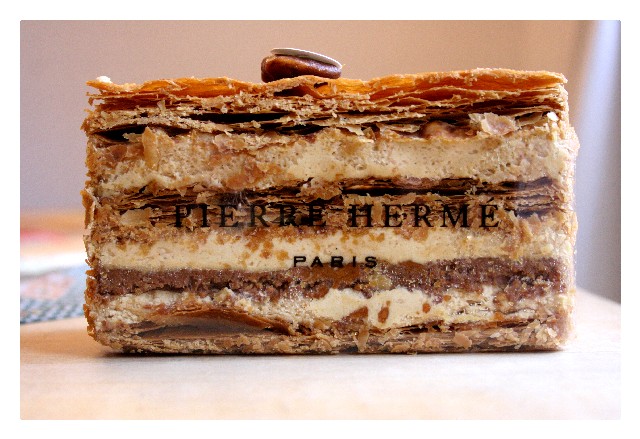
I had a mini kougelhopf (photo above). One bite began my search,and my mind turned over and over and churned for some time, and then I was left dangling there because I could not think of anywhere else I had ever had such a paragon of what I was trying to classify as brioche, but with a depth and certainty of something else.

I wish I had taken notes, because tasting that kougelhopf took me on a real journey. At the time I definitively stated that I would do a survey of the best patissieres in hopes of finding something that doesn't pale in comparison in Lyon. Now however, it doesn't seem like such a reasonable mission considering my altogether plan to live a healthier life. But it was nice to dream. I was glad to have a pastry that made me dream that way.

This is Maggie's pastry:

I brought Loïc some macarons. They had been knocked around a bit but survived.

Labels:


Share/Bookmark

Friday, January 27, 2006

On Size and Scale

Some little envelopes have got me thinking. I was rustling through a shelf at my favorite papetier here in Lyon, and found that she had these little itty bitty envelopes in stock. Since I'm looking forward to Aude's wedding this summer, I thought of ways she could use them at the reception. I bought them with the thought to do some calligraphy on them and show them to her. When I broke them out of the package and held one in my hand, something happened.

It was kind of like a gut memory, something I was not prepared for. I saw an envelope of this sort presented on a silver tray by gloved hands. I saw the notes we used to write in junior high school and slip into the crevice underneath our desks for the person in the next class to read.

I held the envelope in my hand and imagined receiving a posted letter in an envelope this small. But alas, I thought, these envelopes are too small to send through the mail. They will not go through because they are under the regulation size. I remembered one day in my teen years when I painstakingly hand crafted the envelope for a very important letter to my best friend to be exactly the size it should be. Yes, I suppose it was a bit small but not too small, it was kind of square and big enough to take the address and the stamp and everything, and it rested just right in the palm of my hand. The idea was to transmit intimacy. I took it to the post office behind my mother’s shop downtown, and the clerk thrust it back at me. She said it was too small to send, and they would not accept it. It was a shock and a disappointment to me at the time.

Throughout art school, I was very occupied with the idea of size and intimacy and size and monumentality, and everything in between, and I spent a great deal of time pondering the size of things. This in my mind, is a very important aspect of everything we do, and everything we transmit to others, but also in the way we see. When I had a choice, I would always frame a small area of an object and draw it very large. Coming to grips with the question of scale is a long and arduous process that continues well into our adulthood.

Now this idea of the size of a letter being regulated according to machines in America and the rules being very rigid about size is a very post machine-age thing. I got to thinking about how many very basic things in this country are different due to certain institutions dating hundreds, even thousands of years before the industrial revolution. Everyone knows that starting from scratch and building a well running system is much easier than trying to make an old one adapt. And everyone knows that France had a mail system way before sorting machines that would exclude little itty bitty envelopes. Therefore I conducted an experiment to see if my theory was correct. Indeed, my itty bitty letter was delivered without comment. I love this country! I have launched some off to America to see if they are treated differently, having been initially sorted here and I hope they finally reach their destinations.

The amuse-gueules we receive at restaurants also transmit a certain intimacy from the chef. I love it when they contain hand cut forms of cheeses or vegetables, sliced bigger than a julienne but just the right size to make us look closer, to draw us in. It makes us turn out regard to the intricate beauty of the small natural forms in the foods we eat, and also makes us glad that we have people back in the kitchen thinking of these things.

Labels:


Share/Bookmark

Tuesday, January 24, 2006

Ski Picnics

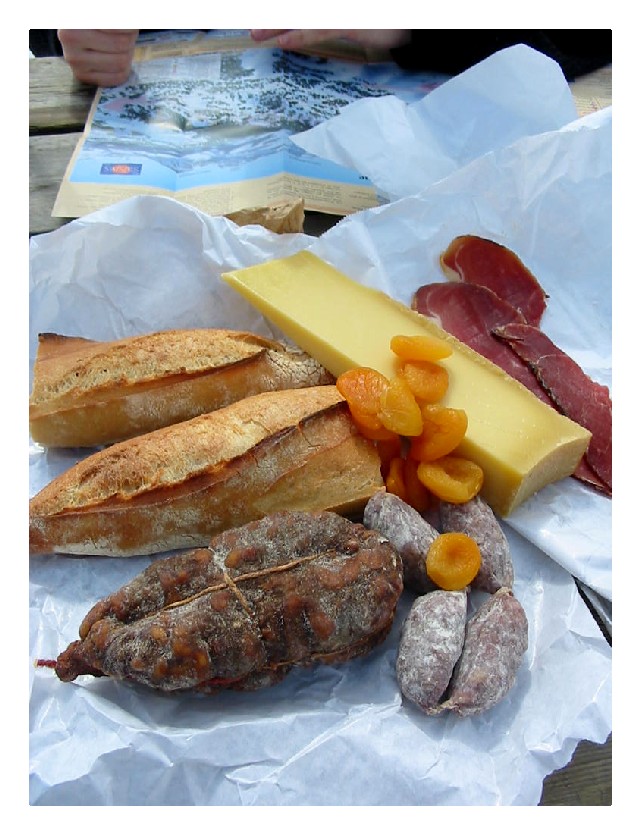
Loïc's idea of the perfect picnic is squatting in the woods with a swiss knife and a piece of cured meat. I like luxurious spreads complete with proper linens, silveware and glasses, and food that has been thoughtfully planned for the event. We have come to compromise on picnics when we ski. This past Sunday we went for a nice jaunt into the forest. Along with a thermos of hot pumpkin soup, we brought simple things. I have hauled very big meals to far-flung places, but simple picnics also have their place.

The first ski picnic I have the pleasure to remember was one prepared by my mother. I suppose I was 10 or 11 years old at the time. This was when my father went all out and bought everyone cross country skis when they were on sale at Marjax. My mother and I soon lagged behind the group. I was just learning to ski and hadn't dressed properly, so I was hot, tired and hungry by the time she pulled out our individual lunches, each in their brown sack. In addition to some sandwiches which I remember weren't too remarkable because of some tomatoes that had gotten everything soggy, she brought out nuts and dried fruits, and something I could not believe: chocolate. I suppose someone had told her the things one was supposed to take skiing because my mother would never choose to feed me chocolate or any sweets if she could help it, or that was my impression as a 10 year old, anyway. I remember that as the first time my mother and I ate chocolate alone together. My spirits lifted immediately after that special picnic with my mom. She said she was proud of me when we finally reached the station to find the others drinking hot cocoa in the lodge.

The next ski picnic I remember very well, it was the first one I had ever prepared. I was to go skiing with my dear friend Willy. We were about 14 years old, I think. Willy was a remarkably graceful person, and was a champion figure skater. We spent a great deal of time together during the holidays. When I suggested we start doing some cross country skiing, he really caught on fast and before we knew it he'd convinced his parents to get him some skis and he got his mother to drop us off at the trails. He was very good at convincing his parents to do things. For the picnic that day, I carefully prepared corned beef sandwiches on rye with russian dressing, with lots of crispy lettuce and pepper. For good measure, I topped them with thick wedges of cheddar cheese which where I grew up was made locally and was extrordinarly good, but at the time I didn't realize how good it was because I had never had any other. We were alone on a rather advanced trail, and lo around lunch time we happened upon a shack beside the trail. We sat down and had our sandwiches, which were packed tight and heavy and full of goodness. The snow was deep and there were icicles hanging pristinely from the roof at the front of the shack with the sun sending off beams of light in all directions. A cardinal came to join us. I was just thinking how great it was to be eating that sandwich when he said - "This is the best sandwich I have ever had". I glowed with pride and we laughed for a long time, I don't know why. It was a pretty good ski picnic.


-------------------------------------------------------------------------------------
Note to mom:

Lest we forget your last visit:


Hey mama! If you're in the mood for another adventure, please book your tickets soon! I miss you very much! Love, me.

Labels: , ,


Share/Bookmark

Monday, January 23, 2006

Cabillaud à la Ménagère

Cod has a great tasting fillet. Being an oily fish, the fillet can be braised along with potatoes with absolutely delectable results. You don't have to worry about this kind of fish going dry if you bake it along with root vegetables for awhile. This surprised me at first, because I always felt that nothing was more regrettable than overcooked fish, and I used to hover needlessly over them all. The more I learn about fish in the French diet, the more happy I am to discover that a variety of species tolerate different cooking methods and times. Cod is a relatively low maintenance fish with high taste ratio for the effort. I'm happy to enjoy more time with my family while I cook up some delicious cod in this simple way.

Preheat the oven to 180C / 350F.

1 onion, sliced not too thin
6-8 peeled new potatoes or 1-2 large potatoes that have been washed, peeled, cut into 4 pieces and tourned. (tourning is optional)
1 tablespoon good olive oil
4 tablespoons butter
1/2-1 teaspoon sea salt
pepper

Grease a porcelain or terra cotta oven proof dish that will hold the fish. Place the sliced onions in the bottom of the dish. Microwave the butter in a small dish until just melted, and add the olive oil, stir the mixture to blend. Drizzle roughly half of the butter/oil mixture over the potatoes. Lay the fish filets flat over the potatoes, drizzle the rest of the butter/oil over the top of the filets, and sprinkle the salt and pepper. Cover the pan with foil, to seal it the best you can. Place in the pre-heated oven for 25-30 minutes. The onion and potato will heat up and release steam, in turn steaming the cod, which will release it's own liquid to mingle with the rest. Serve hot with steamed vegetables.

Labels: ,


Share/Bookmark

Saturday, January 21, 2006

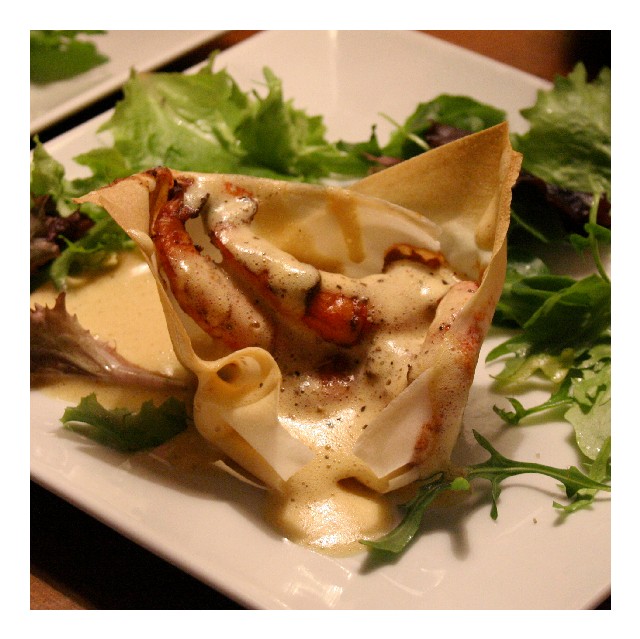
Gambas Sabayon


The sabayon is an excellent addition to any kitchen notebook. Its origins are in Italy, but the French have adopted it quite well. It is a foam that when warm takes the consistency of a sauce, and when chilled becomes a mousse. The formula: eggs/flavorings/wine/heat works equally well sweetened and chilled or as a savory sauce. Some times I make an elegant sweet champagne sabayon to serve as dessert, chilled. It is a thick rich amagam of concentrated flavors.

This dish is a nice appetizer for a special dinner.

Gambas sabayon
For 4 people as an appetizer
Equipment: 4 ramekins, double boiler or metal bowl that fits over a sauce pan.

16 medium to large wild fished gambas or netted ocean shrimp, uncooked
8 spring roll wrappers
2T. butter
1 T. spice mix maison
100 g. green mixed salad

1 head garlic, unpeeled
4 egg yolks
1 T. spice mix maison (that makes for a total of 2 tablespoons)
2 T. lemon juice (fresh)
1 cup white wine
1 t. dijon mustard
1 T. minced fresh tarragon

Method

-Cut the base off the head of garlic, wrap in foil, and bake in a hot oven for approximately 20 minutes.
-Remove from oven and when cool enough to handle but still warm, squeeze the softened garlic into a metal bowl (that will eventually fit over the saucepan.) Add the Creole seasoning and lemon juice and mix the paste well.
-Mince your tarragon.
-Peel the shrimp, remove the heads and de-vein. (For beginners, please note that uncooked shrimp will be blue or green in color. When it cooks it will turn orange.)
-Preheat the oven to 375F / 190C.
-Grease the ramekins and fit two spring roll shells into them, fluffing them into pretty shapes that will eventually hold the shrimp and the sauce like a nest.
-Heat up 2 T. butter in your saucepan and add 1 T. spice mix maison. When the foam has subsided, add the shrimp all at once and cook about halfway, stirring and flipping them constantly. The goal is to finish cooking them in the oven in the shells. (This is just enough to get the outsides to start to turn orange, but not any more, because if you fully cook them before they go in the oven, they will overcook in the oven and that would be a shame.) This should take no longer than about 3 minutes.
-Remove the shrimp to the prepared shells quickly and arrange them in a pretty way, this is how they will be presented in the end. Careful about drips. I use chopsticks to do this for more precision. Slide them in the oven, and set the timer for 5 minutes.

-Rinse out the saucepan right quick and put about an inch (2cm) water in the bottom, and heat the water to boiling.
-lower the heat to keep the water simmering, and place the metal bowl containing the garlic and spice paste on top ove the pan, over the steam.
-Break the 4 egg yolks into the bowl containing the paste.
-Whisk for a few seconds, incorporating the egg yolks thoroughly.
-Add the wine and continue to whisk over the steam until the sauce begins to thicken. -Keep whisking, and add the dijon mustard when you see the first wisps of steam rising from the sauce. It will thicken quickly at this point, and this is when you should add the minced tarragon. At this point in adition to having thickened, it will have turned into a foam. A delicious foam. Be careful not to let this sauce cook much more beyond this point or it will turn.

-When the timer rings (this should time out approximately to the sauce being finished) Remove the shells from the oven. They should be browned around the edges, they will be pretty. Arrange the salad around the plate and leave a little place for the pastry nest. Carefully lift the pastry nests from the ramekins and place them on the plates, use a ladle and give a nice dose of the foamy sauce over the shrimp and around the plate, without covering the salad or the forms of the shrimp too much, their forms are special. Take them to the table immediately.

-Bring the leftover sauce to the table for mopping up by the gourmands.

Variations: Some people don't like tarragon. Never fear, this dish can and has been done without it, with a beautiful garlicky result. The roasted garlic, instead of lifting up and complimenting the tarragon flavor, will become the central flavor. You should consider the seasoning if you omit the tarragon, and adjust with a bit of extra salt just before serving. Another way to do that, if you have some in the kitchen, is to dust the finished dish with fleur de sel.

Labels: ,


Share/Bookmark

Friday, January 20, 2006

Spice Mix Maison


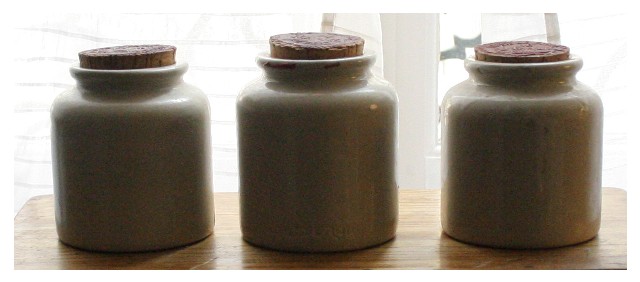
Like equipment, there are certain seasonings that everyone should have on hand and within easy reach in the kitchen. I keep three old mustard pots filled with the following. Good Herbes de Provence as provided to me periodically by my mother-in-law Brigitte who lives in the midi (that's down south in Provence for those not in the know with the lingo), Rough Sea Salt, and my own Spice Mix Maison. It varies from batch to batch, depending on what I have got in the larder. For example last time I ground up a dry smoked Mexican pepper that Loic brought to me to replace the cayenne. Sometimes I add a pinch of this or a pinch of that. Make up your own mix, but start from here:

3 parts paprika
1.5 part dried garlic
1 part dried onion flakes
1.5 part rough sea salt
1 part black pepper
1 part herbes de provence
1 part oregano
1/2 to 1 part cayenne


If you use tablespoons for the parts, you should get a nice big jar of it that you can keep by the stove. Be careful not to mix up the cayenne and the paprika when you've bought them in bulk. Taste things carefully.

Labels:


Share/Bookmark

Tripes


There's a reason why the French refer to tripes in the plural. Cows have four different stomachs, each with its own function. Form follows function in each of the stomachs, and we have different patterns and shapes to appreciate when we find them freshly prepped for the cook pot at the butcher. Any respectable tripe dish should have a sampling of each stomach, because their shapes and forms allow them to sopp up sauce in different ways. A perfectly prepared dish of tripes will give you a variety of mouthfeel all throughout the dish, as each piece will pick up the stewing juice differently.

Since tripes prepared from their raw form take several hours to reach a digestible consistency, for the most part, your butcher will carry tripes that have been previously cleaned and boiled, and are ready to take on whatever style you choose with another hour of simmering. One great thing about tripes is you can never simmer them too long! Prepared tripes run from a brilliant white to a faded tea stained color, depending on which parts of the stomachs they came from. The ones that have not been pre-boiled will look like they need a good cleaning. If you are not sure, ask your butcher.

A nice way to fix tripes

1 kilo beef tripes, cleaned and boiled by the butcher
1/4 cup good olive oil
2-3 cups white wine
5 or 6 tomatoes or 3 tablespoons tomato paste in winter
4 cloves garlic, peeled but left whole
2 medium sized onions, roughly chopped
1 bouquet garni
2 or three poivre long or black peppercorns
1 teaspoon spice mix maison
salt and pepper

-Cut the tripes into about 2cm sized (1 inch)crisscrossed chunks.
-Faire fondre the onion in olive oil (that is saute until soft without browning)
-Add the tripes and let sizzle for a little while, then add the whole garlic cloves, the herbs, tomato paste and white wine. Bring to a boil and then lower the heat, and simmer for an hour. Add the spices at the end.

A wonderful variation of this dish which I like very much is to replace the tomato paste with the juice of one lemon and 2 tablespoons white cider vinegar. At the end, in the last five minutes, when you add the other seasonings, add about a 1/2 cup of pitted black olives. Which one you prepare depends on your mood for tomatoes. You really can't go wrong with tripes, they like acidic mediums to simmer in. I have served tripes over rice, with country bread, etc. Greens of any kind go well with tripes, but what I like best is to serve them alone, followed by a clean crisp simple salad.

Labels: ,


Share/Bookmark

Thursday, January 19, 2006

Tourtes


Tourtes are covered pies in France. They are not called tourtes by virtue of their roundness or their contents. Sweet or savory, tourtes are pies with an upper crust. No matter that in Germany they are round sweet cakes with nuts & cinnamon, no matter that the origin of the word comes from the latin torta, round. Escoffier said so, and so it is. No matter, we still see exceptions here and there, but ask any booksmart gourmand or gourmet, and they may have a thing or two to say if you don't include that upper crust! Anything different and it's a tarte, they'll say. By my twisted logic, I think tourtes are an older, wiser, more thoughtful, slightly more modest version of the tarte.

Labels: ,


Share/Bookmark