Thursday, March 12, 2009
Lucy's Kitchen Notebook - On World Radio Switzerland!


The reason I went to Switzerland was to be interviewed live in Geneva on World Radio Switzerland about my work. Anne Glusker and Pete Forster were so kind to invite me into the studio to talk on Anne's show, Stir it Up, about my passion, what Lyonnais food is and isn't, blogging, Bernadette, quenelles Lyonnaises, and the explosive burgeoning of my interest in food. If you missed the show, you can listen to it rebroadcast on Sunday morning at noon, otherwise hop on over to the website and listen to the podcast! (during the first 7 minutes, Anne gets us up to snuff on Malakoffs.)

Labels:


Share/Bookmark

Wednesday, March 11, 2009

Switzerland: Malakoffs and Horseradish


Simple pleasures - Malakoff and house dried beef at the auberge communale in Luins, Switzerland

In Switzerland, every town, no matter how small, must have a communal auberge. That's an inn and restaurant for the weary traveler to rest. On Monday, I was charmed in spades when friend and fellow food enthusiast Anne Glusker took me into the hills of the lower Vaud Canton in Switzerland to try a local specialty at the source, the Malakoff. Luins is a town of about 450 residents. Local wines were offered at the table, and I enjoyed the refreshing contrast between the Malakoff, which is simple pleasure in itself - a ball of cheese fried up crisp and brown and served sparsely with pickles and onions, along with a glass of a citrusy, crisp, dry, deliciously drinkable wine from the town's vintner, the Chateau de Luins.


Walking among the vines in the town of Luins, Switzerland

It is these simple pleasures that bring us back to our senses when we're shuttling back and forth across international borders, peering at the region through the rough filter of expansive industrial development. But there in between this urgent international hum near the border of France and Switzerland, somewhere between those very important points a and b, tucked under networks of huge autoroutes and crossings, sits a sleepy little cluster-like town, reached when you take a lesser used turn, then swerve this way and that, and climb up into the vines.

Anne Glusker's Malakoff mission in Luins is one of many unique food discoveries that dot the deep ridged fabric of this little countryside, and like any traditional dish, it is a source of debate and precision on every detail. When we questioned the cook at the
auberge, he admitted that there were others who might produce something more exactly resembling the original, dating back to the Crimean war, but he was also quick to point out that his brother was of the mind that they didn't taste as good as theirs. Who makes the most authentic version? Who has the real thing? Who does the best?

My main score of the day was of a completely different vein. Back in Lyon, my repeated pleas for fresh horseradish from the producers is met with stern refusal. They won't grow it because it invades everything and needs a lot of maintenance to keep it from completely taking over, plus nobody wants it except me. I scored a whole horseradish root, which M. Delessert yanked from the ground at my request on his ultra-natural farm in Pralies.


SCORE! Horseradish from a farm in Pralies, Switzerland.

My little plot of land is full of stinging nettles and invasive networks of brambles so if the horseradish took over I'd be thankful! Poking this root into the moist ground will do no harm. The best that can come of it is that we'll have a supply of fresh horseradish to serve with oysters and roast beef!

Labels:


Share/Bookmark

Wednesday, March 04, 2009

Fast Feuilletage, Cheese and Bacon Biscuits


About 8 years ago, the store bought kind was the only puff pastry I dared use, and it was new to me, not having been available in the States before we moved to France. It wasn't long before I started to yearn for something more. I learned quickly, to tell the difference between store bought and higher quality puff pastry. I found out from a friend that I could buy a better product at my local bakery, ready to use in my home creations, and soon left store bought feuiletée behind.

I was going to the trouble of calling ahead and making an order for puff pastry every time I was going to need it, and in general making things more complicated for myself than I had to in the end. I was so afraid of making a mess, ruining it and spoiling a hard-earned expensive lump of butter for a little puff that I refused to even try it.

At one family gathering years ago, someone asked about bakery-bought use of puff pastry apero treat I had brought to a party. I was proud of my creative use of the puff, and told her how to do it. Through some snafu, she misunderstood that I had actually prepared the pastry from scratch. I was so embarrassed that she was going around telling everyone as she passed the platter around. The guilt was horrible. I don't know why I didn't call everyone to the middle of the room and announce that I didn't fold the puff myself. It snowballed in my mind. It became an ethical crisis. The psychological trauma of the guilt set in motion a mission to get up to speed with puff pastry. That was when I realized it's not as hard as people think. And everybody's human.

As long as you keep everything cold, full style puff pastry does come together without magic, and tastes phenomenally better than any kind of feuilletée you can buy anywhere, even those being sold by artisan bakers. The reason is simple. You have chosen your own butter. The butter used in pastry is very important, possibly the most important aspect of anything at all. It makes all the difference in flavor. When someone is in a neighborhood bakery business, they are naturally going to try and maximize their profit margin. Many cheaper butters will taste significantly better than the mix of chemicals and agents used in store bought pastry. But you are in for a real treat if you pick and choose the best tasting butter you can find for your feuilletée. In fact, it will be a revelation.

This is all well and good. Who has time for pâte feuilletée? I rarely do these days, and neither do I have a need for the spectacle that a full style puff pastry can bring to a meal. I am actually more satisfied with home style kitchen table kinds of pastries, as you know already.

This is why today I want to come full circle and share one recipe with you that features a fast feuilletée, one that needs no chilling between layers. It can be thrown together lickety split, literally from start to finish in 10 minutes, and will do for any and all kitchen table tartes and turnovers, quiches for which you would like a little more puff and buttery taste, and apéro treats that will be popped quickly - in other words, those things we'd like to add a little flair and individuality to but don't need layer upon layer of even puffing, or sculptural finesse.

From my list of many variations, here is one recipe for a delicious spicy bacon cheese apéro biscuit. I developed it for baking in the wood fired oven, although any hot oven will do.

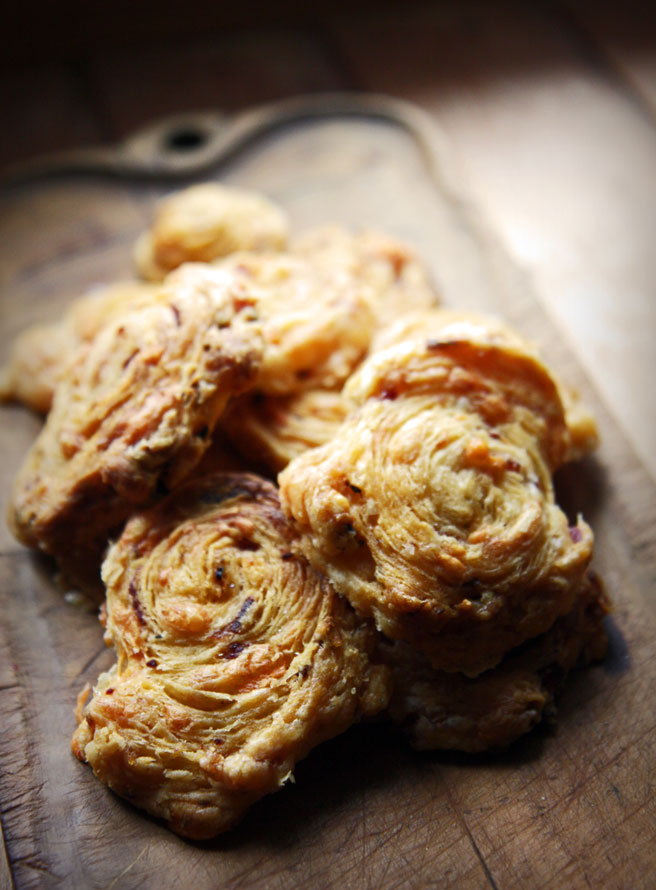
Peppery Fast Feuilletée Rolls
(pictured above.)
good for serving with Champagne or Beer.
Yield: 10 very fattening biscuits. This recipe can be doubled.

125 g. flour (type 55 or AP)
140g. butter
a generous pinch of sea salt
1 good sized chipotle pepper in adobo (the kind that comes moist in a can, just one pepper)
1/2 of a thick slice of bacon
30 g. hard sharp cheese like mimolette, pecorino or cheddar
30 g. Swiss style mountain cheese like Emmenthal
60 g. VERY COLD water (weigh it)

- Roughly work the butter into the flour, no need to get too fussy about it being evenly incorporated, it will seem crumbly but have some chunks of butter in it the size of peas.
- Chop/mince the chipotle, mince the bacon very fine, and mince the cheese into itty little bitty cubes (you might even grate the cheese if you have a grater on hand.)
- Throw all this finely minced and grated stuff into the butter & flour mixture and toss to coat everything with flour. Turn it over and toss repeatedly with a wooden spoon to see that the additions are distributed evenly throughout.
- Add 60 g. very cold water and work it as quickly as you can with your hands into a dough. Do not knead the dough more than you have to to get it to come together.
- Immediately pat this dough into a rough rectangle, and using flour generously to keep it from sticking to your board, roll it out to about a centimeter or 1/2" thick. If it sticks, use a knife to release it, and sprinkle the wet side with flour.
- Fold it over into thirds, one side and then the other, overlapping.
- Do not chill in between folding. Roll it out again, and then fold it again, turning the rougher edges into the center.
- You've done it twice, do it two more times. You do not have to chill this in between rolling.
- After your final folding, roll it out again, and roll that up into a log. Slice off 1cm or 1/2 inch slices, place them on the baking sheet with a couple of inches between them, and bake in a 400F/200C/hot oven until they turn brown.
- These will be quite soft. You have to let them cool thoroughly and turn nice and crisp. Keep them out of sight until guests arrive.

Labels: ,


Share/Bookmark

Tuesday, March 03, 2009

The Verollet Farm in Preslette


It may seem strange to you but the smells associated with a goat farm, to my mind, are pretty close to perfect. The odor of a cow doesn't resonate with me very much. But goats on the other hand... I love everything about them.


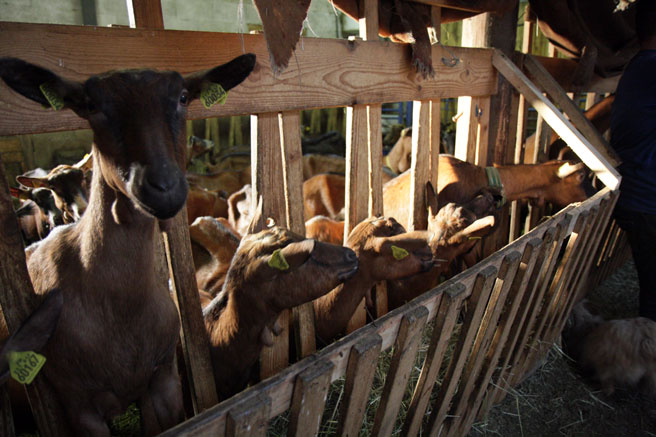
I also loved rattling the latch and entering a goat barn in the hamlet of Preslette in the Savoie region this weekend. It starts muddy and cold, the expanse of grey sky pulling at you through leafless trees. Dogs with varying jobs to protect or herd these goats alert their entire world to your presence, their calls echoing through the valley. Then the door to the barn is open, and you enter a late winter enclave that smells sweet with the perfume of dried alfalfa and cozy animal warmth. Sun beams pierce in through late afternoon shadows and warm up all of the wood, reflections illuminating the animals. The goats stare at this wave of strange smelling strangers that float in on a breath of cool air, observing us all with short phrased questions in their eyes, bells chiming.


The goats are still inside for the winter, with the pasture land at our altitude still layered in patches with a hard crust of snow. Out on the slopes that get the best sun, the shoots have only just begun to penetrate the muddy ground. The melted snow saturates the earth, adding a happy squishing sound everywhere we go, a sound that whispers Spring Soon. Still some sun to come before the heat and light airs the sod enough to turn everything a deeper green.


In the meantime, the little kids born in January are 6 and 8 weeks old, curious, adorable little creatures, eager to nibble your sleeves or anything else they can practice chewing on. They're jumping up eager for a little stroke of their velvety muzzles. They're still drinking milk and get fed together, tails flapping cutely in a delightful little chorus.

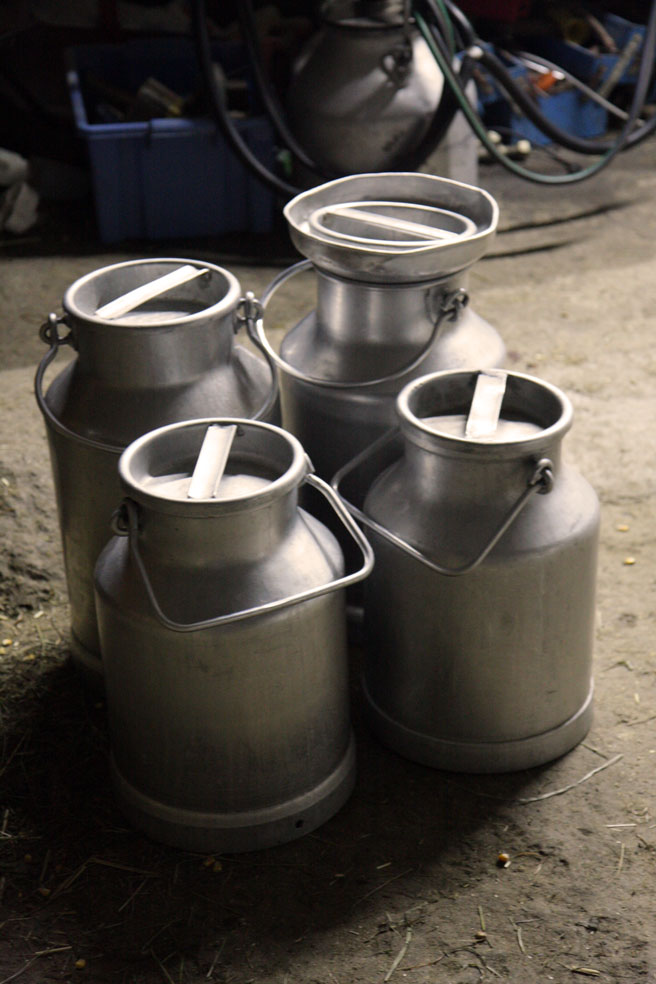
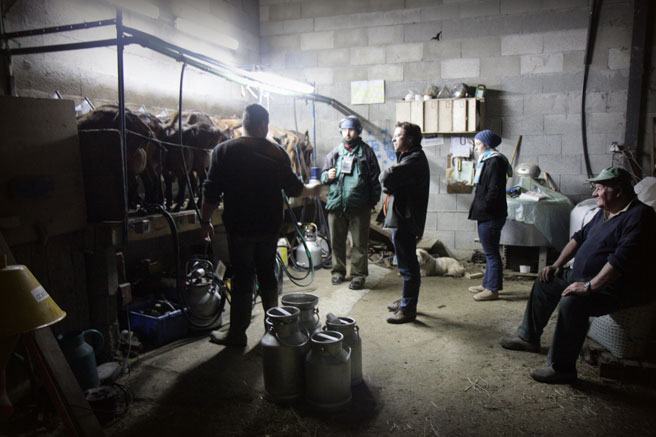
What I loved most, though, was the milking. You have to feel a little sorry for these goats all swollen up with milk, and almost feel their relief too when they trot up in line to their station where they can have a little treat of ground corn and be ministered to. They get milked twice a day. The dog, named Douce, meaning "soft" in French, has been trained for specific jobs, to see them from point to point during the milking process. She will not stay with the goats in the fields when they go out, she has been trained to lead them there. She returns home where she is in charge of keeping things in order in the barn. She is proud of her work. Douce waits patiently in her place for them to finish with the milking and then trots along nudging them here and there. She does a thorough sweep of the entire barn to check that none went astray on the way back to their pens.


There are periods of relative commotion filled with shuffles, whistles and movement, followed by moments of calm waiting, random tinkling of their bells and a soft bleating here and there. The animals are happy to participate in these predictable cycles and engage in various levels of chitchat - See? This is our home. This is what we do. They are affectionate animals, and it seems that many have life stories to tell from their summers on the hills.


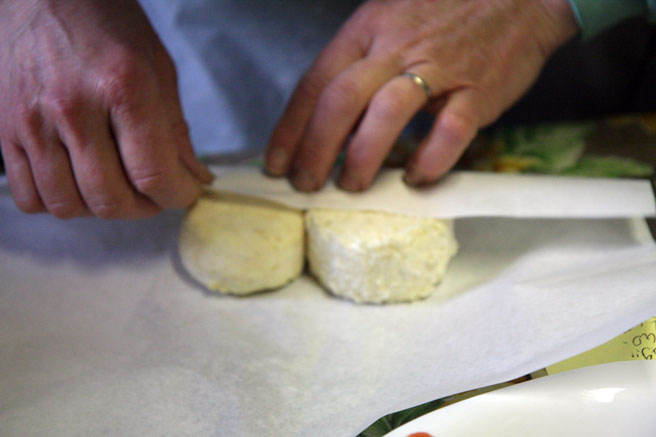
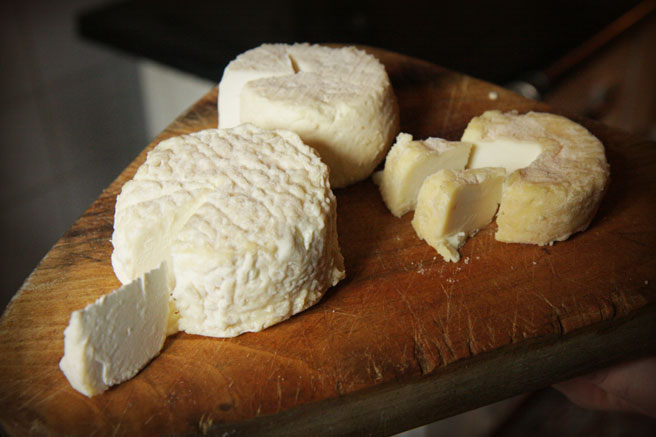
We all got a taste of the warm milk direct from the goats. It reminded me of something, of childhood, a very satisfying drink indeed. We purchased the cheese in three forms, some yogurt, and a bottle of the fresh raw milk to take home. The milk was excellent straight up by the large glass or in coffee. The cheeses were very good as well. In fact this visit just makes me want to get myself a weekly supply of everything they sell.


The Verrolet family farm sells four kinds of cheese, ranging from firm cream cheese to aged tomme. They sell yogurt and fresh raw milk on the farm as well. The cheeses and yogurts are sold at three weekly markets in the area. The tomme is only sold at certain times of the year, since the milk for that cheese comes from the animals that have been out in the pasture eating fresh greens. Their herd size ranges 80 to 100 animals, with a winter birthing in January. A number of the kids are sold off each year. They also have a handful of milking cows, but only make cheese from the goat milk.


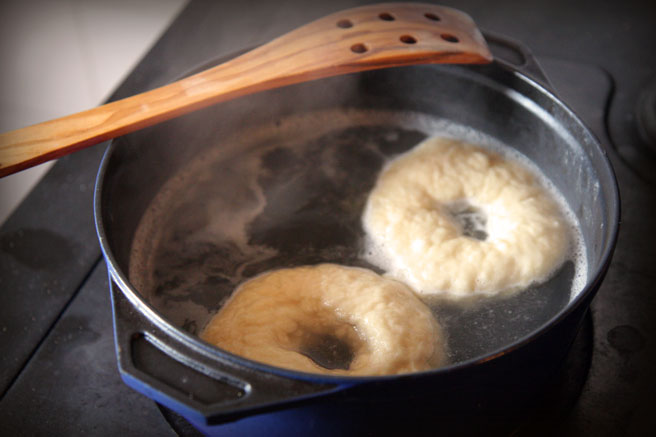
We had to make bagels to do these goat products justice on Sunday morning.

Podcast coming soon.

Verollet, Marcelle
PRESLETTE 73110
04 79 25 71 02

Labels: ,


Share/Bookmark

Tuesday, February 24, 2009

Les Bugnes Lyonnaises


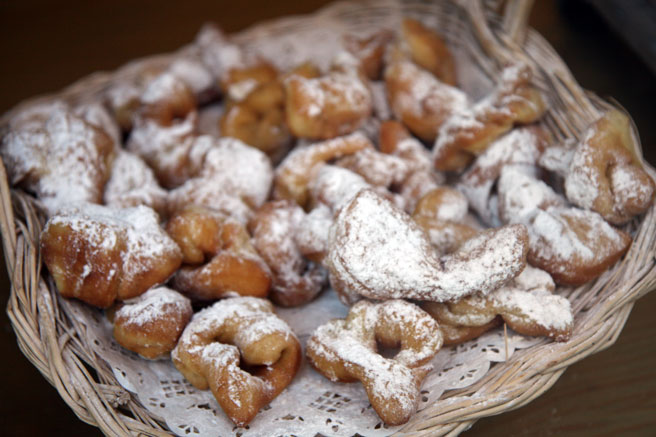
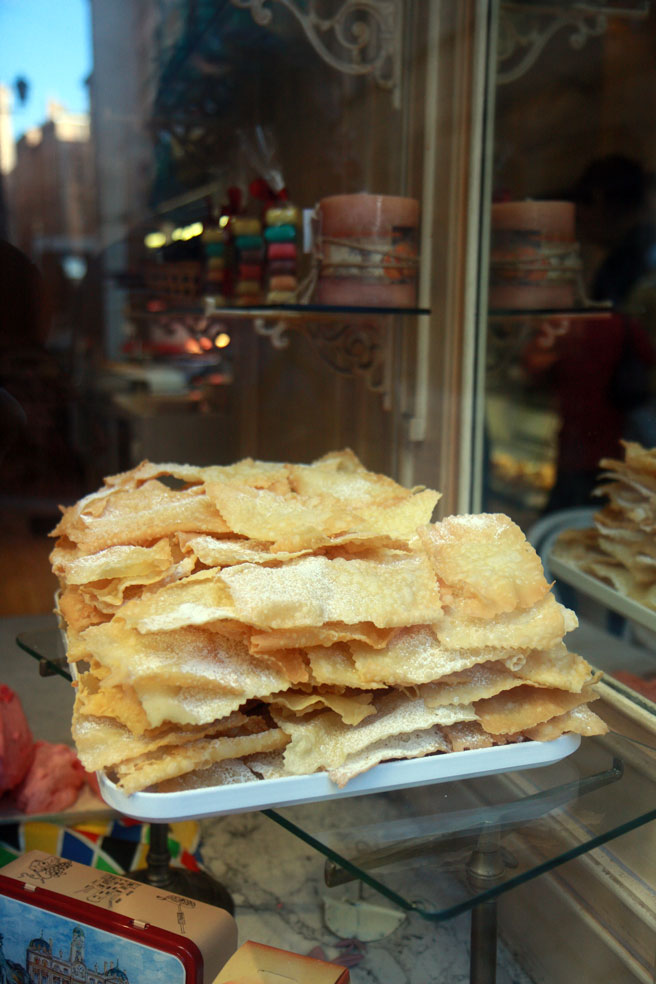
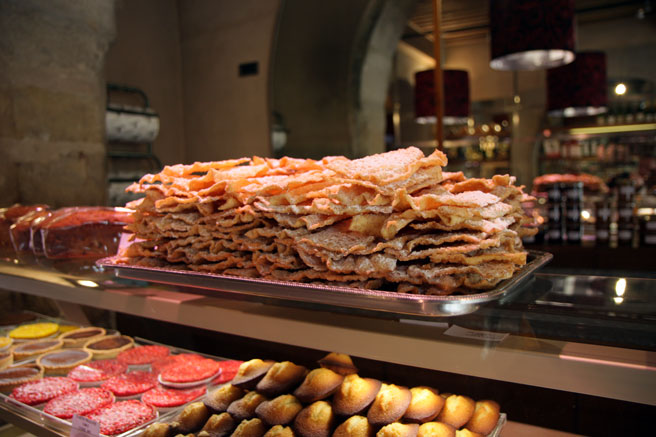
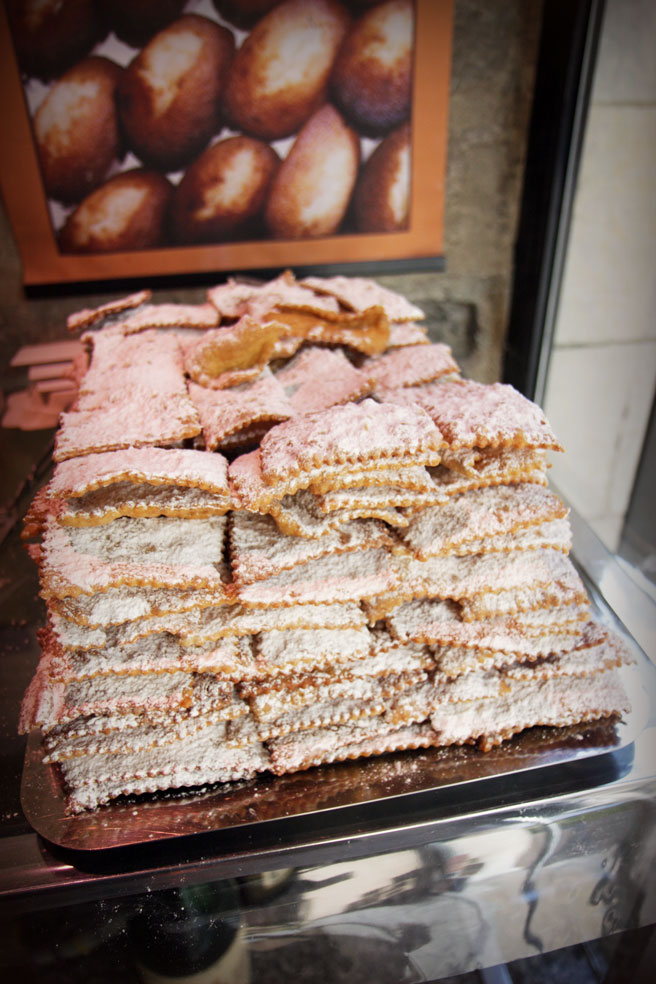
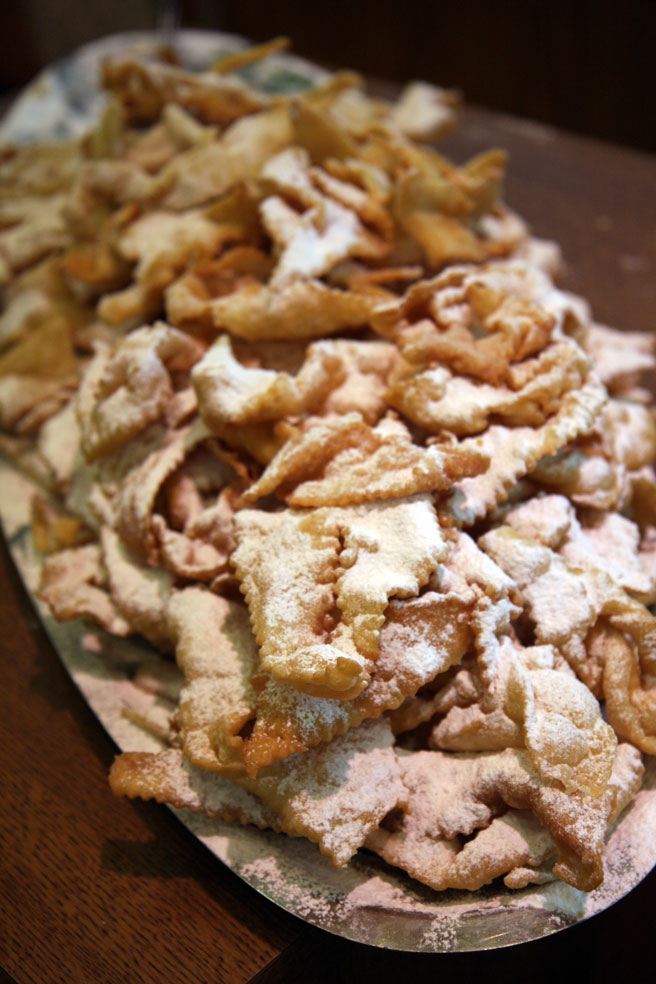
During the month of February, and especially during the French Carnival period, you'll find that the bugne Lyonnaise is kind of a fetish in this town. Last week I mentioned to someone that I was thinking about this little fried confection and it was all it took to get him on a roll. This man instantly launched into a rhapsody about his grandmother's bugnes, and how they used to make them at home once a year the day before Lent. Bugnes have been sold in shops in Lyon since as early as the 16th century, with local records describing their crisp delectable texture. Indeed the bugne historically associated with Lyon is flat, rectangular and fried crisp, but both the flat and leavened kinds are common now.


As far as size and shape go, you can find just about any kind of bugne animal, depending on where you like to buy them. The shape of a bugne in anyone's mind is determined by the neighborhood where they grew up, family lore, or even a gastronome's current fave. Bugnes come in all shapes and sizes. Do not be ashamed to taste, feel the crunch or soft billowy sweetness, judge harshly, speak freely, and love your favorite with all of your heart.


In Lyon, this is a treat traditionally served only on Mardi Gras, but like many of the festival foods, the season has extended over time. You start to see them around the end of January and the boulangeries and charcuteries normally stop making them sometime in the middle of March. There is one vendor on the Quai St. Antoine that sells them year 'round! This means you can still enjoy them after today, that is if you don't give up fried pastry treats for Lent. Enjoy your feast today if you're celebrating Mardi Gras!

Labels: , , ,


Share/Bookmark

Monday, February 09, 2009

Podcast 2: This Stone

This is my second podcast. Still experimenting, of course. A sketch. I used clips from recent recording of jaunts around the 1st and 2nd arrondissement with Cyrus, some sounds from my kitchen, and reading some of my own essays. The music is one of my own compositions, called This Stone. The goal is to master this medium well enough to produce entertaining and informative podcasts on cooking and gastronomy in Lyon. This will come. The third one will be much more focused. This one is just about the possibilities. 2.5 minutes long. Listen to this with headphones if you can!

Click to hear the podcast.

Labels: ,


Share/Bookmark

Tuesday, January 27, 2009

Chef Jérôme Languillier's Day Job


Speaking of traiteurs, Jérôme Languillier, le champion pâtissier on France's team for the World Pastry Cup 2009 is in charge of the pastry side of a simply delectable traiteur located at Les Halles here in Lyon. The day before the World Pastry Cup opened this weekend, I had the opportunity to swing by the boutique at les Halles in the 3ème and check out their daily offering to the masses, have a little taste, and soak up some Lyonnais pride also being offered from behind the counter.

Boutique Traiteur CLOSTAN
102, Cours Lafayette
69003 LYON


The moment of truth for Team France last night at the World Pastry Cup


Jérôme Languillier - Lyonnais pâtissier, Team France. World Pastry Cup 2009.

Today is a special day in Lyon. We are beaming with pride for our man Jérôme!

Labels: ,


Share/Bookmark

Tuesday, January 20, 2009

The Sounds of Bread Podcast

This is the Lucy's Kitchen Notebook podcast in which my friend Cyrus helps me find a way to step outside the box into the world of sound. I proceed from there to the boulangerie to record the action. You should listen to it with headphones if you can.

Sounds come from Eglise St. Nizier, on the presqu'ile in Lyon, Aline serves us at Boulangerie Saint Vincent, 49, quai St. Vincent, also in the 1st arrondissement. Music: Camille, from a song in her album, Le Fil.

Labels: ,


Share/Bookmark

Monday, January 19, 2009

French Takeout


When you come to Lyon to visit, keep your eye out for the lovely takeout shops. They can come in handy when you are exhausted and just want to put your feet up and charge your batteries on an evening or two. Kind of like a deli but French, this kind of shop is called a traiteur. In addition to a selection of delicious reception type foods, you can also find quick fixes for serving up apéro when you don't have the time to prepare. Prepared home style dishes are the meat and potatoes of these operations too: gratins, charcuterie, sometimes a small selection of cheeses, wines, and things like fresh fruit and yogurt or slices from a pie or cake to round out your meal. This is great takeout when you are on the road, and don't have energy for yet another restaurant meal. Ranging from realistic to pricey, here are three of my favorite Lyonnais traiteurs:

Thiellon Jean Marc
11 r Algérie 69001 LYON
Metro: Hotel de Ville
04 78 28 62 56
Good home style dishes, reasonable prices, good quenelles and terrines.

Pignol
corner of 8 pl Bellecour & 17 r Emile Zola, 69002 LYON
04 78 37 39 61
A Lyon tradition and they do lovely little verrines and fancy things in addition to the regular gratins, loaves, and sautés. They prepare lunch boxes for takeout or delivery and also have a little (unmarked) restaurant upstairs above the sweet pastry side, for lunch. Be sure to reserve if you want to eat lunch there.

La Minaudière
5 r Brest 69002 LYON
04 78 37 67 26
Cher cher cher but really really good. Lyon's ritual source for candied chestnuts in wintertime. You must see the window of this shop to believe. Many a jaw has hit the sidewalk there next to the Cathedral St. Nizier.

A hint about ordering: When you order in these places, if you don't do metric, try ordering "pour une personne" or imagine a little yippy dog behind you in line (so you remember the word) and say "une petite barquette" (meaning a little tub) and they'll serve it up without you having to think about grams or how much that spinach in cream sauce might weigh. They'll always glance to you for approval before sealing the deal.

Labels:


Share/Bookmark

Tuesday, January 13, 2009

Labels:


Share/Bookmark

Thursday, January 08, 2009

Choucroute


Basically what you want to do is get a whole lot of sauerkraut, and whatever meat you can find. The meats you choose will depend on your budget, and your local offerings. I adore pork trotters and always include them. You don't need any special equipment to serve a spectacular choucroute for pennies a serving, if you've got the belt cinched tight.

Sauerkraut: a necessity. This is sold everywhere in France at charcuterie counters, either raw or cooked. It sells here for about €1 a kilo. You can do it at home if that floats your boat, recipes abound. If you can find a good source for your sauerkraut, the battle is won. Even if you can only find canned sauerkraut, you can still serve a nice choucroute. Just make sure you give it a good rinse before you start. No matter what form it is in, make it good at home by adding seasonings. Even if you are working with the pre-cooked, you should still throw in your own additions. To each pound, add:

1 California bay leaf or 2 French bay leaves
2-3 sprigs of dried thyme
10 peppercorns
3 cloves
2 cloves garlic, whole, peeled
1 onion, cut into wedges
12 juniper berries (this is very important, because it gives a special flavor that I associate with a nice hot Choucroute on a winter's evening.)
a couple of glasses of Riesling (a dry white Alsacian wine) or if you are in a pinch, a couple of beers.
(These are guidelines. Work with what you have.)

Throw this into a cast iron pot that has a lid, give it a turn here and there to mix things in, bring the liquid to a simmer, and then throw your meats on top. All kinds of pork products will do. Count a half pound per person. Thick cut bacon, whatever local sausages you can get your hands on, smoked meats, pork trotters, the works. Cover up your heavy cast iron pot and put it in a hot oven, and braise for as long as it takes to cook the meats. Me, I usually let it cook for an hour or so, building up the heat at the end to give it a good browning. The steam from the saurkraut will cook the meats. take off the lid for the last 10-15 minutes and brown them at the end. This is completely feasible in a wood fired oven, which adds a nice smoky taste as well.

Serve with Alsacian wine or beer.

Labels: ,


Share/Bookmark

Sunday, January 04, 2009

Labels:


Share/Bookmark

Tuesday, December 23, 2008

Les Treize Desserts: Pompe à l'Huile

Pompe à l'Huile
The whole idea originates from the number at the table at Christ's last supper, a spread called les treize deserts. A platter or sometimes even a special table is devoted to regional specialties like nougat along with a healthy selection of dried fruits and nuts like figs and prunes. Some enjoy it after Christmas mass, others after the holiday meals. When we go down south of the holiday, after every meal, even though we've eaten tons, there's always room to crack a few nuts and fit in some dried fruits here and there, n'est-ce pas? We often find ready-made versions of this regional holiday platter of treats in specialty shops throughout Provence and even at the grocery store, although most families put them together at home as a holiday activity something like making Christmas cookies. Sometimes people don't even know why they do these things, it's just the custom. You may see any or all of the following list making the rounds after holiday meals if you spend Christmas in Provence. This year I will share with you the recipes for creating your own treize desserts platter.

1. Pompe à l'huile, a local olive oil based bread (recipe below)
2. White nougat
3. Dark nougat
The 4 Mendiants, fruits and nuts:
4. Walnuts or Hazelnuts, to symbolize the Augustins
5. Dried figs, to symbolize the Franciscans
6. Almonds to symbolize the Carmes
7. Raisins or prunes to symbolize the Dominicans
Fruits (which are sometimes replaced with candied or dried):
8. Dates
9. Oranges (at our table we sometimes see candied orange peel instead)
10. Clementines
11. Apples
12. Pears
13. Grapes

Of course, les treize desserts are never quite the same from house to house, or even from year to year. For example, who can resist slipping a few Calissons, almond paste candies local to Provence on the platter? When might be the best opportunity to enjoy the candied fruits typically enjoyed in Provence but on the treize desserts platter? Prunes are stuffed with colorful almond paste to make them more appealing to children, and the treize desserts start to take on a life of their own. Before I understood the meaning of this tradition, I just thought it was a great idea to pass the prunes around - it just seemed the healthy thing to do, if you know what I mean.

Pompe à l'huile

4 cups or 480 grams flour (AP or type 55)
1/2 cube moist baker's yeast (20 grams) or about 7 grams yeast powder
5 tablespoons or 65 grams granulated sugar
1 teaspoon or 4 grams salt
2/3 cup or 160 ml olive oil (the best, fruitiest one you have)
1 untreated lemon
1 untreated orange
1-2 tablespoons or 5 grams poppy seeds

*about the yeast: instead of moist yeast, you can also use the powder kind that comes in a packet. Just use two packets instead.

- Combine half (240 g) of the flour, the sugar, the yeast and the salt together, crumbling the yeast into the mixture.
- Add enough hot but not boiling water to the mix to make a smooth homogeneous somewhat moist dough (this usually takes about 1 cup). Let this rise for 45 minutes.
- wash the lemon and orange, and cut the zest (just the colored part) from the fruits, then sliver the zest into very thin strips with a sharp knife.
- Incorporate the olive oil, the remaining 2 cups of flour, and the lemon and orange zest, and poppy seeds, if you are using them.
- Give it a good knead (5 minutes) form the dough into a ball, and out in a large bowl in a warm place free of drafts, covering the bowl with a sheet of baking paper or plastic wrap, topping the bowl with a folded towel to keep it warm.
- Leave it alone to rise for 3 hours.
- Turn the dough onto a floured board, knead very briefly just to get the big bubbles out, and pat it out into a flat circle.
- Make slits in the middle, so that it will cook through when you bake it, and let it rise another hour.
- Bake it in a hot oven (400F/200C) for 20 minutes.
- Paint it with a thin coat of olive oil when it's done.

Labels: , , ,


Share/Bookmark

Monday, December 22, 2008

Postcard: Aunt Lucy

Labels:


Share/Bookmark

Sunday, December 21, 2008

Brigitte's Poires Martin Sec au Vin, Poached Winter Pears


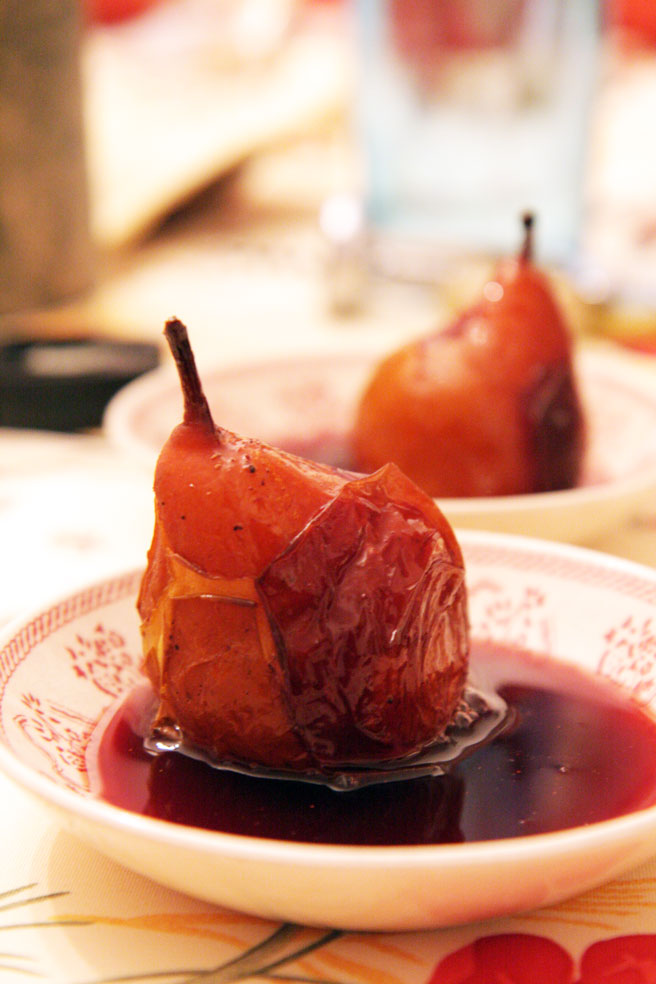
Christmas made easy: Winter pears simmered in wine, served after a simple meal with gathered family. While we still have a few days 'till Christmas, we want to rev up the holiday now! This is an easy dessert to put together one afternoon and put aside to chill, soaking in their syrup. Choose pears that mature in the winter for this recipe, like Bosc. This recipe fills the house with the perfume of the holiday, so now is the perfect time. They cost pennies a person. No special shopping for this recipe. The hardest thing is washing the pears. With poached pears, simple is best. Adding long lists of ingredients may add a strange je ne sais quoi, but that's not what we look for in our poached pears. These are a kind of gift from heaven, so simple, delicious, and satisfying.

Poires au Vin

6 pears, Martin Sec or Bosc
1 1/2 cups red wine, any kind you have
3 tablespoons sugar
1 teaspoon cinnamon

About the pears: Right now in France we have the winter pear called Martin Sec, which is a wonderful cooking pear, because their texture and flavor when cooked stays firm, smooth and sweet. They retain their body when simmered in anything from caramel to wine. If you don't have Martin Sec, a Bosc is perfect.

Wash the pears thoroughly. Nestle them into a pot that has a cover. Add the wine, and bring it to a boil. Mix the sugar and cinnamon together, and sprinkle it over the pears in their bubbling wine. Let that roll at a full boil for 4 minutes, then top off with water to cover the pears by 2/3. Bring to a boil again and reduce the heat to low and simmer, covered, for 15 minutes. Remove from the heat, let cool to room temperature, then refrigerate, in their liquid, for as long as 3 days. Serve cold, with their syrup. You can make a batch of these and have them on hand as a dessert choice at family gatherings.

This is going to be a very cheesy Christmas! Everybody thought the same thing and brought cheeses this year! I gathered some from the Alps and the Lyonnais region, and presented them to Brigitte. This was when I heard that Aude and Seb had done the same thing with cheeses from the Auvergne! This means the cheese plate is going to be the best it has ever been, I think.

Labels: , ,


Share/Bookmark

Monday, December 15, 2008

Menu for Hope V : a Paris Map dated 1937.

You may remember last year's charitable fund drive to feed children school lunches in Lesotho. This year, we're doing it again! In this project, administered by the Word Food Program, all proceeds will go a school lunch program for a community in Lesotho, Africa. Pim sent a box of disposible cameras to the community and asked them to take pictures themselves. Go to her blog and look again at these beautiful photographs, friends. They are are simply stunning and I will say again that they add a face and a real story to our holiday charitable giving.

The genius in this event is that not only can you give to keep these children fed at school, but you can also win prizes! In a nutshell, each $10 donation puts you in the running to win the prize of your choice, from a whole list of great ones donated by chefs, foodbloggers, and food professionals around the world. Think of each $10 you donate as a ticket to win. You choose the prizes! Winners will be announced on January 9th. To see all of the prizes worldwide, see Pim's global list, and to see the prizes donated by European food bloggers, go to see Sara of Ms. Adventures in Italy, our regional host this year.

So what will be the prize this year? A special map. While cleaning out the secretary, I found an old map, folded behind a drawer, from the year 1937. I knew immediately that this would make a great prize for the Menu for Hope raffle this year.


Prize No. EU19 - Shipped Anywhere in the World

Prize no. EU19: This old map of Paris, dated 1937, features miniature illustrations of the great monuments of Paris as markers, and on the reverse side, a map of Paris' outskirts, also with illustrations of the chateaux and places of interest surrounding the city. The dimensions are 75x55 cms landscape, and would make a striking and beautiful decorative piece floated in a frame, anywhere in your home. The problem is going to be deciding which side to display, frankly. About the map itself: It is one of the maps that were printed by Printemps for distribution to visitors to Paris for the 1937 Expo Internationale. Note in the upper left hand corner is a box explaining how to get to the Expo from Printemps. It has fold marks typical of an 80 year old map, frayed edges here and there, and a place along one corner that will need a bit of attention while you mount it, but it is in surprisingly good condition for a map of its age. And did I say it is beautiful?


side A


side B

Note this map is printed on both front and back, so you will have to choose which side to display.


To bid on this prize or any of the others, go to the Menu for Hope 5 Firstgiving website and click to bid! Make sure to put the prize no. EU19 next to your bid(s) and use a valid email address, so they can contact you when you win!

Labels:


Share/Bookmark