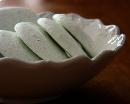
Prepared with pike, a freshwater fish traditionally plentiful in the lakes just north of Lyon with quality butter, milk, and eggs, quenelles are a rich and succulent offering on Lyon's regional list of specialties. A triumphant
quenelle Lyonnaise is going to have a firm consistency, but a certain lightness in its quality. It won’t taste heavy or floury, instead it should have an ethereal melt in your mouth deliciousness mingled with a hint of sustenance, consistency and richness. A successful quenelle will not resemble a soufflé or taste eggy. The quenelle is classified as charcuterie; those who are in the business of the quenelle indeed do sausage too. The ingredients found in the
quenelle de brochet of Lyon are all traditionally local, although today you may see the use of pike offered at market, commonly imported these days. The key word has always been and always will be 'fresh'.
The historical origins of the quenelle come from La Grande Cuisine, with differing theories as to its origins, one being that the name comes from German word
knodel, meaning dumpling, while other sources cite the Anglo-Saxon
knyll, which means to pound or grind, attributing it to the process applied to meats and fish used in this dish.
As to their really being Lyonnais, we can conclude from literature that quenelles in general didn't necessarily
originate in Lyon. Poultry quenelles are mentioned in a 1750 edition of the
Dictionaire des alimens, but no identification as a regional specialty is given. In the early 19th century
Cours Gastronomique, recipes for fish and various meat quenelles are quite similar in method to the modern dish, but again, they aren't specified as Lyonnais. There is no mention of Lyon in the work by Dubois and Bernard from the mid 1800s, which offers a series of recipes for quenelles.
The
quenelle Lyonnaise seems to have made its distinction at the end of the 19th century, when in the 1890 edition of the
Dictionaire universel de cuisine, a recipe for
Quenelles de poisson à la Lyonnaise incorporates fish, beef fat and bone marrow, specifying that what makes them Lyonnais is the particular juxtaposition of
maigre et graisse, or both lean and fat. Marrow seems popular for quenelles during that time. In edition no. 25 of the Parisian weekly Le Gourmet dated February 1894, there's a recipe for
quenelles de poisson (no mention of Lyon) that does not include pike in the list of suitable fish but does include the bone marrow.
In Mathieu Varille's
Cuisine Lyonnaise, first published in 1928, a descriptive recipe for "
la vraie quenelle Lyonnaise" is offered, meaning that perhaps there was some question about whether there was a real one or not. The proportions match exactly those of Escoffier's published recipe for "
godiveau lyonnais ou farce de brochet à la graisse" using equal parts pike fish and a mixture of the fat from veal kidneys and beef bone marrow. He does not cite the source of his recipe.
In Lyon we are particularly attached to the use of pike fish in our quenelles, wherein the rest of France seems not much to care. La Mere Brazier, who opened her restaurant well before Varille wrote his history, quite sternly insisted that the only quenelle prepared in her kitchen would be made with pike, a tradition that has been strictly followed over time. It seems that pike, in essence, remains elemental in the soul of the Lyonnais quenelle.
Pike is a bony freshwater fish that was plentiful in ponds and lakes just north of Lyon at the beginning of the last century, and quite popular in Lyon at the time that recipes using this particular fish began to be identified with Lyon. In order to enjoy it fully, the Lyonnais traditionally pounded it and ran the meat through a fine sieve in order to remove the bones. The process of making a Lyonnais quenelle involved incorporating a
panade, a simple stiff chilled paste prepared with milk or water, butter, and flour into the pounded sieved fish.

Warm panade, having been cooked down two hours, ready for chilling
Some general French recipes may cite a choux paste as base, but the recipes specific to Lyon do not incorporate eggs into their initial panade, nor do they build on the dough. In Lyon it begins with the fish. The incorporation of eggs and butter for the
quenelle à la Lyonnaise comes at the end, before forming them and poaching them until firm. Some producers, notably in Bresse, use semolina instead of flour, and produce a stiffer paste that they allow to rest before poaching. In Lyon, plain wheat flour and an immediate poaching are the norm. Once poached, quenelles can be kept cold until their final last blast of heat by a number of means, in a typical French heavy covered dish on the stove top or in the oven, to be served plain, with a whole list of suitable sauces, butter, topped with cheese, however you like them.
The folks at the charcutier Au Petit Vatel prepare quenelles from a recipe developed in the early 1900s, with the original owner. One particular charcutier named Jules Légroz perfected his recipe for quenelles at a traiteur called Sauret in Lyon. The reputation for his quality product grew, and he formed relationships with local chefs, for example, the legendary Fernand Point, of the restaurant La Pyramide, in Vienne, 15 miles south of Lyon. He eventually opened Au Petit Vatel and sent his son Louis for his initial kitchen training (a 2 year stage) in the kitchen with the legendary chef. The young man returned to run Au Petit Vatel, which still exists on the corner of rue Corneille and rue de Sèze in the 6th arrondissement of Lyon. Louis Légroz was clear in his claim that his father invented the
quenelle Lyonnaise. Apparently chef Point was complicit in this bit of family lore. The business changed hands in the 1960s to M. Vaivrand, who continued using the original recipe and method, but invested in mixing equipment to allow the production of larger batches of quenelles. I spoke to Vaivrand's son, Michel, who owns the shop with his brother, Frank. Michel grew up making the quenelles, having learned the precise method from his father. Today he proudly counts himself as the producer of the original
quenelle Lyonnaise, but does not discount the authenticity of the others being produced at different establishments throughout the city. His production is perhaps 1500 quenelles a week, an artisan's work. In any case, the
quenelle Lyonnaise entered the public domain a long time ago.

Michel Vaivrand, the man who does the quenelles at Au Petit Vatel
Mr. Vaivrand invited me into his kitchen and he talked about quenelles from the perspective of a person that has lived and breathed them all of his life. First and foremost, he feels strongly about the quality of ingredients used. His main concern is that the ingredients are fresh: the fish, the eggs, the butter, everything must be completely fresh. He also stresses method, with a strong emphasis on keeping everything cold and timing just right.
I watched his daily ritual as he begins with around 14 pounds of chilled pounded and sieved fish, followed by the incorporation of a pre-chilled panade, something like a dozen bricks of cold hardened dough. This is a rather violent process, one that splattered me with bits of fish. He then added 90 cold eggs to the mix. His recipe is quite specific down to the callibration of his eggs. The butter is incorporated in the blink of an eye, it seems. No longer than 30 seconds, leaving little chunks of cold butter throughout. He points these out and emphasizes that this is one of the little secrets to a good quenelle (hmm, can we see the
maigre et graisse coming through here?). The incorporation of more eggs is done by feel, taking into consideration variables like the day’s weather, the quality of the fish, the consistency of the mix, little by little but rapid and concise at the same time, arriving at a final result that he deems correct within a minute or two. Timing and cadence is clear in his method. It is of the utmost importance.

A large mixer indeed. Note the dots of butter.
The final quenelles are formed and put directly into a salted water bath. It simmers at a carefully controlled 90 degrees celcius, where the quenelles initially sink, then float to the top and continue poaching, carefully turned and tended to until M. Vaivrand decides, by a touch test, that they are adequately firm. He then transfers them to a cold water bath that softly agitates and cools them. Once they are cool, they are ready to go into cold storage and to be placed in the display cases, to be sold within the next day or two.
Although Au Petit Vatel supplies to a number of restaurants, their main source of business remains the walk-in customer. A faithful local clientèle consists of the bulk of their business. Indeed when I arrived in the morning there was a line 4 ahead of me and two behind before I was graciously ushered behind the counter and back into their maze of kitchens. Mr. Vaivrand notes that his quenelle resides firmly at the heart of Lyon's childhood memories. Au Petit Vatel is a destination for many expatriated Lyonnais, who make the requisite stop to his shop when home just for a supply of quenelles to take with them. He also does some mail order to certain special clients pining for home, although he admits that is quite rare, due to the cost of cold shipping. He has an annual wave of faithful ski vacationers who make a ritual of picking up quenelles at his shop to enjoy while on vacation. But the rest are regular gones from the 'hood who know a good thing when they taste it.
Mr. Vaivrand of Au Petit Vatel sent me home with two quenelles that he formed à la cuillère before my eyes. I cooked them simply at home and served them with a simple garnish of
beurre d’écrevisses. That's crayfish infused butter, something also coming from his kitchens. It's prepared by slow cooking whole pounded crayfish, shells and all, in butter for seven hours before clarifying it with a special process, leaving the butter infused with a simple clear note of flavor. At this point, I believe. This is
la vraie quenelle Lyonnaise.
 Au Petit Vatel
1, rue Pierre Corneille (on the corner with rue de Seze)
69006 Lyon, France
04 78 52 11 45
Labels: La Cuisine Lyonnaise, Lyon Bonnes Adresses, Lyonnais Specialties