Monday, August 06, 2007

Man in Kitchen - Blanquette de Lotte


After a mysterious trip to the market by himself, he kicked me out of the kitchen and took a long time there. That's perfectly fine with me, I thought, my feet up, snacking on peanuts and watching an artfully dubbed American policier at the end of the day. I caught a whiff of the lovely fish stew, and the fact that it took so long gave me a hint. There are very few fish that we can simmer and stew. Monkfish is one. My feelers say it costs near €30 a kilo, for the good tail part. If you only buy a little bit, it doesn't destroy the budget.

He graciously shares the recipe he used, from his cookbook, Francoise Bergaud's Mon Bouquin de Cuisine (divided for two, adapted and translated below):


Blanquette de Lotte

For 2 gourmands:

300 grams of monkfish tail in one piece along with with 150 grams of the bones of white fish like sole or halibut, provided by your fishmonger (for free, we hope!)
2 1/2 cups of water
1/2 cup dry white wine
1 small leek, green parts removed, sliced thin
1 carrot
1/2 an onion
1 clove
1 bouquet garni
30 grams or three tablespoons of butter
100 grams or three ounces of fresh mushrooms in season
2 teaspoons flour
an egg yolk
1/3 cup creme fraiche or whipping cream
1/2 a lemon
salt and pepper

Wash the leeks and cut the carrots into thin strips (the recipe says to grate them but Loic julienned them and they were very pretty that way), peel the onion and pierce it with a clove, and wash the fish bones.

Prepare a fumet: Heat 1 tablespoon of the butter in a pot, add the carrots and leeks, and cook them carefully without browning them, until they begin to soften. Add the fish bones, the clove pierced onion, the bouquet garni, the white wine, and 2 cups of water; add pepper, but don't add salt because the fish stock should reduce; cover and simmer for 15 minutes.

At the end of the 15 minutes, cut the monk fish into big chunks; heat another tablespoon of the butter in a large pot and add them once the butter is hot to just cook them on the outside, without browning them.

Remove the fish bones, onion, and bouquet garni from the fish stock. Season the fish stock, and put it in the pot with the monkfish, bring to a boil, lower the heat, cover, and let cook for 8 minutes: the monk fish has firm flesh that calls for longer cooking than other fish.

During this time, squeeze 1/2 of the lemon, and mix it in a cup with the egg yolk and creme. Set aside.

Wash the mushrooms and sprinkle with the rest of the lemon juice. Heat the mushrooms with a little bit of butter until they start giving off liquid. Simmer them carefully in their own juice without browning them until they soften. Add them to the monk fish.

At the end of the cooking time of the monk fish, add the flour to the remaining butter by crushing it in and creating a paste, add to the monkfish and mushroom cooking liquid, whisk carefully to incorporate it. Bring it back to a boil. Remove from heat and incorporate the lemon and cream. (he added some leftover new potatoes at the end)

Turn it into a serving dish and serve it immediately.

This dish keeps well for a couple of days in the refrigerator or can be frozen.

Labels: ,


Share/Bookmark

Saturday, February 24, 2007

Snail Butter - Beurre d'Escargots


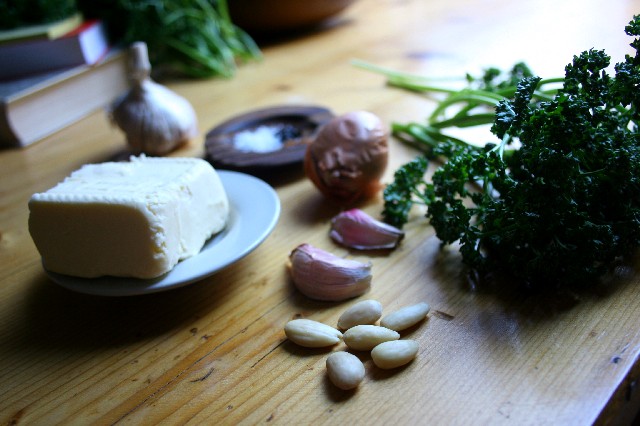
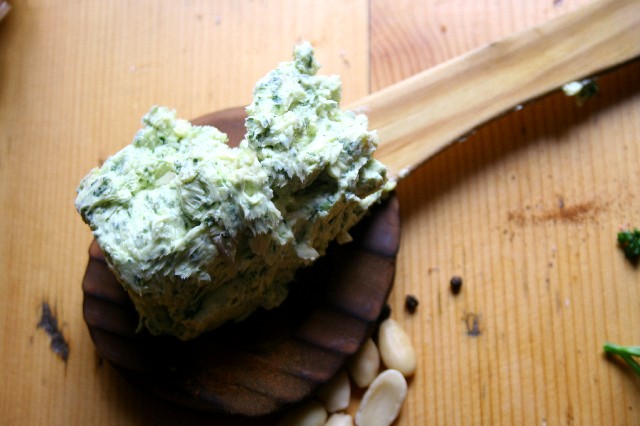
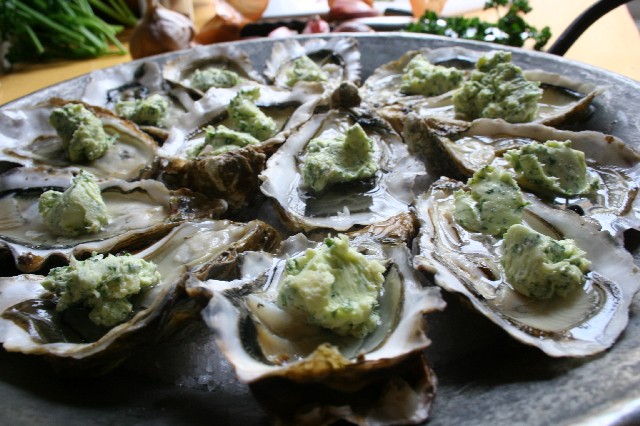
In Burgundy they eat their snails swimming in delicious garlicky parsley butter, spearing them from their shells with cute two pronged forks made just for the purpose. But beurre d'escargots is not just for snails anymore, you know. It can be spread on warm crusty bread, a knob can be set to melt on a freshly seared steak, it can be spread on cod to be baked in papillote, melted over potatoes, and more. It keeps for weeks, if you don't find uses for it all at once, and it also freezes well. Today I made some to try out an idea for oysters.


Hum de dum dum...


The recipe I finally settled on over the years as my standard in fact comes from Paul Bocuse's cookbook La Cuisine du Marché. I initially had a rather blah feeling about this cookbook because some of the recipes say things like "garnish with sliced truffles and serve", and Lord knows only Kate can do that. Lets just say some of the recipes are not put into a realistic framework for the home kitchen, even for a French home kitchen, and the market is often missing those truffles! I wasn't too convinced at first that I could cook from his book as a companion to my common market excursions, although logically it seemed that the market he must have had in mind was one like St. Antoine. The method was bare bones as well. Not one photograph, no context given for anything, and no description about how to do anything. Just reminders and advice about ingredients, how to choose them, and proportions. In fact many of his recipes are missing oven temperatures or times of cooking. One day I realized that this book is actually Paul Bocuse's kitchen notebook, with information he compiled over many years, and like many of the best references, the content seems richer the more I learn. I started getting more and more from it, and it is now one of my first references when I'm curious about how to do something, because the proportions are always true.

His proportions for beurre d'escargots:

1 kilo of butter
20 grams coarse sea salt
1 gram of ground black pepper
a grating of nutmeg
50 grams crushed garlic
40 grams chopped shallots
50 grams almonds
100 grams finely chopped parsley

this translates to a reasonable amount as follows -

100 grams of butter (or a bit less than a stick)
2 grams of coarse sea salt or about 1/2 teaspoon
a grind of black pepper
a light grating of nutmeg
5 grams or about a clove of winter garlic (more if the garlic is fresh - use your judgement)
4 grams minced shallot or about 3/4 of a small shallot
5 grams of almonds or about 5 almonds
10 grams or the leaves from about 20 sprigs of healthy parsley, finely chopped

Crush the shallots, garlic, and almond with a mortar & pestle until smooth. Add the minced parsley and the lightly softened butter. Mix them well until it is a homogenous paste. Keep cool in a ceramic container.


Hey! Lets try it on some OYSTERS!


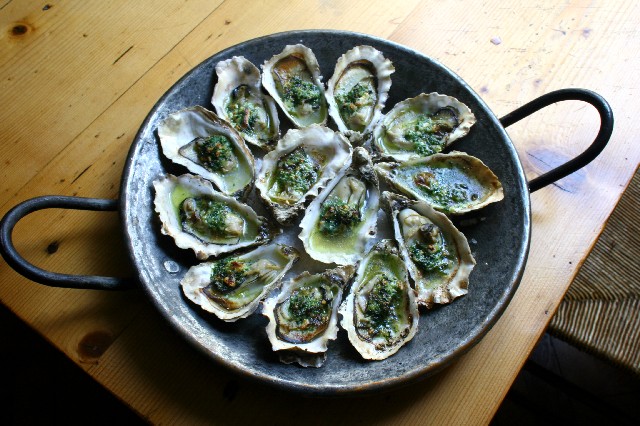
After about 7 minutes in a very hot oven.

Philippe Dupuis, Produceur-Ostréiculteur, always gives us 13 when we order a dozen. I always make sure Loic has the last one. We got into a heated discussion on the way home about the difference between the claires and the specials. We ate 6 no. 5s raw and then cooked the no. 3s. They were all delicious.
Just as we were finishing up the no. 5s I saw that I was not the only one inspired by oysters this morning.

Labels: , ,


Share/Bookmark

Friday, January 26, 2007

Top Secret Chocolat


What is Chocolate Nirvana and how is it achieved?

When I was going through a particularly turbulent adolescence in the early 1980s, my mother and I bonded over what she called "chocolate nirvana" in the front seat of her beige Ford Taurus station wagon. Like many mothers of teenagers, through my stilted life lens, she was one of those boringly dependable figures in my life who rarely ever revealed that she had any weaknesses at all, except through these little flashes that had hit us very rarely, over the years, like the sun through beveled glass. When I was going through the "crise", she took the old school approach – no comprehension between us. Mom has since allowed us to see the more human facets of her personality, and I appreciate her friendship now and love her in all of her complexity. But at the time, she was my perfect mother, and regretfully for everyone involved I was not.

The first time I was enlightened to her secret weakness for chocolate was much earlier, in the mountains. But just as I'd forgotten that snowy day in an onslaught of worries of cup sizes, makeup, tails dyed which shade of pink, how I was going to raise the cash for my next pair of pastel colored leggings, dozens of vacuume cleaner belts as bracelets, braces, and fine thin hair that just would not stand up on end without gasoline, she sprung another glinting hint at me at a traffic light somewhere near James street on the east side. She instructed me out of the blue that the idea was to fill your mouth to capacity with chocolate in order to completely overwhelm the senses in a wave of chocolate flavor. In a stupor I forgot to blame her for ignoring my weight loss attempts and was sucked into her instruction.

The goal was to weather the little crunching that came after the jaw had worked through a mouth stuffed completely with plain M&Ms, holding thin Ford Musgrove lips together in order to not God forbid let any M&M juice drool flow down our chins as we tried not to laugh. She had to pull the car over into the muddy slush on the shoulder after crossing under a railroad bridge to pull herself together, before merging back into the traffic. These little flashes gave me hope that she was human. At that time, in the dawn of my womanhood, plain M&Ms were just about the pinnacle of the chocolate experience available in the slushy salt-cracked streets of Syracuse New York.

Since that time, my relationship with my mother has grown, and so has my understanding of her love of chocolate. I always try to bring her the best of the best now, she must enjoy it sparingly for health reasons, and she eats it pure. We have enjoyed chocolate together from just about every country it is produced.

There is eating chocolate, and there is cooking chocolate. I didn't really get it until I came to France, and realized that all of the best tasting home cooked chocolate recipes from the French specified chocolate with the lower percentages.

Why? How can you get a better tasting fondant au chocolat, cake, mousse, etc. from a chocolate containing a lower percentage of cocoa? How can the cocoa content affect the end consistency of a dessert? I dove right into cooking home desserts here in France and by sheer empirical experience had every reason to maintain a die hard faith in the "dessert" chocolates, especially formulated for cooking. It is not just a marketing ploy. I have tried all grades, and have concluded from experience that it is a shame to waste the eating chocolate for cooking. Using haute gamme chocolate usually ends up with dense heavy results, and the flavor balance of many baked desserts is lost by using it. "Dessert chocolate" melts better, makes a more stable ganache, and its flavor comes through betterwith melting and cooking. It makes a better tasting sauce. People choose chocolate with a cocoa percentage of 60-65 percent for the best cooked chocolate desserts. If you don't believe me, conduct a test, and get back to me.

I have done tests with all of the common cooking chocolates available to me here in France. The winner on all counts comes from a company called Ethiquable, and is a product of equitable commerce, coming from the Dominican Republic. But that’s just a bonus. In my opinion, this is the best dessert chocolate available. If you live in Lyon, you can purchase it from the equitable commerce shops, one upstairs at the bookstore “Raconte Moi La Terre”, at the Ethiquable Gourmande shop at la Halle Martiniere, etc.


There are those recipes that you transmit immediately without hesitation to all of your friends, and there are the recipes that you hold like an ace in the sleeve. There are recipes that project such classic beauty that everyone assumes they have the personality of a historical figure, difficult and complicated. When you bring a beautiful classic dessert to the table, and your guests have no idea how simple it was to prepare, do you do need to make an effort to hammer in just how simple it is? With profiteroles au chocolat, I do not feel that need. I bask in the glory of their deceptive simplicity.

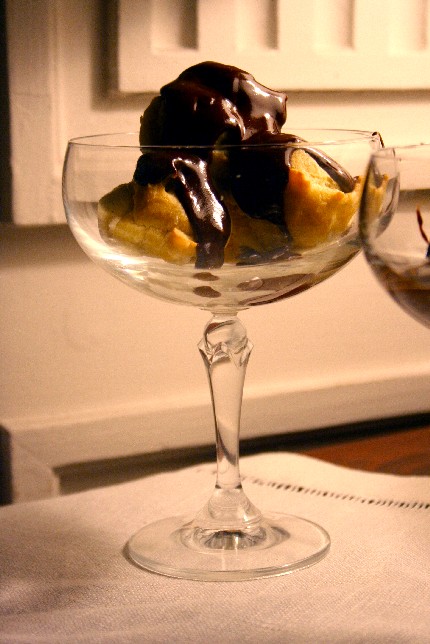
Home-made profiteroles au chocolat. This dessert is not about chocolate overload, it is about choosing the absolute perfect setting to leverage the taste of chocolate to the hilt by presenting it just so. There is a reason why they call this dessert profiteroles au chocolat and not "ice cream stuffed choux pastry served with sauce". The reason is that this dish begins visually and virtually with chocolate, takes you on a tactile journey right on through, starting and finishing with it on the palate, stating it's theme and summary in the perfect words, rebelling against it for a moment with convincing sumptuousness, and telling us in plain words finalement that this dessert is, as the spoon scrapes the dish, once and for all, about chocolate.

Profiteroles au Chocolat
(serves 4)

Profiteroles au chocolat can be whipped up in the course of dinner preparations very easily. The recipe is not fussy in the least, there is nothing to master, nothing to worry about, and it takes very little time. You can make the choux paste in 5 minutes and work on other things as they puff up into golden pouches, let them cool while you prepare and serve dinner, fill them with ice cream just before serving, and have them on the table in the blink of an eye.

Make the choux paste. This is the exact same recipe as gougères, without the savory spices and cheese. On the evening you plan to serve them, as a first task before getting dinner started, get these in the oven. It takes no more than a 5 minutes.

½ cup water
50 grams or 5 tablespoons of butter
¼ teaspoon salt
75 grams or 2/3 cup flour
a grate of fresh nutmeg
2 eggs

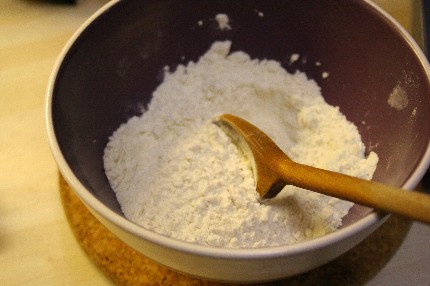
Mix the flour and nutmeg, and have it ready in a cup.

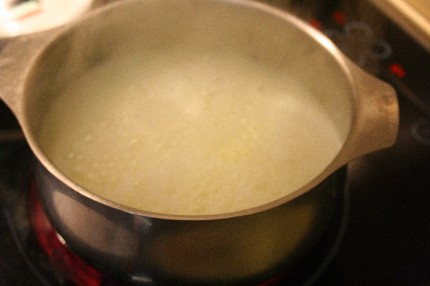
Put the butter and salt into the water and bring it to a rolling boil.

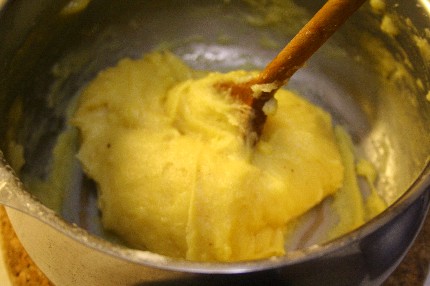
Add the flour all at once, and stir it briskly with a wooden spoon until the dough separates from the sides of the sauce pan.

Off heat, roughly stir in one egg in the same manner to incorporate it fully, and then the other.

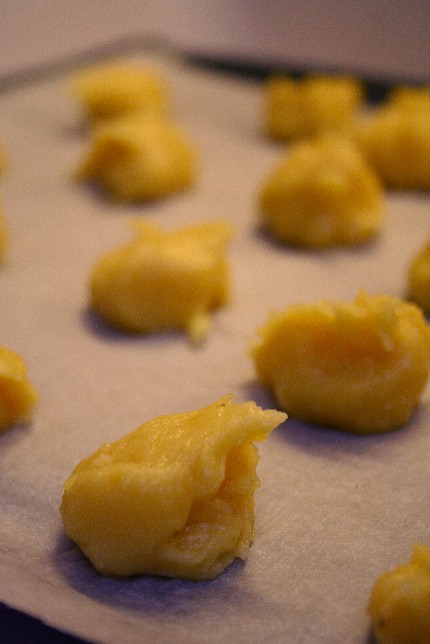
It is impossible to mess this up. Put the dough by teaspoonfuls onto a papered cookie sheet. Give them a little personality with the shapes, and the puffs will better take the chocolate sauce. Bake at 210C/400F until golden and puffed. Let the choux pastries cool enough to handle, slit a hole in the side of each one, and let fully cool.


Just before serving dessert, take 15 minutes to fill them with ice cream and make the chocolate sauce.

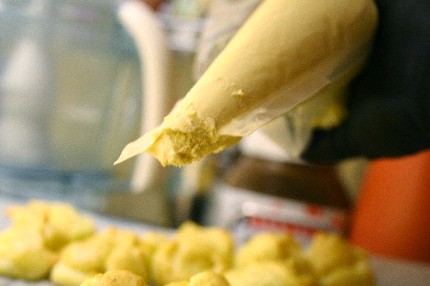
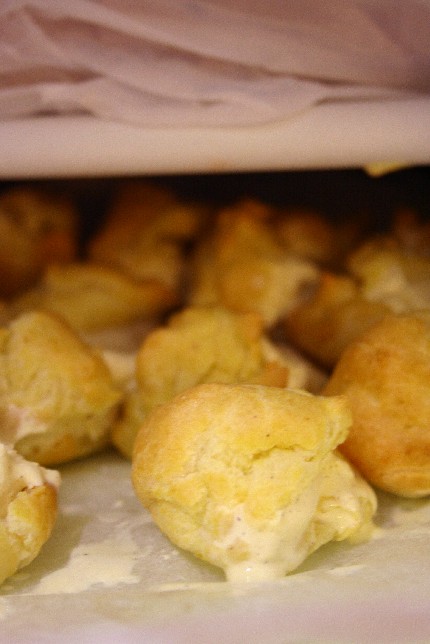
Use a disposable pastry bag or a ziplock with the corner cut off to pipe ice cream into each cooled puff. Cut the end rather large, small enough to fit into the end of the puff, but large enough to effectively squeeze them full of ice cream quickly.

Set them in the freezer to keep them from melting while you make the chocolate sauce:

1 200g. bar of dessert chocolate (60%)
¾ cup water
30 grams or 3 Tablespoons butter
1/3 cup whipping cream

Melt the chocolate along with ¾ cup water in a bowl suspended over simmering water, stirring from time to time. (you can fill the puffs while the chocolate is melting.) You do not need to hover over the chocolate, and you only need to stir it enough to mix the water and melted chocolate. When you are ready to serve dessert, remove the bowl from heat, whisk in the butter in, and add the cream. If the sauce thickens more than you like, add a few tablespoons of water and return to the heat to liquify.

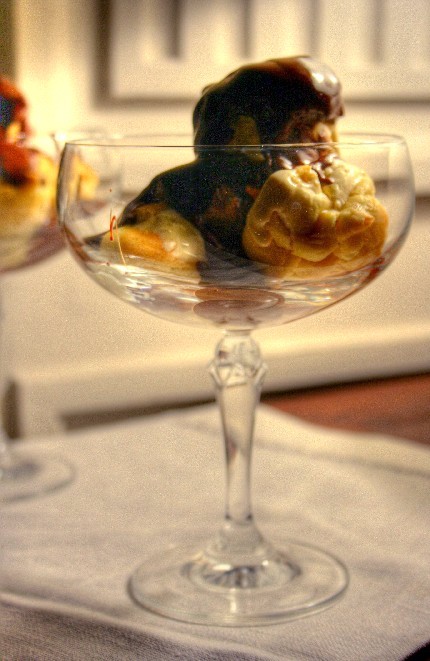
Put the ice cream filled cream puffs into dessert dishes, and spoon the hot steaming chocolate sauce over them. Serve immediately.


This post was written for Sugar High Friday, a monthly blogging event in which bloggers, given that they can pull their act together in time to do so, produce a dessert following a group theme. This month's Sugar High Friday desserts around the theme "Chocolate by Brand!"

Labels: ,


Share/Bookmark

Sunday, January 21, 2007

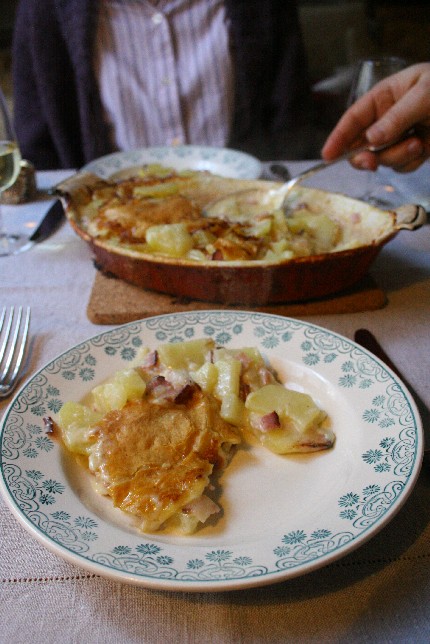
Sunday's Tartiflette


In the past few weeks I have been looking through the recipes I gathered through the first winter as a newlywed here in France in my first Kitchen Notebook. There are some real oldies but goodies that we go back to every year. Recipe number 18 is one such recipe, an absolutely delicious potato dish that uses a specific cheese from the Savoie region, the Reblochon.

At the ski and hiking station towns in the Alps, especially when there’s a snow problem like we have this year, you'll find would-be skiers wandering through the ski stations looking for something to do. This year is bound to be a banner year for the local cheese co-op. We made a cheese pilgrammage to the town of Thones which has a Reblochon creamery, with more description of the co-op there.

The ski town co-ops are usually found in the heart of the ski station or not far from it, and is the place where local farmers with troops of the right kinds of cows (Abondance, Tarine and Montbéliarde in the case of Reblochon) that have eaten the right kinds of things throughout the year bring their milk. Creamery produced Reblochon de Savoie produced on site is the Cooperative cheese you can find in these local shops. You can identify the creamery made cheese by the little red label on the cheese.

Reblochon de Savoie which has been produced directly on the farm from only one herd is marked with a green label. It is produced in much smaller lots, and can be more expensive. One of the main differences with this cheese is that the milk, being direct from the milking, is warm from the cow when the natural rennet is added. Most farms which are certified to produce Reblochon cheese from their single herd’s milk do it directly from their twice daily milkings, thus produce two small lots per day.

With creamery produced cheese, the milk that comes in from local farms is put together once daily and brought up to cow body temperature before they add the rennet, although like the farm produced cheese, it is not pasturized. Some farmers take some of their milk for farm production of Reblochon, and send the leftover to the co-op. Under both conditions, the milk comes from specially raised and fed cows with living conditions that are specified under the AOC.

Like most traditionally produced cheeses, the flavor of Reblochon cheese varies throughout the year. The cows for Reblochon producing herds eat herbs and grass in the open air throughout the warm months, and have a specially AOC controlled diet in the barn during winter.

The differences in flavor really depend various subtle differences in method between the cheese makers, located within strict geographical boundaries, but most of all the conditions during affinage. Your local fromagère can have a lot to do with how the taste develops.

Choosing farm-produced Reblochon will not necessarily give you a better flavor, but it may taste a bit different from the co-op cheese in the same town. The conditions for production are strict enough and so similar that both farm and creamery produced Reblochon have the same wonderful rich creamy tangy flavor redolent with the pastoral goodness we find so typical in this cheese, and the differences are sometimes not discernable. We never hesitate to stop at the co-op and buy lots of creamery Reblochon, because co-op produced cheese is still excellent, not to mention the price – about half of what it costs from the fromager in the city.

We serve Tartiflette in winter, with a salad and crusty French bread. This is truly a one dish meal, and it’s very easy to prepare.


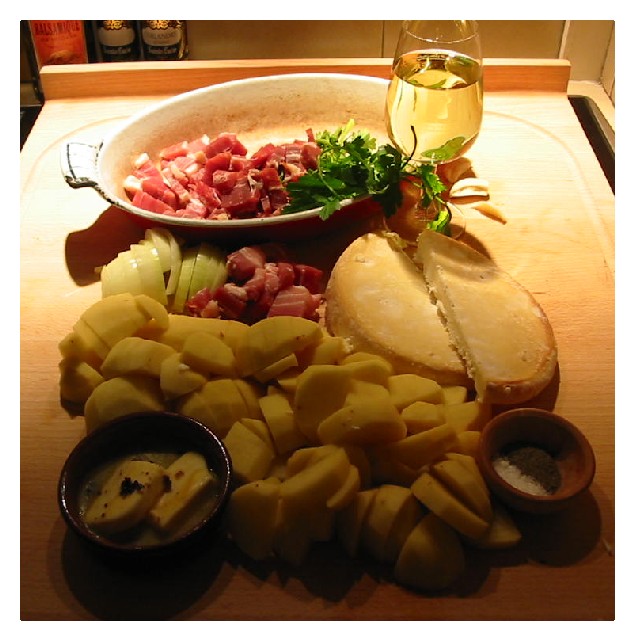
Tartiflette

Potatoes to fill a small gratin pan
1 medium onion
200 grams (6 ounces) of smoke and salt cured pork in any combination: poitrine fumé or the best smoked bacon you can find, smoked bacon plus salt cured Savoie ham or Southern style country cured ham. Just get what’s the best cured pork available to you.
1 clove garlic
2 tablespoons fat: butter or duck fat
Salt and pepper
1/3 cup crème fraiche epaisse or heavy whipping cream if you don't have creme fraiche
1/2 cup dry white Savoie type wine
1/2 of a Reblochon de Savoie
Fresh parsley


- Peel the potatoes and cut them into slices.
- Roughly chop the onion.
- Heat the duck fat in a heavy skillet and add the onions, bacon and ham, and sauté gently for 3-5 minutes.
- Add the potatoes and continue to sauté for 5 more minutes.
- Add the wine, give the potatoes a stir, cover, season with salt and pepper as desired, and let simmer and steam in the wine for 10 minutes more.
- Grease the gratin pan with duck fat, crush the garlic clove, and rub the garlic clove all over the inner surface of the pan.
- Reserve the remaining garlic for another use (the vinaigrette for the accompanying salad, for example).
- Add the crème fraiche to the potato onion bacon mixure, and transfer it to the gratin pan.

- Slice the Reblochon in half with a sharp knife flat wise, and place the two pieces on top of the potatoes, rind side up.


- Place into the very hot oven and bake for 10 minutes at 250C or 550F
- Turn the heat down to 200C / 400F and bake 10 more minutes
- Turn off the oven, and leave the dish in the oven without opening it for another 10 minutes.
- Serve hot with a salad, crusty bread, and the the wine you cooked with.

Labels: , ,


Share/Bookmark

Saturday, January 20, 2007

Blanquette de Veau ... for Bux


No dish is prepared with more tender simplicity than a Blanquette de Veau. It is French food to soothe and comfort palates of all ages. Slow simmered veal belly and sometimes the addition of lean shoulder meat is slowly simmered and served in its own sauce which has been thickened and enriched by simple classic means. The result brings us gently back to the present.

The real blanquette de veau is made from veal belly / breast meat only, but these days we also add lean meat, and sometimes mushrooms or onions. The skin, cartilage and bones from the belly cut gives this dish a special silky richness all its own. If your butcher cannot get you some veal belly, don't despair. Being slow simmered, whatever cut you use will turn out soft enough to melt in your mouth and the white sauce will remain very flavorful.

The Blanquette de Veau is recipe number 77 in my kitchen notebook, one I began to prepare for Loic during our first year of marriage. It the first of the many recipes that Brigitte, my mother in law, shared with me at her kitchen table.

Brigitte Durandeau Vanel's Blanquette de Veau

Poitrine de veau (veal belly), about a pound
Cubed lean veal shoulder, about a pound
1 glass of white wine
1 onion, peeled
2 cloves
1 French bay leaf
2 tablespoons of flour
4 to 8 tablespoons of butter
1 large lemon
sea salt and white pepper
optional finishing add-ins: mushrooms which have been simmered seperately, egg yolks (for the sauce), onions, pitted green olives, or sliced poultry quenelles (for an effect much like chicken & dumplings)

- Pierce the onion with the cloves, and place it along with the meat, the bay leaf, and salt and pepper into a heavy stewing pot.
- Add the wine, fill with water to cover, bring to a boil, lower the heat, and simmer for one hour.
- Remove the onion, cloves, and bay leaf.
- Put the flour in a small bowl with one ladle of the veal broth, and mix it so that no lumps remain. Incorporate it into the soup.
- Add the olives, simmered mushrooms, or slices of poultry quenelle at this time, and simmer for an additional 15 minutes.
- Strain off the sauce, and whip the butter into it piece by piece. Brighten the sauce with lemon juice, return it to the pot with the meat, and serve it over steamed potatoes or rice.

My thoughts go to the loved ones of friend Robert Buxbaum. May he rest in peace.

Labels: ,


Share/Bookmark

Thursday, November 16, 2006

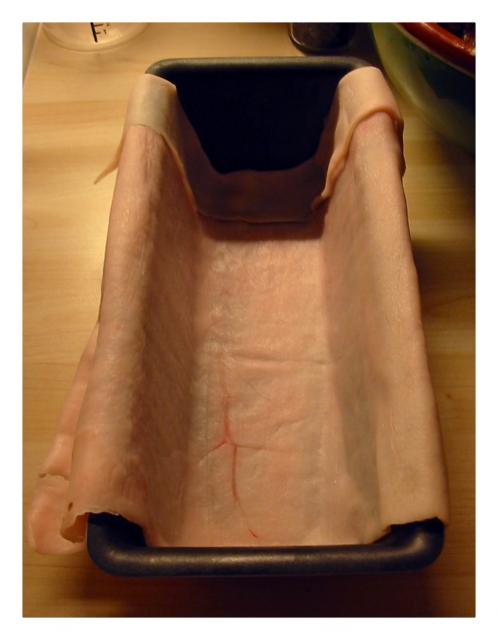
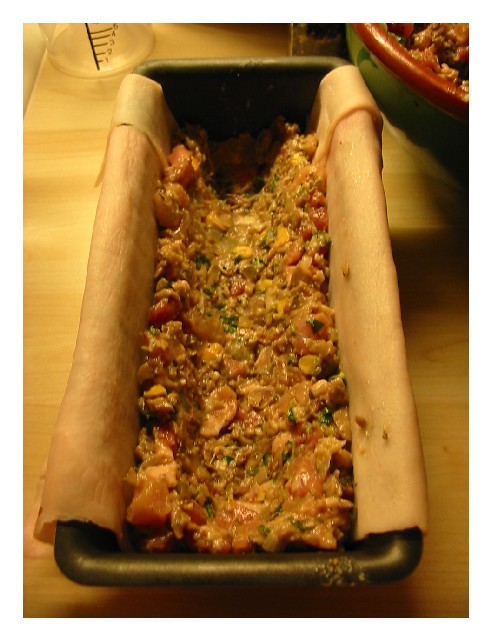
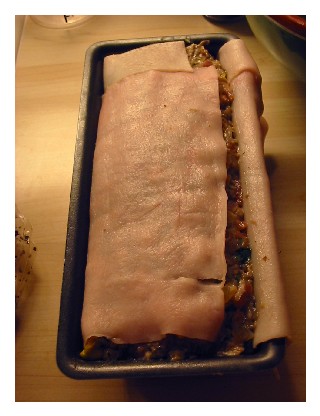
Terrine Notes - Terrine de Lapin

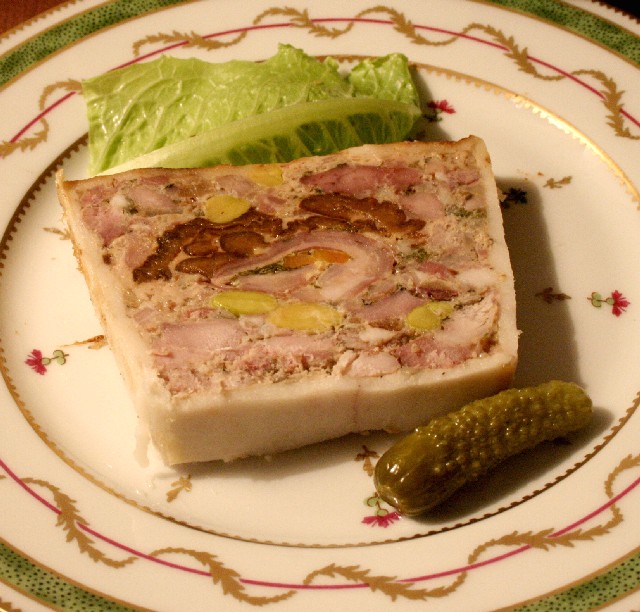
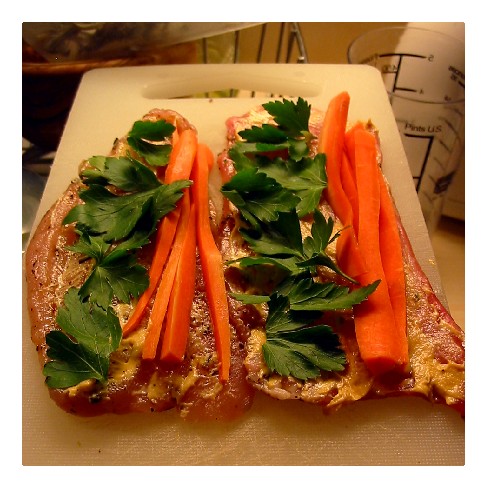
My house rabbit terrine, which incorperates a layer of dried prunes for color and flavor. Rolling the flattened haunch with a mixture of carrots and herbs makes a flower design in the middle.

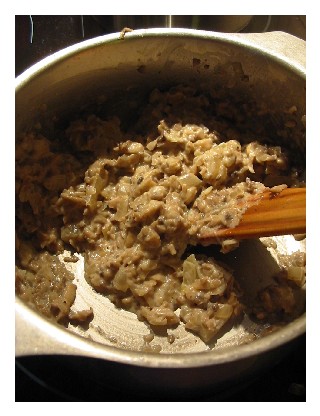
With Thanksgiving coming up, I thought I'd bring out some old notes on the terrine making. Sometimes it helps to visualize some of the steps in my mind. I have done terrines with rabbit, a mix of farm raised rabbit and wild rabbit, and various other poultry. I started terrine-making with Richard Olney's recipe in his book Simple French Food, and have made my own tweaks and changes over time, the main difference being that I include duxelles, which is mushrooms that have been cooked down and combined with cream, in addition to a rabbit demi-glace panade, which is made by crushing old bread and garlic and working the demiglace into it to make a paste. We serve a slice of a house terrine as a first course at the Thanksgiving table. Since we have a large number of French guests every year, we like to start off with simple courses to ease the group into the concept of the big feast. The courses are an interesting and entertaining way to kick off the meal.

A terrine is done completely in advance, and should sit in the fridge after weighing down the top for at least 5 days before cutting. It's perfect for Thanksgiving because you can have it done well in advance and not even worry about it until the day of the meal, yet it is really elegant. I like to cut my terrine slices the morning before the meal, because slicing 16 pretty slices of a terrine takes some attention to detail.

Terrine des deux lapins (a mix of wild and farm raised) from last year's Thanksgiving meal. Instead of prunes, I used dried mirabelles, which tasted great with the wild game and also added to the flower motif in the center. Click the photo for a closer look.


This year I am going to make a two duck terrine, using colvert and farm raised duck, and perhaps dried figs instead of dried mirabelles.

Labels: , ,


Share/Bookmark

Friday, October 27, 2006

The Duck Neck Dish


This dish is like one big juicy fresh duck crackling cornucopia cradling even more goodness - its soothing decadence transports us and we are shocked back to the present with healthy peppery rocket. It is listed under MUSTS in my kitchen notebook, good in every single way. If I could, I would call this a Lyonnais dish. But it comes from a man in Paris.

When we first moved to France, I was really happy that Aude was passing along monthly issues of the Saveurs magazine to me. The recipes were my first French lessons. I would study them fastidiously with a dictionary. The thing about Saveurs recipes is that they are often from chefs, who like chef M in the cooking class, don't like to really be pinned down too much on ingredients and measurements, and sometimes won't mention a step while they’re doing it. With Saveurs magazine, what we've got to go on is a super styled finished photo of our goal, and sort of a quick rundown on how to execute it.

The recipes are for the people who know what's what in the kitchen, and a lot of slang words for ingredients and measurements are used as well. I remember getting so exasperated with Loïc when I ran across an ingredient I couldn't translate and he said he had absolutely no idea what they were talking about. "These people are crazy" he said. "How am I supposed to know what that is?" he’d say, scratching his head in his scientific way. There was one ingredient standing in the way of me making a certain soup and he wouldn't tell me what it was! I thought he was doing it on purpose and it got me in the fightin’ mood!

Those days are over and over the years the Saveurs magazine and I have come to a kind of detente. I don't ask more of Saveurs than they can give, and they give in their way. I understand. I look for inspiration, and you bet that magazine has lots to give, and with experience in the kitchen and a little bit of ingenuity, I have learned to fill in the blanks. For this recipe, the incredible combination of rocket and crispy browned duck skin is the jewel to be gleaned. In recounting this recipe, I am adding the American measurements and my notes and instructions.

Cous de canard farcis au risotto de roquette – Arugula Risotto Stuffed Duck Necks , a loose adaption from a recipe in edition no. 150 of Saveurs Magazine, by Jean-François Mallet

4 duck necks, whole, not deboned yet
2T. coarse sea salt
2 legs duck confit
1 egg
200g. or about ¾ cup Arborio rice (for risotto)
2 shallots
15 cl or one small glass of white wine, any kind
150 grams or about 1 quart loosely packed fresh leaves of rocket (arugula)
80 grams or about 1/3 cup of grated parmesean cheese
salt & pepper

About Rocket: aka arugula, or roquette in French, comes in two different forms, wild and cultivated. The wild leaves have more flavor. Either one will do for this recipe and its presentation. Here in Lyon, we have a choice between shipped in from Italy, and locally grown and sold at the market. I have tasted both side by side for this recipe, and will recommend that in addition to paying less for the local, it tastes better too. While the imported version sizzles and pops like a sparkler, reminding us of it's name, the local version's peppery burst explodes on the palate like a healthy burst of sun and warms us from the inside out. Try and get some local rocket for this dish, it takes it to that higher plane. Everyone at the market should have it this time of year.


About confit: This is duck or goose cooked over a period of several hours immersed in its own fat. The result is succulentand moist slow cooked meat, that can be canned and put up for several months. The longer a meat that has been put up by this process is stored, the better it tastes. In fact, canned confit, the kind you can buy in the store, can be excellent indeed – it has had the time to age and do it’s magic in an airtight environment. You can prepare a confit yourself, and store it for occasions such as this. Your product, having been prepared carefully and lovingly at home, will taste even better than excellent indeed. If you do decide to prepare a confit just in time for this recipe, it won’t be as moist and succulent as one which has been in storage for awhile.

- De-bone the duck necks, following my instructions. Liberally sprinkle the outside of the neck skin with salt and place in the refrigerator (can be done up to 48 hours in advance). Remove and discard the esophagus tubes and any glands, and put the neck meat and bones into a stock pot. Cover with water. Bring to a boil and reduce heat, as you would any poultry stock, and let the stock simmer for 1 to 2 hours. An idea for this would be to debone the necks and set the stock to cook in the afternoon, if you plan to serve this dish for dinner, and let it simmer very slowly throughout the afternoon.

- Remove as much duck fat as possible from the duck legs confit, and set the fat aside for later use. Remove and mince the meat from the two legs, and place it in a large mixing bowl where you will mix the stuffing. Add the parmesean.


- Prepare the Risotto: Peel and mince the shallots. Melt 1 tablespoon of the fat from the confit and sauté the shallots without browning until they begin to turn translucent. Add the Arborio rice and stir to coat with the duck fat. Once the risotto begins to turn clear, add the white wine and let it absorb into the rice.


Ladle the duck stock directly into the risotto, filling it to just cover the rice, and let it cook without stirring it, absorbing the stock. After adding stock about 4 times, the risotto should be al dente, and you can season it with salt and pepper and remove it from the heat. Let it cool while you prepare the rocket.

- Wash the rocket and chop all but a couple of handfuls of it finely (the recipe says to do this in the mixer, but I don’t recommend it.), and add it to the bowl with the minced confit de canard, and the grated parmesan.


Add the risotto and mix them together, and season. This can be done in advance and refrigerated for later use.


The stuffing actually fills the necks better when it is chilled and somewhat stiff. The recipe says to chill it for 20 minutes, while 10 minutes in the freezer will do. Just before stuffing the necks, add the egg to the stuffing.

- Stuff the necks rather full with the stuffing.


One neck ready to go in the oven.
The question of whether to tie, sew, or otherwise fix the necks closed for cooking comes to mind, and many traditional recipes call for you to fix the pouch closed. My investigations indicate also that if you want the skin to stay taut and thin across the stuffing, you must fix it closed. However, if you simply fold the skin underneath at each end, the neck skin retracts and thickens with cooking, thus squeezing the stuffing out of the end that provides the least resistance. It makes a pretty overflowing cornucopia-like presentation this way, and the neck is juicier in the end. If you prefer to keep the skin thin and crispy, fix it closed, by either sewing it, using a skewer, toothpicks, or string to keep it closed. If you do this, the skin will be thinner. Your choice. Place the stuffed necks in a large ceramic or cast iron dish, giving each room to breathe, room for the heat to get at them from all sides and make them a nice golden brown.

- Salt the outside, and add the remaining duck fat from the confit to the pan, and bake, uncovered, for 30 minutes at 160C/350F. Baste the necks with the liberal amount of fat that is rendered by the neck skin every five minutes during this time. At the end of 30 minutes time, pour off the fat, sprinkle with grated parmesan, and turn up the heat to 200C/450F. Let it continue to brown and crispen on the outside to taste.

- Serve on hot plates with a fresh rocket salad, sprinkled with your choice of vinegar and seasoned with sea salt. There's no need to prepare a vinaigrette to go with the greens, they are just right as is with a little vinegar and salt.


I really loved the combination of the fresh rocket with the rich delicious taste of the duck and risotto. I think they were an excellent combination. Bravo!

Labels: ,


Share/Bookmark