

Tuesday, October 06, 2009

The Hunt


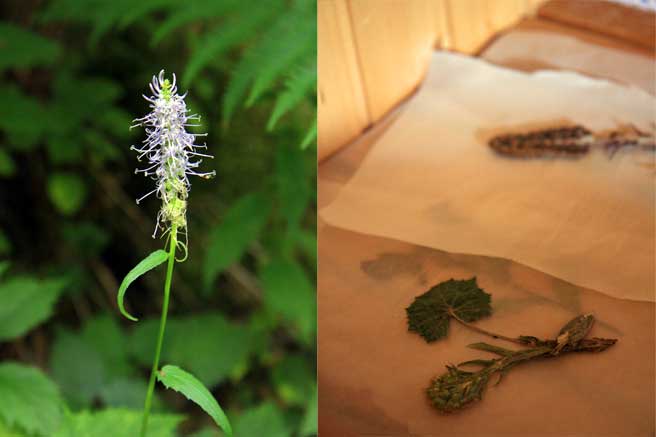
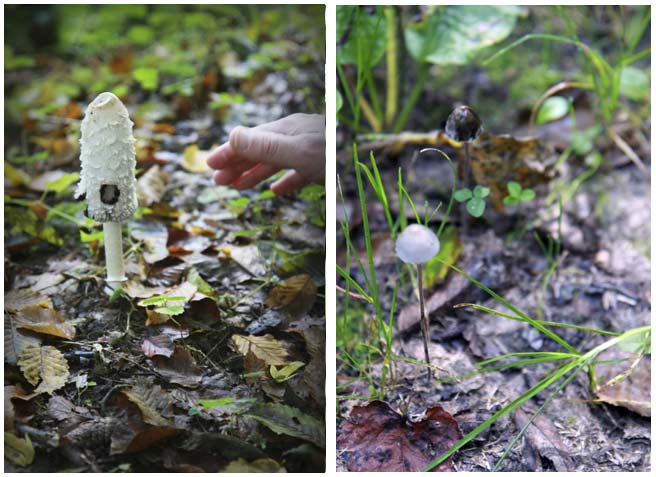
It has gotten to be somewhat of a passion. Creeping slowly through the forest, calling softly to one another, "Look!"   "That one!"  Then I rush up and take a picture.  Some people like bird watching, some identify wild herbs, species of ferns, animal tracks and trailings, rock formations, moss species, fishes in the streams or flowers. While it all fascinates me, we've both been curiously drawn to the wild mushrooms of Autumn.

In our way and at our pace, we've been learning about them little by little. I think the best part of hunting for mushrooms is tuning your vision to find them. It takes a lot of concentration. Look right under your feet and at the same time, learn to get a feel for the conditions that different mushrooms thrive in.  You might walk along saying to yourself, "oh how pretty, the first fallen oak leaves of autumn" but when you're out looking for mushrooms, you'll see those leaves on the ground and look up to locate the tree, then go find what might be growing in fairy rings at the bottom.


Water rushes around moss covered rocks.  Birds and chattering little creatures make up a kind of murmuring melody against the water sounds. But this is still punctuated by the pop and sharp echo of rifles firing in the distance, it being hunting season.  The sound pulls us back, pushes back the temptation to believe that we are in a wonderland all to ourselves. We stick to the loggers trails and don't venture too far into communal forests, especially if we haven't checked at the Mairie to see if a group has registered to hunt that day. It is not a free for all, you know. Hunting is highly regulated here. All the same, this is the time of year when early in the morning groups of men with serious looks on their faces can be seen along the roads near the small villages holding rifles, their silhouettes stirring up images from long past, echoes of another time. I expect game hunting must be great fun. But I've never seen a smiling hunter along the road. Perhaps this comes from what they've learned about handling rifles.


We could not help ourselves and we picked a bunch of mushrooms based on a hunch that they might be good to eat.  Alas, the guide book we have warns of one mortally poisonous mushroom that mimics another perfectly delectable one that's good to eat, so what's regular amateur to do?  In the end we didn't eat them.  There were plenty of other foraged things to eat, like the chestnuts and walnuts that right now are falling from the sky. Who knows, maybe the mushrooms were edible, but you know, since we now have certain responsibilities, we don't dare. I would not say that is a complete change from the past, just an extra little nod, of thanks even, a chance to expand our souls for an instant and remind ourselves just how lucky we are.


Recipe:  Chanterelles on Toast


1 handful of Chanterelles
2 tsp to 2 tablespoons butter, depending on the size of your handful
3 sprigs of flat leafed Parsley
1 small shallot
fleur de sel or salt to taste

Chanterelles, a wild mushroom that is found in October, are plentiful in some forests. If you can't find any, definitely do not pass these up at the market when they are fresh and clean.  Inspect them carefully. Pass over any with dark patches indicating they are saturated with water, mushrooms that are smeared with mud, or have excessive dirt and grime. Seek out the mushrooms that are in tact over fragments and pieces, which are more difficult to clean.

They are best cleaned with a paring knife and a brush, (a stiff watercolor brush works well for me) carefully removing stray dirt from the gills along the bottom with the brush and paring off the base and any hopelessly muddy spots at the top. You can dampen a paper towel and wipe the tops as well if needed. Soaking or rinsing these mushrooms in water is not a good idea since the chanterelle is spongy, unlike the black trumpet, which can be cleaned by a series of rinses.  Trying to clean chanterelles with water furthermore turns whatever soil might be on them to mud that gets trapped in the gills.  Try your best to avoid using water when washing your chanterelles.


Once your mushrooms are clean, pull them apart into uniform sized strips, and sautee them until golden in hot butter that has been graced with a sprinkling of fresh minced shallots. Add the parsley during the last few seconds in the pan, and transfer them directly to toast. Enjoy while hot! You might try these with a little glass of muscatel, good music, and some friends to get your evening started.

Labels: ,


Share/Bookmark

Friday, October 02, 2009

The Quiet Man on Saint Antoine


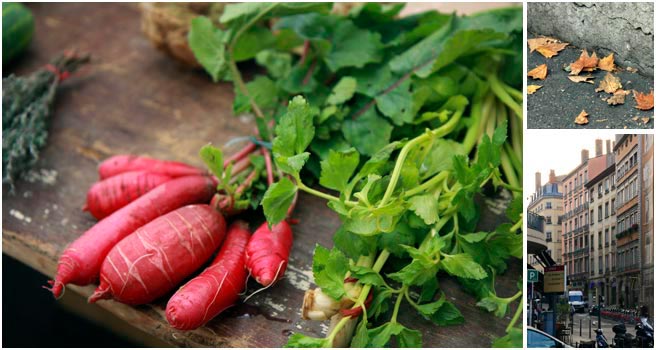
When you stroll the market in the city, look for bunches of crisp tender greens attached to the Autumn roots for sale.  They are the mark of the freshest produce.  There's one man along the riverside who places things thoughtfully down on his table, as if he wants to stay in harmony with that which nature has given him. Amongst the burgeoning splendor of crops on the move at this market, this zen kind of presentation can hit you quite squarely. He does not impose strict order on his table, nor does he make his activity seem like a daily grind of repetitive stacking and selling. He does not shout, pile things up or line up splendorous rows of the same thing over and over. He does not shine his goods with colored lights or erect red umbrellas to cast a rosy glow on everything. He lets the natural beauty of what comes from his garden speak like quiet poetry on an Autumn morning. A bunch of this, a group of that, a flourish, a swirl. Some wild things, some which he's planted in rows. Fifty-fifty him and nature. No matter what the pace we choose to profit from this labor, or how we present the fruit, it will continue to grow. I find that heartening.

Labels: , ,


Share/Bookmark

Monday, July 27, 2009

The Little Blue Bag and Salt Potatoes


It has been two summers since my last trip to Chaumont.
Pending a passport for baby Ian, it was all up in the air until the last minute, but we did end up boarding a plane at the beginning of July to cross the Atlantic. I spent my childhood summers in that little town, and when my father built the house there, it graduated from the place where my heart remained over icy winters to the place I now call home.

My mother embroidered each of our names on individual blue drawstring bags when I was a kid, to keep 5 children somewhat organized when we traveled. These bags, packed full, with their drawstrings pulled tight, were piled into the back of the car when we went to Nashville, and also when it was time to go up to the lake. Every summer, soon after school let out in June, we used to pack whatever personal belongings we thought we might need for a summer and head to Chaumont. It was a simple time, and looking back I realize we didn't need much. A little blue bag was really enough.

Our time was organized for the most part around work on the boat my father built. It always began with the children being charged with the big job of scrubbing the teak decks of Cambyration from stern to bowsprit with wire brushes before my father would oil them. Nearly every surface in and on the boat was oiled teak, so there was a lot of scrubbing to do. After that, my mother would do her work cleaning and organizing summer provisions down below, and we would carve out our territory for the summer. We each had our bunk which would change from year to year, depending on which straws were drawn and the varying negotiations that took place. The best spot to have was the v-berth. It was most like a regular cabin. It had a door that could close, and I could open the forward hatch and listen to the water lap against the hull while I watched the stars.

At the beginning of the summer when we were on deck scrubbing away, there was special kind of joy that came with that initial hard work. It was all in the idea that the whole summer was ahead of us. Sailing camp, always some time spent cruising lake Ontario and the St. Lawrence, and time spent with our summer friends. Every nook and cranny of the small town of Chaumont, New York was there to amble over and through, from the graveyard where I used to ponder the pretty old bottles left on the graves despite the sign forbidding them, to the quiet side roads off main street, where we learned the shortcuts and paths cut by generations of children before us.

Arrival in Chaumont meant getting used to the feel of the smooth quarried limestone at lake's edge on my bare feet. We relearned all the best paths during those first few weeks while our feet were still tender. Although the boat house and ship yards were full of sharp stones and surfaces, we still spent a significant amount of our time in bare feet. It was a matter of pride, after all. There were always smooth and rough places, as well as a perpetual puddle that was home to a gang of wasps that used to hang out in the same corner by the club, year after year. We stubbed our toes, stepped on bees and sometimes walked through places we shouldn't have, but that never stopped us going barefooted.

The limestone cliffs and stones had a way of retaining the sun's warmth in the evenings. Sometimes I think I can still feel their heat in my bones. Up through my teen years, nights meant stretching out on certain stones to stare at the night sky. There was one behind the pavilion, tilted just so at the water's edge that always was a favorite of mine. I will never forget the complex geography of the cliffs in the quarry. I had every single one memorized, and the first weeks at the lake, I would retrace my favorite paths, taking note in what the elements might have changed over that year's icy winter. The texture, the places where a child could climb, the footholds, the caves, the marshland, the fields and woods beyond down Independence Point, all like a map with endless detail. I had my favorite ledges to sit and survey the landscape once I got tired of climbing. My heart was full and soul replete revisiting these points one by one every summer.
A close friend of mine and I were corresponding recently, and she brought up the importance of having a place called home to return to, you know, after the childhood home is gone. A place apart from where our adult lives unfold. Her place is in Michigan, where she spent her childhood summers. She and her family drive out there from the East coast every summer now. They spend a couple of weeks in the log cabin that her great grandfather built, just as her mother, and her mother before her did.

This year, although I was thinking of summers past in Chaumont, I also found myself placing the details of these memories at a safe distance. It is hard to say why. In my mind's eye, it was like my childhood's delectable memories were like my little blue bag packed full, with the white string pulled tight. I was afraid to open it. It's almost as if I was saving myself a certain remorse. Now that I'm back home at my desk in France, I realize that going home with baby Ian brought out that blue bag, and it hovered there like an elephant in the room the whole trip. Opening up and delving into all those memories would remind me how far away France really is, I realize. I know that the little house we now go to in the Alps is most likely going to become the place my son Ian knows by heart. I experienced a vicarious joy watching my brother's children in Chaumont this year. Their relationship to the place is so similar to my own when I was their age. I hope their children will also know the beauty of the home my father built.

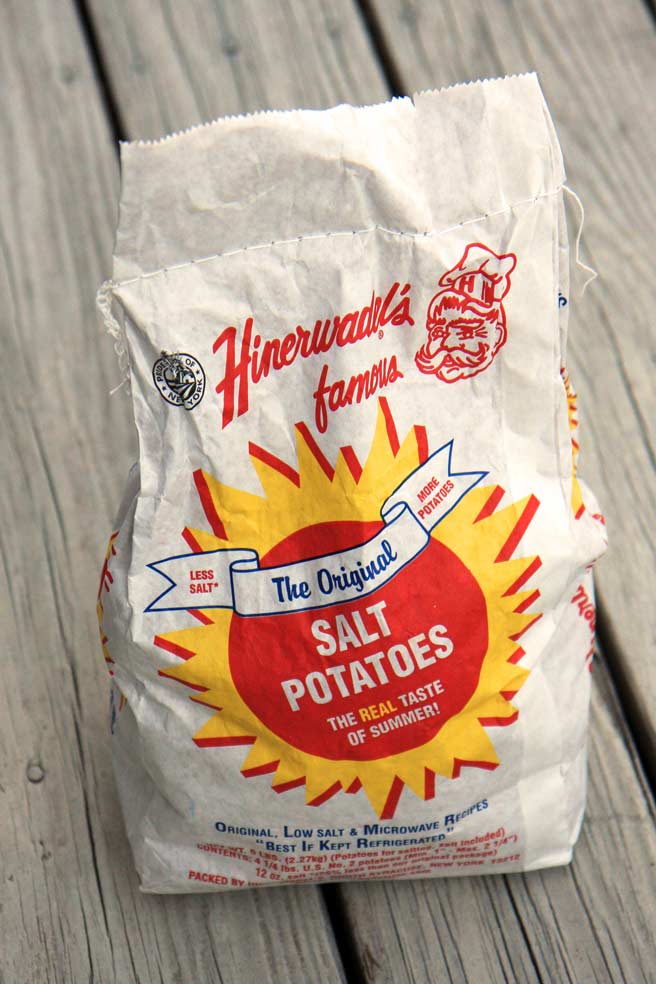
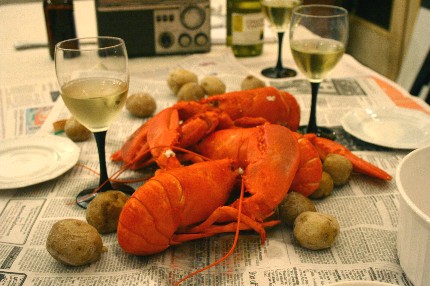
With that, I leave you with a simple recipe for Salt Potatoes, something I always fix right away when I get to Chaumont these days. I buy the bag with the salt even though I know it's not really necessary, mainly because there's a certain nostalgia in it. Salt potatoes originate in Syracuse, New York, the place I grew up. Syracuse was called the Salt City, because of the trade from the salt marshes there that was done on the Erie Canal. Laborers boiled potatoes in the salty brine from the marsh, creating what we now know as Salt Potatoes. I suppose the contemporary version is a bit sterile in comparison to what they enjoyed, but we love it nonetheless.

Salt Potatoes

5 pounds of new potatoes
1 cup salt
butter for dipping

Scrub the potatoes with a brush, but don't remove the skin. Dissolve the salt in a large pot of water, and add the potatoes. Bring this to a rolling boil, and continue to boil them in the brine until cooked through, 15 to 20 minutes. Check to see if they are done by pricking with a fork. Melt the butter and serve it in a little bowl alongside the potatoes. Salt Potatoes are served plain, part of simple family summer meals. Dressing them up in any way would spoil them.


(Photo from a previous trip to Chaumont)

Labels: ,


Share/Bookmark

Friday, June 26, 2009

Postcard: Le Temps des Cerises


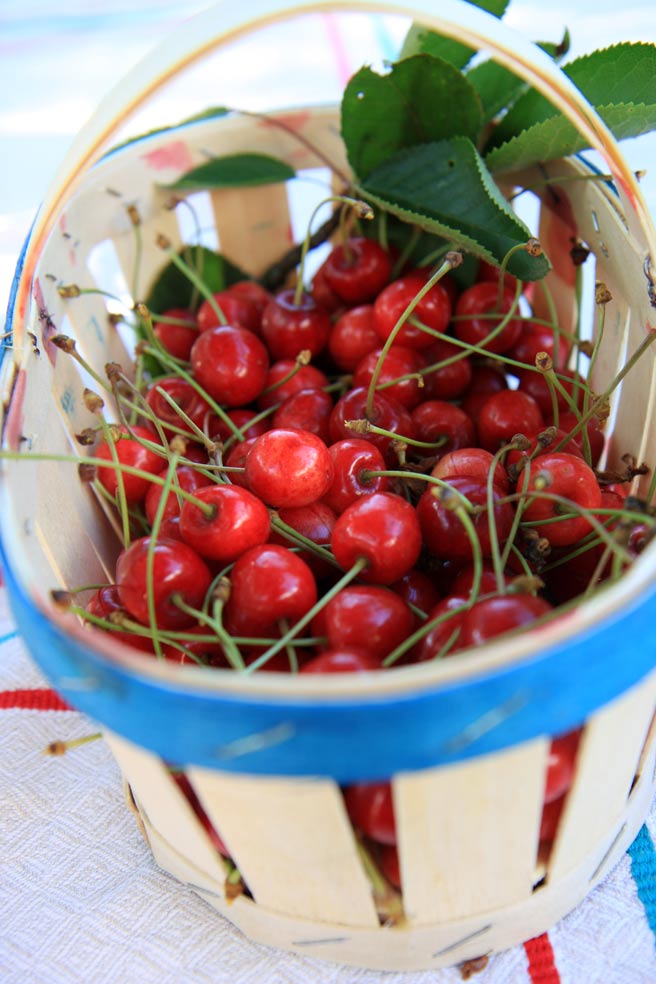
The cherries were unexpectedly sweet. One of the neighbors in the village said that the tree produced sour cherries, and there I was plotting out all the great things to do with them. Sour cherries are a treat indeed. I think he was imagining things, raided his neighbor's tree before they were ready, or in the end was just just trying to come across like he knew everything about everyone's gardens. These cherries are juicy and sweet. The skin is red, but inside the fruit pulp is clear, like a plum. I don't know what kind they are. The best way to find out is to take some to the market and ask the cherry vendors. Loic spent some time on a ladder over the weekend and could only pick from the lowest branches, this tree towers up about 50 feet high. It is an old tree and that's probably why it produced so much fruit. No wonder the birds aren't much interested in what I have been putting in the feeder lately! Nothing better to do with these cherries but to eat them straight up. Next year we will be better equipped for the harvest and I will cook and put them up.

Labels: ,


Share/Bookmark

Sunday, June 21, 2009

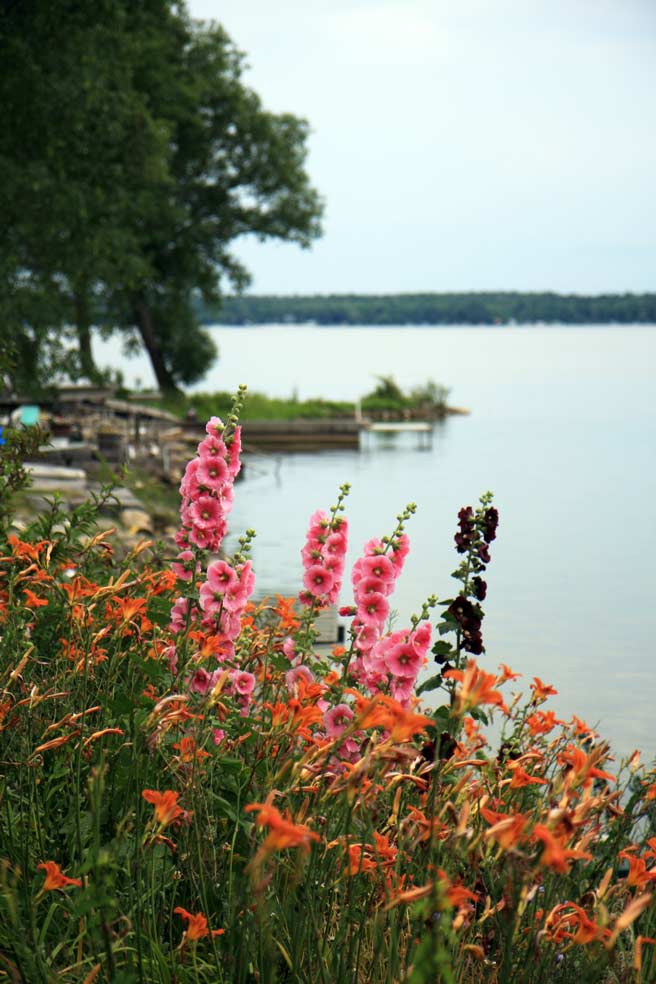
Postcard: Our Field of Flowers


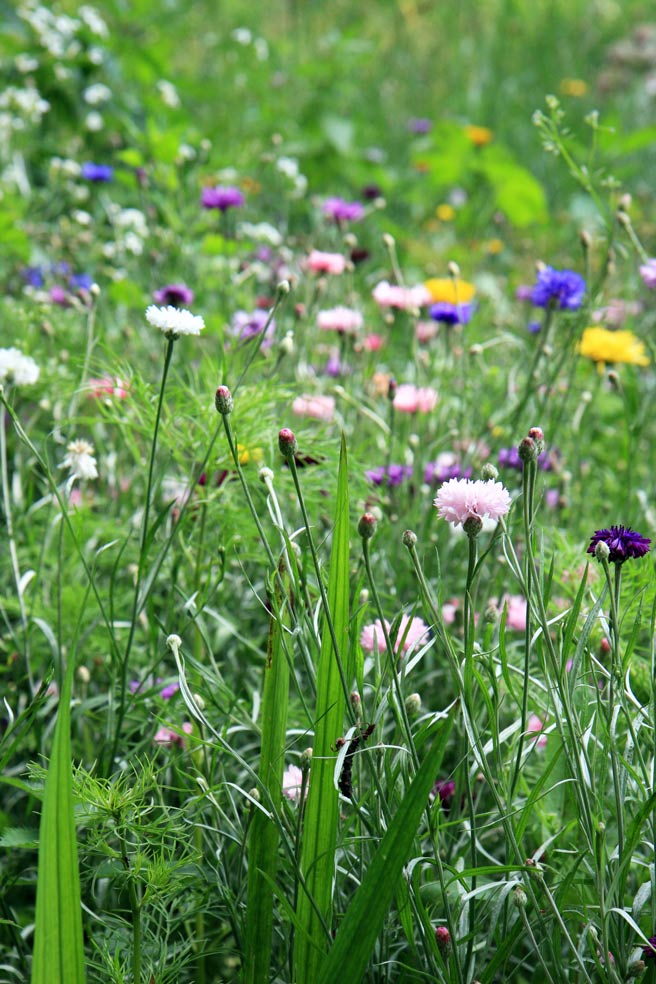
We planted this packet of seeds and this is the first wave of blossoms. It took awhile,
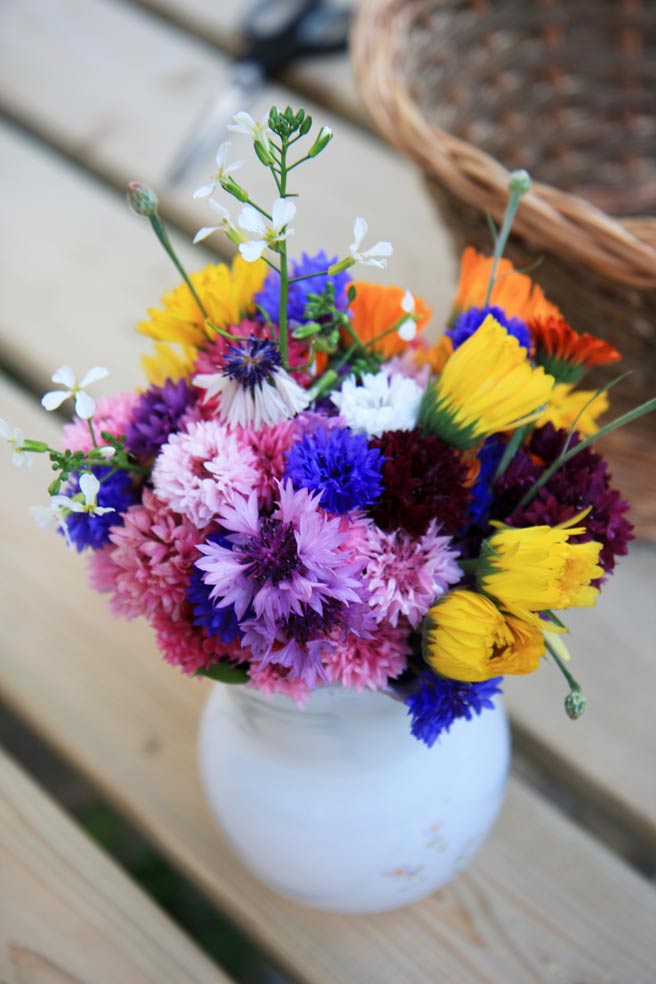
I'd say between spreading the seeds and the first blooming, 2 months. They should really get colorful at the end of July, early August. I also put a bunch of bulbs out but not sure which plants they are, everything is growing in one big tangle. I have completely forgotten even what the bulb flowers are supposed to look like. I do remember I thought they were pretty, and that they grow tall. During the planting, I had this packet of seeds for edible sprouts from the health food store, which contained all kinds of funky grasses, and sunflower seeds, removed from their hard shells. We have a few sunflowers towering up thanks to that mix. They say on the website for the field of flowers that you should cut as many as you can if you want to see them bloom longer. I dutifully took to the garden with my basket and a pair of scissors. It was the first time I have ever done something like that, although for some reason I felt like I'd done it forever. There's nothing like it, clipping the flowers you've grown from seeds yourself. I can tell you that the hardest part was pulling out all those nettles before planting the seeds. I am happy with the result so far.

Labels: , ,


Share/Bookmark

Monday, June 15, 2009

Super Mini Best of: Fraises des Bois


Walking up a forest path that wound its way up from a gorge and quickly enough arriving at some sunny open pasture land got me to thinking, during that week alone. Something about the way the land opens up above the tree line just sucks out the trivial thoughts and allows my mind to breathe. The incline, the one you work on before you arrive at the top is actually quite steep, but the path has been beaten in such a way that any reasonable person can handle it if they aren't in a hurry. One side of the path (the sunny side in the morning) runs along on your right side, sort of like one of those walls full of plants we see designed by artists in the city. The downhill side gives you the feeling you're surveying a kingdom of sorts. A dark deep world that plunges into the gorge to the river below, a chance to see the straight uprightness of the trees and contemplate their numbers. I have always been the sort to zoom in and find little microcosms along my way, when drawing, when writing, when observing. I think it comes from my love of miniatures. I love to study the varying flora, bathed in sun early in the morning.

The first time I climbed this hill, it was when we had some interesting early spring flowers. The fiddleheads were still tight little fists ready to either pinch off and pop into that day's salad or be left to unfurl like green versions of the lace panels you find dangling like icicles in the windows of Alpine chalets. There was a glorious mess of vines, pretty exotic looking yellow and blue spritzes of mountain blossoms of many kinds, lizards, and freshly melted source water babbling down the layers of folded crushed slate deposits. One pretty little flower that was easy to identify and seemed prolific was the wild strawberry, the fraise des bois.

I took out Loic's trusty Opinel and a little plastic sack that I had so level-headedly prepared in my pre-parental clarity for occasions such as these, and dug out two fraise des bois plants, which I transplanted directly into the crook underneath the cherry tree in the garden when I got back to the house. Over the weeks, I checked and weeded around them, hoping they would get enough sun. Lo and behold, last weekend, there were several ripe berries ready to be eaten.


I was terrible about it. It was late afternoon. I had been busy and unable to take a moment to myself for many days. Loic had brought some work home and wasn't able to help, and I was juggling the brave task of keeping the stove going and also working out the logistics of getting the baby's system perfected at the country house. I hadn't even had a moment to bathe. He decided to take a break to play with the baby - my chance to get some air! I headed straight out to the far end of the garden before either of them could call my name.

I looked, quickly gathered that these juicy buttons were prime for a harvest, and plucked off the ripe berries. I popped them down like they were magic pills and crushed them with my tongue. In that instant I finally was transported back to that frumpy bed in St. Petersburg, hit with a wave of exquisite memory from the exact beautiful flavor. Hey Loic! No on second thought, I better not say anything, because I didn't save any. Any at all.

Jump to this weekend when finally he was freed from the clutches of the national concours and we were able to go out walking as a family. We chose that particular forest walk because it is easy, and I also was pushing for it because of that lingering burst of flavor that kept springing up in my mind. I remembered thousands, but memories can be deceiving. At the bridge over the place where two streams meet, he first pointed to a bunch of ripe fraises des bois, and I brought out the sack. We worked our way up the hill. I am not exaggerating when I say we were both completely astounded at the harvest before us, it was like a wall of wild strawberries. We gathered and gathered, and with every few steps up, it was like we'd not even seen that the best was yet to come. By the time we got to the top of the hill, the sack was full.

Loic told me I was being unreasonable when I dug my hand in, slightly crushing some of the berries, to bring out a handful for each of the two horses that had been set in their pasture there at the top. I don't know. I think they enjoyed them, although now that I have tried to tame a baby, and thinking of their relative minds in my imagination, I cannot imagine that these horses will ever tell family stories about the silly lady with hair like straw who came and opened her palm full of fraise des bois that day. I think they forgot me about 5 minutes after we were gone.

We did two things with them. We put them in yogurt, and we made a coulis.

Labels: , ,


Share/Bookmark

Thursday, October 11, 2007

Do Your Chestnuts Justice


Along the route to school at the top of Circle road, it was considered supremely auspicious to come across a chestnut on the path. The reason for this was that although there was a tree, the neighborhood's squirrel population made it pretty unlikely for a kid to find one of these outide of their prickly shell, a mysterious nugget that looked like a shiny river smoothed stone. As a child I had no idea that they were edible, we just considered them good luck. I carried one in my pocket for months when I was in the second grade.

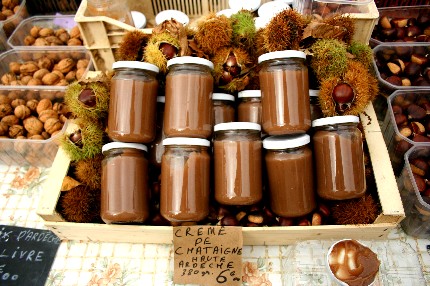
Here in Lyonnais region, the chestnuts are at market, and we see that the producers are again this year offering their sweet chestnut spread to tartine onto morning toast or to use in any number of home desserts. The glacier Nardonne, on the Saone quai, does a chestnut themed sundae that includes, in a silver chalice, the nuts in a special house prepared ice cream, the paste, candied nuts, thick hot fudge and chantilly. It is enough to put even a gourmande into a chestnut coma, and should be followed by a strong cup of coffee if you've got anything planned later in the day.

On the rue de Brest, the traiteur La Minaudière, owned by Cellerier at Les Halles, slow roasts them in sugar until they are glowing transparent candied gems that they stack in pyramids in the shop window, and remove one by one at the customer's request with silver tongs. They wrap some in golden paper. These go for a pretty penny, and the market supports it since these particular candied chestnuts from this particular traiteur are etched in stone as a must for hundreds of Lyonnais families at the Christmas holidays. If you go down the narrow side street beside the traiteur, you can peer through arched stone windows into their kitchens while they work.

Peeling chestnuts is a tiresome activity for me, ranking up there with pitting cherries or olives. This is a task I endure every year at Thanksgiving. I always prepare a chestnut and bacon dish. The idea comes from the first time I tasted a savory pork spiked chesnut puree, in China, of all places. I introduced this idea to the Thanksgiving table our first year in France, given their easy availability, and my special memories. Now, when I bring out my lists and sit down with Loic to plan the meal, he always insists on that dish. It has become a steadfast tradition and I don't think we'll ever cross it out.

Everyone has their tips and tricks for getting these nuts out of their shells. Some score and boil them, some roast them first, etc. Chestnuts are known to explode when heated in the microwave. Be careful too with your knife, it has to be ultra sharp when you peel chestnuts. The duller the knife, the more you risk injuring yourself. I remarked to one man who grows the nuts that I still had not found an easy way around this task. He brought out a pocket knife, and lickety split, peeled one of his in front of me. If it were only that easy for me! I dread the task every year but the fruit from my labor is always worth the struggle. I investigated the idea of purchasing shelled chestnuts at one time but found that industrial methods of removing the skins involve soaking in toxic acids. Needless to say I choose to do it by hand these days.

How are the French using chestnuts in savory cuisine? In Provence, specifically in the Var, you might run across farinettes (little crepes) with chestnuts, eggs, and a sauce Choron, a tomato seasoned bearnaise sauce. In the Lyonnais region, you can find chestnuts in pumpkin soup with aged Beaufort, chestnuts and bacon, or tender glazed Cantal pork ribs, served with split pea purée sauce and chestnuts. In the Aquitaine, in the southwest, you might find veal sweetbread escalopes served with brasied endives and chestnuts. In Cahors, one restauranteur starts dinner with an appetizer called the "Crème Esau" with lentils, chestnuts and truffle seasoned whipped cream. In Cannes, they're eating chestnuts with Mediterranean sea bass. In the Lorraine, slow braised chestnuts are paired with wild boar. Katie has prepared a nice dish with butternut squash with the nuts she found. The possibilities are endless.

Labels: , ,


Share/Bookmark

Wednesday, November 29, 2006

Getting Spices


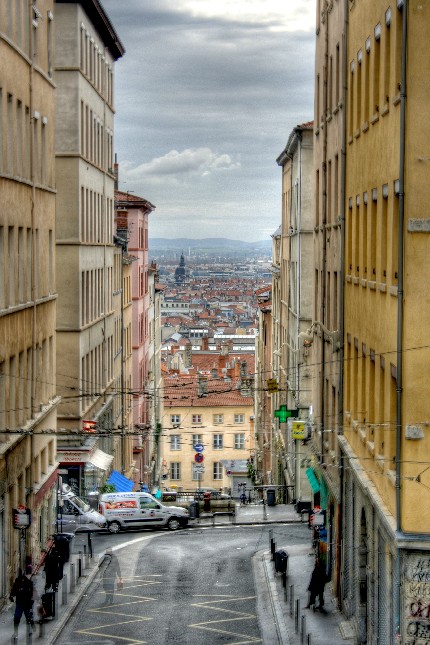
Climbing up the hill to the Croix Rousse plateau today, I counted the steps. Images came to mind and I counted, days and weeks the years here in France in which I endured some disappointments but also had some of the happiest days of my life. I took a moment as I mounted the steps one by one to review the main archives of the last seven years.
There was that carefully crafted poem typed with an Underwood on a post card that symbolizes something very big that I will one day open out. There's the dissertation on onion skin, the ideas I dwelled on for perhaps too long but like many of these things can leave a feeling of the good that has come from conscientiously maintaining a commitment to a principle. There were the administrative files, the carte, the country, the file to request and the file to explain and the file that was lost at the prefecture and had to be filed again. These files give us an official history, and here in France this history is meticulously kept for the benefit of future generations.

The unofficial history is altogether another story. The kitchen notebooks and stories of families and friendships are very important to preserve. It is being able to choose and encapsulate, to focus and prioritize that allows us grow stronger in our abilities to do these stories justice. I thought about these things as I reached the top of the first one and then found a different stairwell to climb. But then again it is also learning to take a moment and live it.

Soon my thoughts began to become more fluid and far between as they often do when I undertake repetitive activity like climbing stairs, and I probed the hopeful places in my heart. I rested lightly on these thoughts, just very briefly and respectfully, and did my best to heed Clare’s advice and breathe to allow myself to be open to their implanting and coming true the way they should.


Here at the present at the top of the hill I went about my plan to stock my larder with a trip to Cap Epices, a store that sells spices in bulk, dried imports, and olives. We see them on the Quai St. Antoine, and I often wait in line there to get a ladle of this one, a scoop and a pinch of that from them during the bustle and hustle of the market. People jostle and poke and lean against one another as they call "next!" until it is your turn. For this reason I also go up to the shop where I can inhale the singular aromas and stand in the wooden cave that is their boutique and mull over them. It is the only time I can really envision how I can use them, and think about their provenance.


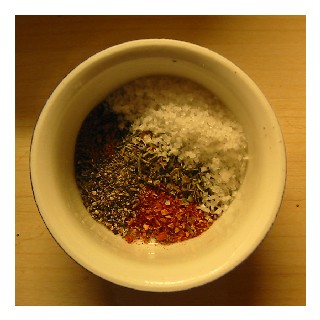
There are 23 jars in my sliding racks for spices, many of which are empty at the moment, mainly due to my own impatience and lassitude, and a habit I have of only buying what I need. Aside from the three large jars continuously in a state of use containing sea salt, herbes de provence, and my spice mix maison, I only sometimes have a nice full selection of the spices that might come in handy. Today I purchased enough for another batch of my mix, the best curry I have found, and a few other things, including an interesting mix of spices to make pain d’epices, kind of like a gingerbread honey cake that is very popular around the holidays.

Labels: , ,


Share/Bookmark

Monday, November 27, 2006

Thanksgiving 2006


View from the couch the morning after Thanksgiving.

Our meal was on Saturday, to give family and friends a chance to travel since the third Thursday of the month of November is not a holiday here. The meal itself went more smoothly and was a better success than any of the 6 French Thanksgivings we have had here so far. This was of course was a combination of good luck and nice people.

What struck me this year as the overall theme was the way that others reached out and took over when it was time, without question and in perfect synch with my expectations. In the days leading up to the meal, I was busy all week, many things in advance, even more than usual, just because I was not sure when and how I would be available. By the time the day came, my planning had been put on paper, and I had given everyone responsibilities. I called out the requests to my entourage to cover every detail.

Callan, our expat American guest this year, brought forth an excellent idea for the Apéro cocktail, which was called a Rasmopolitan, like the Cosmopolitan, which she got from Glamour magazine. You freeze raspberries into ice cubes (very elegant). our rendition of the recipe was to spike the cranberry juice & vodka with a little bit of raspberry syrup (the original recipe calls for sugar syrup). Callan brought the fresh raspberries to the house in the morning and prepared the ice cubes in short order and disappeared into the day again, the raspberry ice angel! We so appreciated her contribution and attention to detail. It started the meal off really well.


I was not sure about what I’d be able to do on the day so I was pretty meticulous about preparing the consommé in advance. During the week I hit the Bresse chicken man at the producer’s market and he had 3 old hens from his barnyard just for me. They made the most flavorful broth! The color was really gorgeous this year. We served this enriched with a capful of Madeira and floated poached cèpe ravioli and fresh minced fines herbes.


What is a verrine, you ask? A pretty and entertaining shaped individual serving glass in which colors and textures in the form of foams, mousses, and various ingredients have been artfully layered and sprinkled for a stimulating visual effect. But most of all a verrine is an opportunity to inject flavors into a second introductory course while remaining light as a feather.
Since this is a festive holiday being celebrated in France, of course foie gras made an appearance. Last year it was in the raviolis I made to serve with the consommé.

This year they appeared in the second course verrine. I started by preparing first a simple foie gras terrine, which is actually very easy to do. You remove the large veins from your foie gras, marinate the foie in cognac and sea salt overnight, and then after pressing it into a terrine, let it cook in a bain-marie which has been placed in a very slow oven. This refrigerates as long as you want it to, up to two weeks by the book, or longer. In the minutes we served the verrine, we put a good hunk (about a cupful) of the foie terrine which had been warmed to just above room temperature along with a few tablespoons of heavy whipping cream, a tablespoon of Madeira, and seasonings like salt and touch of paprika into a bowl and whipped it up into a very smooth thick liquid puree. This was put into a gas charged canister which we call a siphon here in France, in which we normally make chantilly, and piped it into glasses. In the previous days, we did some taste testing and chose a ginger preserve from England and a fig compote that both really set off sparks with the flavor of the foie gras.

The siphon went into a warm bath (actually the water in which we had poached the raviolis in the previous course) When it was time to serve, Loïc was delegated the technical task of inserting the gas capsule piping the just warmed foie gras, which was the consistency of whipped cream, into little oval shaped glasses, layering it along with the different compotes. Heart shaped brioche toasts and a glass of fruity Gewurztraminer completed the course. The guests broke out into applause. It was a strange moment, knowing how easy this was.


The third course was the Turkey, stuffed with the usual freshly cracked at the last minute oyster and regular corn bread stuffing. Mom brought those bags in which you can cook the turkey, and once we’d convinced Loïc that this would not kill us, we used it – really a wonderful invention. The bird steams in its own juices and your effect is so fabulously silky and moist that I think that this imported American innovation in turkey roasting technology is vastly superior to any other roasting method. It saved our eyebrows, it gave us time to spend with the guests, it saved our lives. Thank you Reynolds.

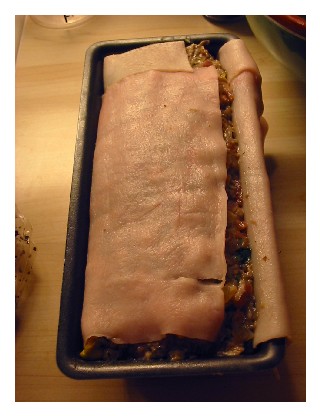
I arranged sage leaves in a decorative pattern over the simply butter slathered bird and then covered this with a veil of crepine, which fused to the skin becoming invisible in roasting and held the herb arrangement in place. I will develop this idea and share it with you with a how to in the weeks to come, because I feel that it is a great trick and it can apply to much more than Thanksgiving.

The sides consisted of A real winner of a recipe which we do every year now for Autumn Vegetable Succotash from Martha Stewart's on-line recipes, a chestnut and bacon puree which was inspired by a dish I once enjoyed in China, glazed carrots (I insisted that Loïc do those again), and thin green asparagus tips wrapped in bacon. Green asparagus is not as common to the French as the white, and since our guests were mostly French I knew that it would be appreciated.

The cheeses this year were all from within a couple of hours by car from Lyon, Epoisse, Langres, an ash covered chevre, an Arome de Lyon, and a fruity Comte. Dessert, which Loïc always prepares, dessert being a man thing in this household, included a Kentucky Bourbon Pecan Pie, and a take on the pumpkin pie using butternut squash, a recipe that has been tweaked and adjusted from a 1985 Southern Living cookbook.

Three guests independently arrived with bouquets of orange roses, a strange and interesting coincidence which I am convinced means something wonderful. The smallest flowers made their way into the table arrangements.

Labels: , , ,


Share/Bookmark

Saturday, November 18, 2006

Greens & Game


A nice salad was in order after dinner last night, in which I had the foie gras two ways and a succulent veal sweetbreads & kidney with a fresh morel fricasee. The only green I got with that meal was a sprig of chervil. I woke up in the night worried that I needed to eat more greens. The arugula is out in full force now at the market, and we are beginning to see some of the common roots that will see us through winter.


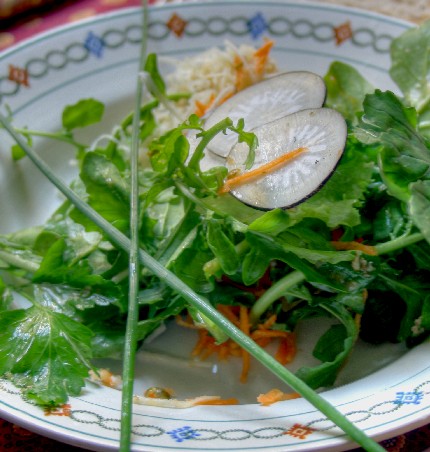
Today we had Franck for lunch and before we served an autumn pepper and rutabaga velouté with crispy duck neck slices similar to this soup and flavourful faisanne (wild pheasant hen) roasted on the spit, we enjoyed a nice salad of celery rave (celery root), carrots, roquette (rocket or arugula), leaf lettuce, parsley and chervil, ciboulette (chives), and radis noir (black radish). The vinaigrette was a mix of fruity olive oil, fleur de sel, plain apple cider vinegar, some of the mixed poultry stock we had going, finished with crushed capers and green peppercorns. The sauce was light and flavorful at once.


I took the care to send the soup through the chinois and it really made a difference. I do think it's best to strain it when we have guests. It adds a special lightness and creaminess. The faisanne was absolutely delicious, and each part of the bird tasted differently. We don't think about that much when we eat chicken or other farm raised poultry, but it was really pronounced in the wild bird.

Labels: , ,


Share/Bookmark

Thursday, November 16, 2006

Terrine Notes - Terrine de Lapin

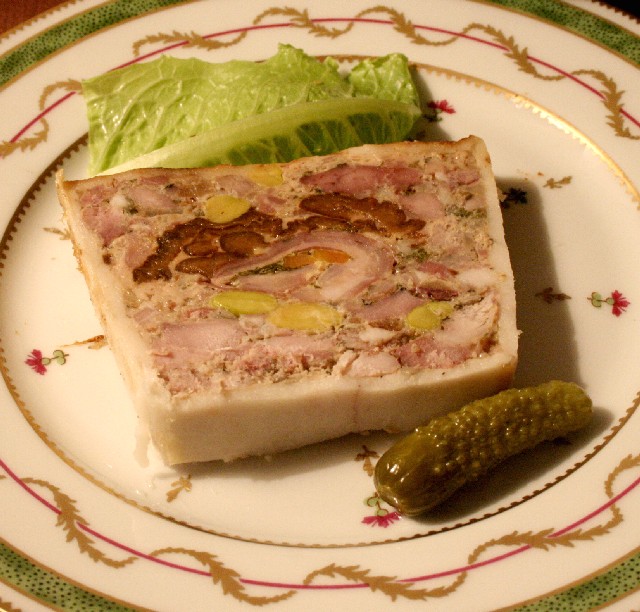
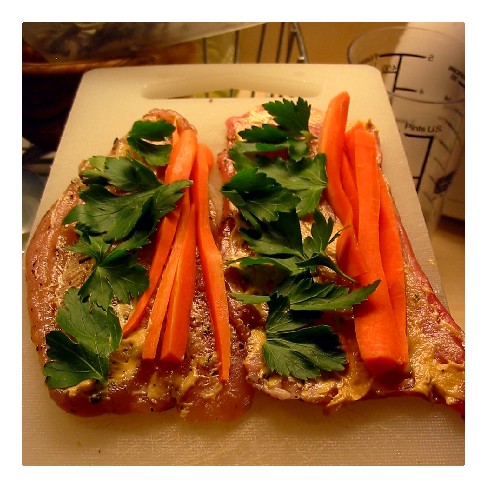
My house rabbit terrine, which incorperates a layer of dried prunes for color and flavor. Rolling the flattened haunch with a mixture of carrots and herbs makes a flower design in the middle.

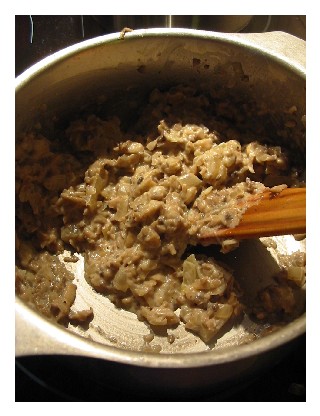
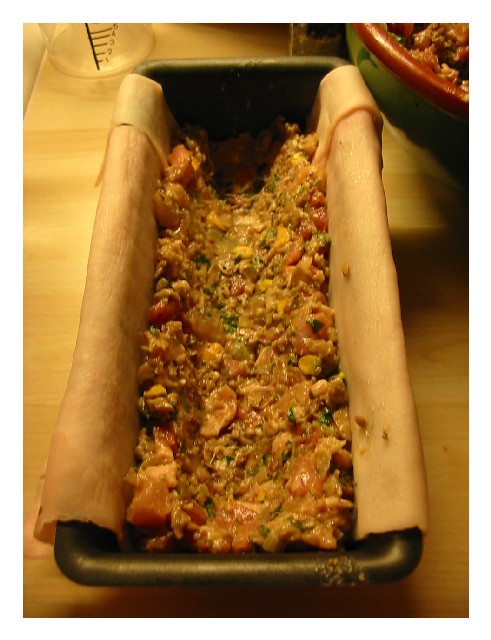
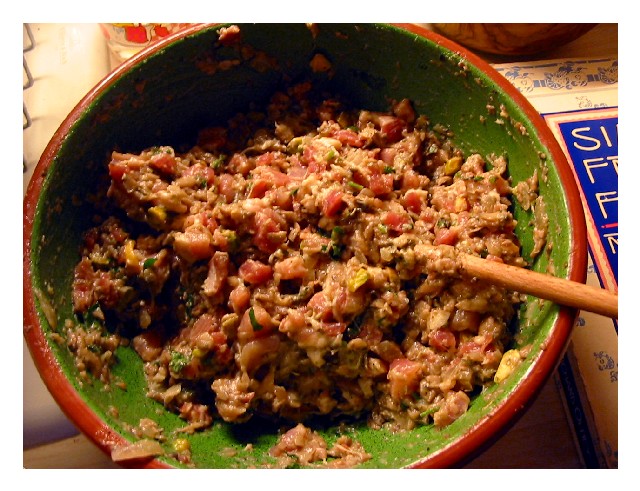
With Thanksgiving coming up, I thought I'd bring out some old notes on the terrine making. Sometimes it helps to visualize some of the steps in my mind. I have done terrines with rabbit, a mix of farm raised rabbit and wild rabbit, and various other poultry. I started terrine-making with Richard Olney's recipe in his book Simple French Food, and have made my own tweaks and changes over time, the main difference being that I include duxelles, which is mushrooms that have been cooked down and combined with cream, in addition to a rabbit demi-glace panade, which is made by crushing old bread and garlic and working the demiglace into it to make a paste. We serve a slice of a house terrine as a first course at the Thanksgiving table. Since we have a large number of French guests every year, we like to start off with simple courses to ease the group into the concept of the big feast. The courses are an interesting and entertaining way to kick off the meal.

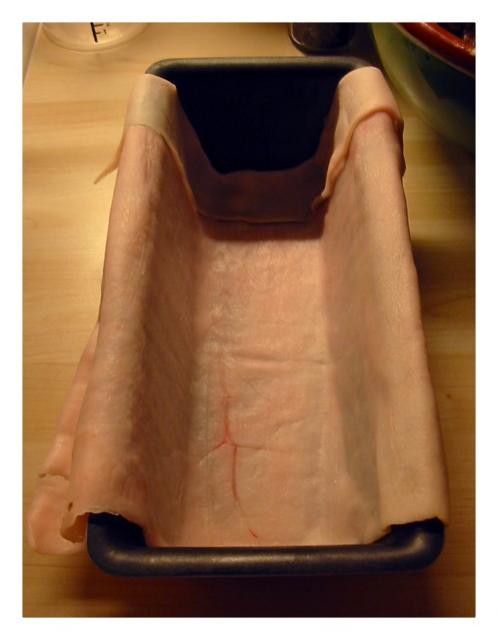
A terrine is done completely in advance, and should sit in the fridge after weighing down the top for at least 5 days before cutting. It's perfect for Thanksgiving because you can have it done well in advance and not even worry about it until the day of the meal, yet it is really elegant. I like to cut my terrine slices the morning before the meal, because slicing 16 pretty slices of a terrine takes some attention to detail.

Terrine des deux lapins (a mix of wild and farm raised) from last year's Thanksgiving meal. Instead of prunes, I used dried mirabelles, which tasted great with the wild game and also added to the flower motif in the center. Click the photo for a closer look.


This year I am going to make a two duck terrine, using colvert and farm raised duck, and perhaps dried figs instead of dried mirabelles.

Labels: , ,


Share/Bookmark

Sunday, November 05, 2006

Sunday's Caille Laqué au Beurre Blanc de Noir, Wild Chickory & Radis Noir Slaw


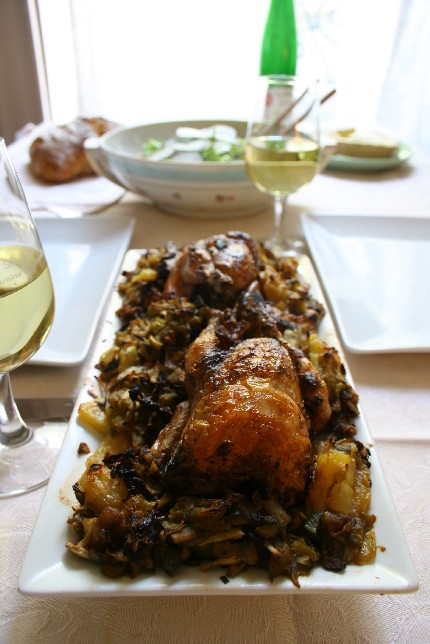
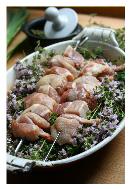
When the moment came to take out the quails to stuff them, I changed my mind. Stuffing a quail is kind of like playing with your food. Why stuff a little itty bitty bird like this? At most I would get two tablespoons of stuffing into them, and what good would that serve? Better spit roasted and served on a bed of oyster, grey chanterelle, celery root and eggplant dressing, wouldn't you agree?

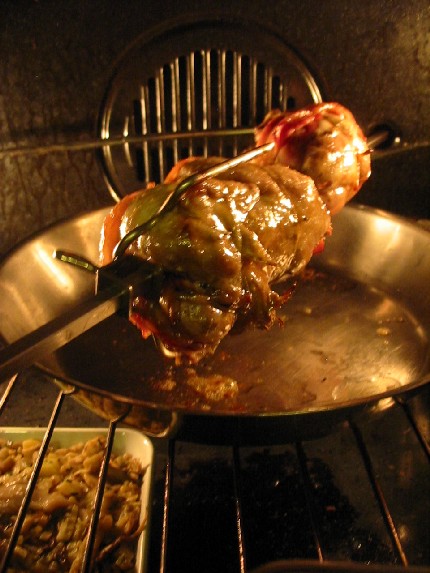
I decided to use a recipe from my kitchen notebook that I have done on many occasions with excellent results, my spit roasted

Caille Laqué au Beurre Blanc de Noir


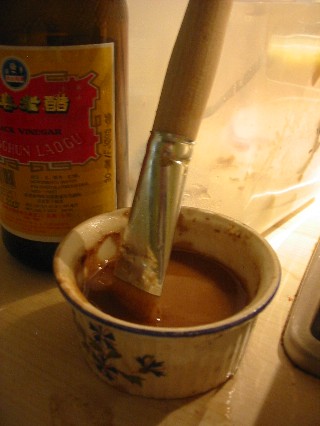
Beurre blanc is a sauce made with shallots, butter, and vinegar. When I lived in China, I discovered the magic of a certain fermented black vinegar, called Chinkiang Vinegar, which has a distinctive flavor that when used judiciously, can have a delicious succulent effect in many dishes, and as I have discovered, not just Chinese food. It is a vinegar that is so special and unique that you really have to be careful when you're using it to make sure that it does not assert itself too much.

When roasting delicately flavored birds such as quail, a little goes a long way. The vinegar is made from fermented rice and yeast, and the ingredients on your bottle should reflect nothing else. The fermentation process in this vinegar is what makes it have its special flavor and no amount of sweeteners or salt can recreate it. There are a lot of fakes out there, read your ingredient labels. If you have a choice between one that has salt added and one that doesn't, choose the one without salt.

The goal is to enhance the flavor of the birds and bring out the flavor of the meat with a tangy foil of flavor at the skin, tempered and calmed and lifted by the butter in this classic sauce with a twist. When carefully and repeatedly basted, this sauce can produce a beautiful mysteriously tangy seasoned browned skin that heightens the flavor of the meat. A succesful execution of this recipe means that when you eat this quail, you say: Mmm quail.


For a couple of quails (multiply as necessary), you need:

2 T. Chinkiang Vinegar
6 T. good quality butter
1/2 a shallot
salt and pepper

Puree the shallot and the vinegar and cook it down to about half. Off heat, whisk in the butter in little bits, to create an emulsion. Prepare your quail to roast on the spit, making sure you don't bump them up too close to each other, so that your sauce and the heat can have a chance to reach every part of the bird. Paint the birds with the beurre blanc de noir emulsion, season them with salt and pepper, and set them to roast. Baste them every 3 minutes, 8 times.

What I do is set the timer and execute other tasks in the kitchen in the time between basting. Every time the timer beeps, I quickly drop what I'm doing and give the birds a quick and thorough baste. Careful opening that oven!

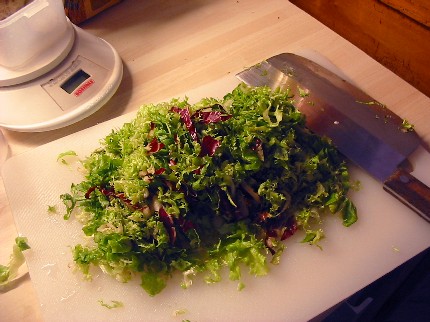
I washed, dried, and chopped the wild chickory, minced the onions and apples, sliced the radis noir, and made a salty shallot vinaigrette for the slaw.


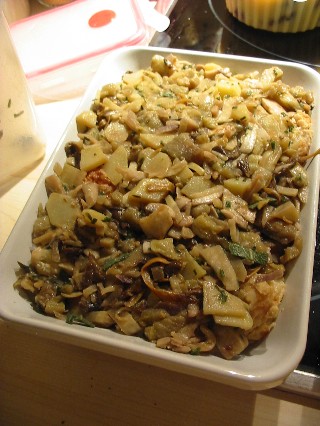
I opened the oysters, diced them and added them to yesterday's precooked eggplant, grey chanterelle, champignon de Paris and celery root, and set that in the oven to brown on top while the quails roasted.


When the birds were done, I put them on a warmed serving plate with the dressing all around. I'd say all of the meal from start to finish was on the table within a half an hour (barring the dressing, which was prepared yesterday except for the oysters, which I added at the last minute).


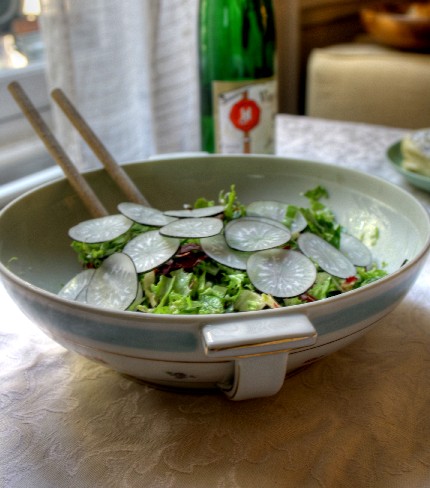
The wild chickory slaw with radis noir was balanced with apple and onion and a salty vinaigrette

I would have been happier with a Condrieu to go with this dish, or even one of the more assertive white Burgundies we see around a lot these days, but we had this leftover Reisling, and it was alright with the quail.


Note: Loic went gaga over the slaw. It's a keeper. I suppose I should think of a better name for it. He was also delighted with the whole idea of oysters in the side to the quail. I think I'll add nuts to the slaw and serve it again soon, perhaps with something like a bacon roasted monk fish.

Labels: , ,


Share/Bookmark