Sunday, July 15, 2007

Summer's Berries

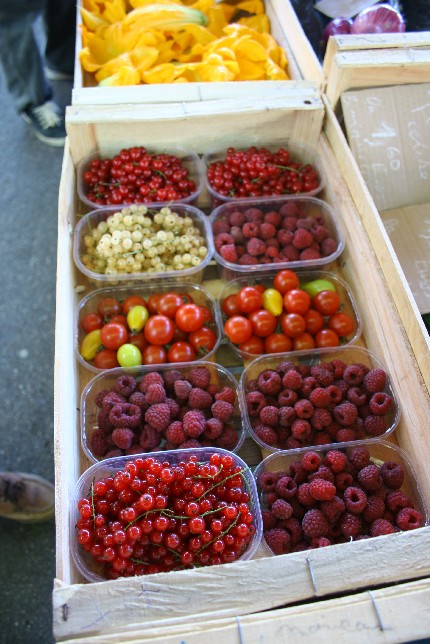
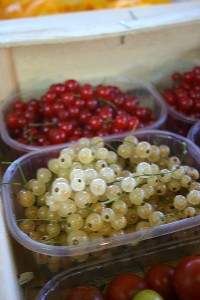
We often see white currants, sometimes dusted with confectioners sugar, as a gorgeous garnish on the beautiful cakes and cream desserts here. This week I made cheesecake, adding a summer twist of a tablespoon of fleur d'oranger to flavor it, and serving it with fresh raspberry coulis. Guess what went on top of each serving?

There is something in the way they glow in the morning light that attracts me.

Labels: ,


Share/Bookmark

Tuesday, May 22, 2007

Mara des Bois Economics


Mara des Bois are up by half a euro a barquette.

Sometimes when something first comes out, we're just dying to embrace everything it means to have that moment in the season arrive. We feel the sting in our pocketbook but it's bittersweet - we still fight to get some of the season's first pickings. Then time marches on. When more producers begin to come forth with more and what stood out as an exception becomes part of the background, competition begins and the prices come down again. This happened with the Cèpe mushrooms - the first ones were cher as all hell, and I paid willingly, with nearly a tear of joy in my eye.

There's a complex relationship between our hopes and memories and signs and signals of the cyclical nature of life as seen on the market table. These vendors of course know when we must have something at any price, and they have the priceless skill of stopping us in our tracks, bringing us back to the moment. We reinvent our limits. We think of the best way to use them. Or sometimes we soak in the view and continue walking, content to come back again when we have concluded between us that things have reached their just balance.

Labels: ,


Share/Bookmark

Tuesday, May 15, 2007

Cigaline Strawberries

The photo simply does not do this berry justice.

Lets start at the very bottom of the strawberry totem pole. I am not talking about the hard bred belly-ache berries meant to be bounced around on the back of a flatbed truck thousands of miles from a desert based hydroponic irrigated tent city where they have been coaxed from lonely ne’er-a-honey-bee-touched individual stems suspended above vats of chemical gels. I understand that these berries are indeed fake, they don’t taste real, they have that hairy 5 o’clock shadowed incredible hulk look to them and can crunch like Cortland apples when we attempt to bite them. We’ve all seen them, been mesmerized and horrified by the sheer plastic existence of their glorious buxom audaciousness. The strawberries one commonly finds available in the middle of February displayed next to cans of reddi whip, for instance. They look like Alice Cooper’s tongue. These are big and bad at the market, and have been, since, voila, February. They sprouted into importing warehouse-monger’s tables like a bad fungus at that time and now are bigger and redder than ever.

Then we have a pretty flowery kind of fungus that sprouts on old walls and makes us feel nostalgic, the proliferated profitable Provencal variety that is yes a certified variety, but which, while perhaps once indeed a very nice berry, have been watered down and bred together and sorted and sifted and had their seasons pushed to just about the limit of their existence. Those precious precocious fully market-maximized French ones, also most likely never having touched soil although their ancestors from the 70s were soil-touchers. They are presented alongside the rest with the hyped pretentious ceremony of the Boujolais Nouveau. I know you have seen them: Gariguette otherwise known as those supposedly coming from the Garrigue. Although sometimes you do come across a juicy tasty basket here and there, in the product we see here in the valley, the quality control is just too thin and the temptation just too great through the vast logistic channels that bring them from the nether-regions for us to be able to rely on them as real berries anymore. Maybe at the source, at one time, but not here, not now.

Then there are the real strawberries. The ones you have to look for and sometimes you don’t find. The ones that tickle your nose with a teasing promise of fidelity, forming questions in your mind - should I trust again this time, can I trust again? Will these berries deliver? The ones that are soft and won’t last but a couple of days from the day you get them. Will we pay for some hype or will I be transported back to that oblong room with the frumpy firm semi-double bed as only the Russians can imagine to be good for two people in St. Petersburg, where Loic left me to dwell alone with that little sack of forest berries that the lady had brought to the market in a cup and was doling out with a soup spoon? The ones that I tasted, reclined, twisted my torso just so, and fed to myself one after the other from that crinkly paper in the lace filtered twilight, lost in Russian fairytales? Will I ever experience that flavor, that moment, again?

So what is the precocious variety I succumbed to last weekend here in Lyon? It’s only one more of those incredibly tender, wild, snatched from the edge of the forest-floor tasting berries that I raise my right hand and I hereby certify and swear on my gourmandise, are real. The Cigaline.

Good and real, and close if not as good as the Mara des Bois that I wrote about in their season last summer. We bought a half pound, not knowing how good they were, but having a suspicion that they might prove their mettle due to their shape and color and smell. Knowing the vendor as a producer, and not having seen this variety anywhere else, I was drawn to buy them – why the heck not?

Bref – I brought them out and unceremoniously put the basket on the table between us, with a passing thought about how many fruits I should be eating. A dutiful thought. Loic likes a bowl of water on the table in which he can rinse the berries. It’s a French thing. We picked them up by their green stems and bit them off at the base.

How extraordinary, I thought. They veer quite close, in fact. This afternoon I look at the plaster moulding and shadows of the flowers coming in from the walls, watching them move, thinking of how Cezanne painted his walls grey, and colors and contrast, and I think perhaps this berry has earned its mettle. Yes, better than the rest. Like strawberries should taste. Give me another. Give me more. And we continued like that until, voila, they were gone.

Labels: ,


Share/Bookmark

Friday, September 29, 2006

Regarding the Quince


The coing, or quince, is kind of a strange fruit. Sort of a cross between a pear and an enormous crab apple, its flesh, even when ripe, is often hard and difficult to cut in the center. My experiences with the coing have been rather marked, the first ever having taken place in China.

I had just arrived in Beijing and the moments there were swirling around me in a fantastical joyous chorale. The colors were bright, and all of the new adventures to come were just laid out before me like the wide stately avenues crossing the capital. I had so many choices. They were like ripe fruits just waiting for the taking, and each choice I made was to determine simply and directly what would happen thereafter.

Everything was riding on everything. It was precarious but true. I had all of the essentials covered. I had arrived after a strange hop-started slightly melancholy 12 days in Turkey visiting an old friend, I had a single bed to sleep on in a safe place, and I had a job. A small job, but with possibilities. When you are 24 years old, these things are really all you need.

I was relieved to see that I could actually speak in the language I had studied so long just to come to that moment. Looking back on that time, I am so glad that I was able to breathe and stay calm, because only after a person lets go and trusts their surroundings can they truly live to their potential.

In celebration of my arrival, I had been invited to dine with Mr. Ma. We had just finished a lovely dinner. He was a curious man. Chinese, extremely soft spoken and his face never showed his power. He smiled light heartedly with his entire visage except for one small place inside his eyes which to me was curiously attractive. He looked as if he had very soft skin but I didn’t dare touch. His hair was cut in a businessman’s style and he had lovely classic gold round rimmed glasses.

Some men sparkle like crystal, solidly emanating facets of their power as they move from one task to the next, from subject to subject. Mr. Ma sparkled like a diamond, unpredictably, and at moments with a fleeting gorgeous intensity. In fact, the whole idea of Mr. Ma in my 24 year old mind was sublime, out of my reach. I could not fathom who he was. I was taking him at the highest face value I could.

He had ordered an amazing array of special regional dishes which he pronounced slowly and with emphasis, looking into my eyes to be sure I understood their significance. I understood nothing with my book smarts, but didn’t realize it. In fact I had absolutely no knowledge of the incredible world of Chinese cuisine that was to unfold to me in the years to come. That night I walked the tightrope of learning and living. At the same time I was like a cat lapping milk, my back warmed by the sun.

We came out of the underground regional restaurant near the Jian Guo Men Wai, and I had just tried many silky and beautiful and also staid and satisfying things to eat. The lamps were lit, and we decided to go walking. It was then that I discovered that Mr. Ma was an antique collector, a quality I admire in a person. In fact, he had a shop. We decided to walk there. I talked about Vienna bronzes assuming he knew about them and he talked about the ancient Chinese bronzes he sought and collected, as if I knew all about them too.

We were headed down the big wide stately avenue and the evening light and the dry city breeze swept us along, hints of summer evenings still in it. He asked me if I knew what the fruits on the trees were. I did not. I was unable to understand the Chinese word, I had studied fruits and flowers somewhere around the halfway mark in my Chinese language studies, and the only word I remembered from those lessons was Hua Ping. Vase. He struggled to get the word out in English. His mouth got small like a little kiss and he said, Quince. The fruit is called a quince. I watched his mouth and vowed I would never forget that image, ever. I have memorized it from the last low sun’s beam of twilight imprinted in a streak across his cheek to the sound of the taxi driving by.

The Quince should always be chosen as ripe as possible. A ripe quince is yellow and has a strong odor of the fruit. It is commonly covered with a fungus that protects it naturally from insect invasion, and those with the discriminating eye choose the ones featuring this dusty coat. The coating looks like sawdust, and its presence is a good indication of the fruit’s freshness. The quince is very good peeled, seeded, sectioned, and poached in spiced wine and syrup, made into jam, put in chutneys, or cooked in plain sugar to bring out the best in its unique flavor. The flesh of the quince will brown in contact with air, so if you’re mincing it for compote or cutting it into wedges for conserves, you should immerse the cut pieces in water/lemon juice mixture, and any conserve liquid should also have some lemon juice. Some French recipes call for the quince to release its flavor into syrup by long poaching the fruit and then as a last step, discarding the pulp of the fruit. The resulting syrup is used to flavor crèmes, flans, mousses, and blanc-mangers. About this time of year, George Blanc, in Vonnas, not far from Lyon, serves a dessert composé of corn meal sablés with fresh figs and fig raspberry jam surrounded on the plate with a line of quince syrup.

Pate de coings, stewed until a thick paste that hardens like gum drops is spread out on parchment on kitchen tables throughout the country of France. Last year a magazine had a recipe for quince prepared somewhat like pears poached in wine. I was not satisfied with the result of that recipe, but was happy that I was attracted by the idea. It was extremely pretty, with the wine soaking in increments from outside to in. I ended up recycling it into a tarte with a sweet crust. With these two fruits I am going to make a little batch of jelly for Loïc.

Labels: ,


Share/Bookmark

Thursday, August 24, 2006

The Mirabelle Emergency

We got a call from Aude & Seb asking us if we would come out and help save a tree. Something happened this season (the canicule in July?) and one of the old trees in the orchard behind the chateau produced an insane amount of fruit. The branches of this tree are so laden with ripe fruits that two large branches have actually broken from the weight, and more are at risk. They needed people to come and help relieve the tree of the weight.


I set a writing project aside and Loic re-arranged some of his work, and we headed out with a fruit palette and my shopping basket. When we arrived, they were waiting there with Lise, Sebastien's grandmother. She had a neck brace on, apparently she strained her neck while picking fruit. Aude & Sebastien led us up through the orchards (I grabbed a couple of apples along the way, as seen in the basket). When we neared the tree, a sharp odor of vinegar hit us, and I actually felt as if this old tree was in distress. The broken branches lay where they had fallen, still alive, clearly some fruit already rotted but many mirabelles still fine. Bees swarmed everywhere.

The sight that awaited us of the actual fruit was awe inspiring, the fruit on the branches reminded me of peppercorn pods - completely covering the branches.

We had a ladder and in a few minutes we had picked enough to fill both receptacles completely. They were guessing the number of tons of fruit that were left on this one tree.


We sat and visited for a few minutes and Lise gave me her proportions for Mirabelle jam, the one her family has made with these particular fruits every year.

Mirabelle Jam (as dictated by Lise)

For every one kilo of Mirabelles, use 800 grams of granulated sugar. Pit the fruit, and add the sugar, put it in a big bowl, and let it sit overnight. This will produce plenty of juice. The next morning, cook the fruit down for 20 to 25 minutes (I'll add that to make jam the best temperature to cook it to is 220F) and put it directly into jars, seal, & sterilize.


Lise laughed because she said that just the other day she heard an interview on the radio with the fruit growers in the Lorraine, the traditional Mirabelle producing region, who were all sad because this year's crop did not yield as many fruits as they had expected and hoped for.


We got the fruit home and Loic weighed it. 20 pounds. Oh Lord, how am I going to deal with all this fruit? We can give some of it away, and Jam is one thing, but there's only so much jam a person can put up before they become a nuisance pushing jam and fruit on everyone.

Not to mention the fact that I have a good number of peches de vignes I was planning on using before the mirabelle emergency happened.

I remembered a series of excellent dinners I shared with a friend, her husband is from the Ile de Reunion. His aunts and uncles come to the mainland every so often and before they arrive, they send ahead a huge package full of various flavors of home made "PUNCH". This was a delectable treat, served over ice on the terrace of their apartment. It is fruit along with its pits long macerated in Rum Agricole with a good dose of sugar syrup. When I asked him if there were any secrets, he said that for a successful "punch", you must burn the sugar when making the syrup. So with a few kilos of these mirabelles, I will burn some sugar and make some Punch. This will also make good giving at the holidays if it tastes good.

Otherwise I have a sheet of fruit drying in the oven overnight, Mother's suggestion. These will make good snacks when we're out biking. Our oven has a fan to keep the air circulating and we're leaving them to dry overnight. I am drying the fruit at 75C, 140F. It will make nice little mirabelle prunes. I wonder, should I salt them like I had in China? I loved the salted prunes my office mates shared with me in Beijing. Perhaps I should have dipped them in a salted brine before drying them. If these aren't sucessful I can always try another batch! I have a Chinese friend coming over and maybe she can help me decide what to do with some of these.

The remaining recipes I've scrounged up are:
Liqueur de mirabelles (done with eau de vie)
Tarte aux Mirabelles
Compote de mirabelles
Gâteau lorrain aux mirabelles
Tôt-fait à la mirabelle
two recipes for Pork and mirabelles, one a terrine and the other a roast
and Magret de canard with a mirabelle sauce.

Time to get cooking and maybe add some recipes to the notebook.

Labels: , ,


Share/Bookmark

Monday, August 21, 2006

Mara des Bois


Strawberries have been in France since the early 18th century, when plants were brought from Chili, by the French explorer Antoine Amédée Frézier in 1713. They were long considered a medicinal fruit to treat rhumatism - recent studies of strawberries indicate that the berry contains trace amounts of acetylsalicylic acid, otherwise known as aspirin, and the fruits are a natural antihistimine.
Our elders, especially ones who lived through the Second World War and have lots of stories to tell, will recount to you near mythic tales of luscious flavorful wild berries that they had in their youth. These days a really flavorful strawberry is not easy to find. Our generation barely knows the intense sweet flavor that was bred out of the berry to favor larger hardier breeds that will endure long transport and an extended season.

In the early 1990s, the Marionnet nursery and growth laboratory developed the Mara des Bois. This berry has quickly become one of the best selling "haute gamme" berries in France, because it brings back memories of the sweet juicy intensely flavored berries of times gone by. Bigger than a wild forest berry, the Mara des Bois still yields the flavor of the forest berry, thus is coveted for plain eating and also by the best patissiers for their creations involving the fresh fruit.
If you travel to France in late August, you will see this breed at the markets. Put it on your list of the things to look out for, and by all means have a taste!

Labels: , ,


Share/Bookmark

Tuesday, May 30, 2006

Time for Jam

Loic likes his toast with jam. What I do is take my leftover butter scraps (I buy all kinds of butter and have been known to have stumps of 6 different kinds cluttering up the fridge at a time) and the leftover herb bouquets, and give them a blitz in the moulinex. I then incorporate some sea salt, press the herbed butter into an old cheese pot, and enjoy my alloted amount in increments spread on my toast for breakfasts. Loic, however will have none of that, since he had a childhood butter trauma. He loves to slather his breakfast toast with jam and lots of jam. Now that the fruits are coming out I am taking the opportunity to make one jar batches of fresh home made jam for him, fruit by fruit.

Oh, it takes about 20 minutes. It doesn't take close surveying until the last couple of minutes when you have to watch a little and stir to make sure it doesn't burn, so you can put it on, get it going, and then do other things until it's done. Last week I made rhubarb jam by combining 3 finely chopped stems of fresh red rhubarb, 1/3 cup granulated cane sugar, a peeled, cored, and chopped apple, and 3 tablespoons of water until they reached 220F (my candy thermometer is in farenheit, since home candy making is a really American thing). And gave it a quick saucer test. I then poured it into a clean jar and let it cool. No need to sterilize or heat seal this jar of jam because Loic eats it very quickly. Tomorrow morning I will make a batch of strawberry jam, since the rhubarb is almost gone. These strawberries got me thinking of that.

the rhubarb jam is almost gone.

Labels: , ,


Share/Bookmark

Wednesday, May 24, 2006

Les Cerises de Pascal


There was nothing to do but eat them plain. I got a livre - a pound.

Labels: , , ,


Share/Bookmark