

Tuesday, June 13, 2006

Eggs - Meaning and Method


My mother is a collector of Rabbits. Mother of five. Mrs. Moody, family friend and professor of English theory and other long and interesting explanations who lived up the street from my childhood home, collects Owls.

I collect Birds. Song birds, the ones that are wild, the ones that fly, have rather slender wings, migrate and have that non-predatory esprit de vivre that domesticated ones don't have - those that pipe up without provocation and live through a certain stylism, seeming long and thin because they fly so fast we only see them streak by.

Up until a few years ago I thought it was because I was fascinated with the idea of migration, maybe running away but now that I have come to realize who I am, returning, visiting a place again and again but all the same covering vast spaces across the globe. Since the beginning I've been on the move, really.

I go to that staid place home again and again. Perhaps this act of cyclic returning gives my collection more meaning. I derive pleasure from this migration symbolized in the painterly aspect of certain small work of art, the hand in the multitude of little statues, old prints and representations of these kinds of birds making a certain kind of sense in my mind. Making sense as I choose them one by one.

Maybe it's what birds produce. The way they can expel a life project and separate it from themselves, hover over it with devotion, distinct, able to leave it be for a moment and then return, tend to it, incubate it with their own heat, and eventually, with enough devotion, see it through to becoming something on it's own.

My father poached me an egg for me the last time I saw him well. He knew it was what I needed. I had gone home to see him searching some advice, the kind I had always expected to receive from him. I was going through one of those rough spots that inevitably show up during our late 20s, almost staged as I presented it to him, strange because we had already developed an important adult respect between us, and yet at this time I needed his parent/kid advice for this one thing.

There I was, addressing him adult to adult with a real kid's life problem and there he was, comfortable oscillating within that strange mix, in his wisdom, just the man he was but at the same time everything I expected him to be - I'd laid the situation out for him to consider and was wondering what was coming next.

He cleared his throat, and said: "Well, Sugar, I think right now is a good time for me to poach you an egg." For some reason, and I guess for reasons that John Sellers the ad man knew, like the ingenious campaigns that constructed the logic of the transmission of his ideas of life, family, and the philosophy of the world in his mind - that which made us follow him reverently - he knew that all I needed, in my blurred hour of young adult need, shadowed in the passion of my childhood, brought to light in the angst of events that were making me older, sheltered in the simplicity of his wisdom, was a poached egg.

How could he know? That was his genius. Oh how a poached egg prepared by my father made me feel whole again that day, even as I faced the fact that no one had the answer to all of life's problems. And how he quietly stood ground, knowing that one day maybe I would take the whole and small into consideration.

Every time I poach one now, I still think of him, with fondness and devotion.

How to poach an egg

Fresh eggs are paramount to a good poached egg. If the egg is not absolutely fresh, the white spreads out all over the place in a filmy mess. A fresh egg will keep its form and the white will remain firm and cradle the yolk just right. Bring your eggs to room temp (this will not kill you, I promise - it should take about a half an hour on the counter. You may even leave the egg out for longer, or less time. Just consider that if you are to serve poached eggs in the morning, pull them out before you put the coffee on). Put about 2 inches of water into a small saucepan and bring it to the boil, then reduce the heat to low, so it just barely quivers. Add a teaspoon or two of vinegar to the water (that would be about 1 tablespoon each litre or quart of water). Crack the eggs one at a time into a teacup, and transfer them with as little splashing as possible into the simmering water. Let the egg poach for about 3 minutes, cooking the white through while maintaining the yolk nice and fluid. Carefully scoop your poached egg out of the water with a slotted spoon and transfer to the plate. If you plan to reserve the eggs for service later, dunk them in cold water to stop the cooking.

Note, the Salade Lyonnaise features poached eggs, bacon, and croutons on top. I make a reasonable version of this salad at home, because one egg, some smoked bacon and a few garlic croutons is enough. Sometimes if you order a Salade Lyonnaise at one of the restaurants here they bring out what appears to be an entire salad bowl sized vessel brimming with meat, several eggs, and a mountain of croutons and place it before you! I once made the mistake of choosing a Salade Lyonnaise as the appetizer in a menu (when you choose an appetizer, main dish, and dessert for a fixed price, very common here in France). I'll never do that again!

Labels:


Share/Bookmark

Monday, June 05, 2006

Cheese Pilgrammage: Thônes


Driving up towards Bourg-en-Bresse and then hanging a left at Nantua, we cruise by the small roads into the Savoie region and visit with friends in Thônes, about 20 minutes outside of Annecy.

Our first stop in town is to the co-op, where they sell the cheeses from surrounding producers including all locally produced Reblochon, Raclette, Abondance, Beaufort, Tommes of various sizes and kinds, and one of the rare pressed goat milk tommes called the Chevrotin. We find their cheeses on display in their shop where the cave is built right into the rock with cheese stacked on old wood shelving in a controlled environment, the shelves visible through glass walls.

What is a Tomme de Savoie? This cheese is not standardized by AOC because there are so many hundreds of producers each with their own methods, although it is certified as coming from the Savoie region with its own special mark. The Tomme is the Alpine mountain cheese that has the longest history of any of the uncooked Savoie cheeses, historically made from small quantities by the milk farmers with their leftover milk. The cheese for the Tomme is coming from the milk of the Tarine and Abondance (see photo above) cows that dot the countryside of the region.

Nowadays in any grocery store in France, you can get some really forgettable industrial tommes with catchy names implying they come from Savoie. More often than not, they come from big city suburban factories that make absolutely no distinction in the origin, i.e. the cows, that produce the milk that gives way to these cheeses. Lowest price wins, don't care what they're fed, when and how, and the cheese, well, not so interesting.

On the other hand, when you are in the Savoie and happen upon the really good stuff that's been properly made and handled and aged in the right caves, you will be doing yourself a great favor to note the name and place of the producer, ask questions, and appreciate it. You will find that the best examples of this cheese can really be outstanding. A return visit will work its way into your itinerary the next time you pass through the town where you had it the last time - simple. Little by little you will locate the best cheeses and little by little you will be able to tell the difference, and judge.

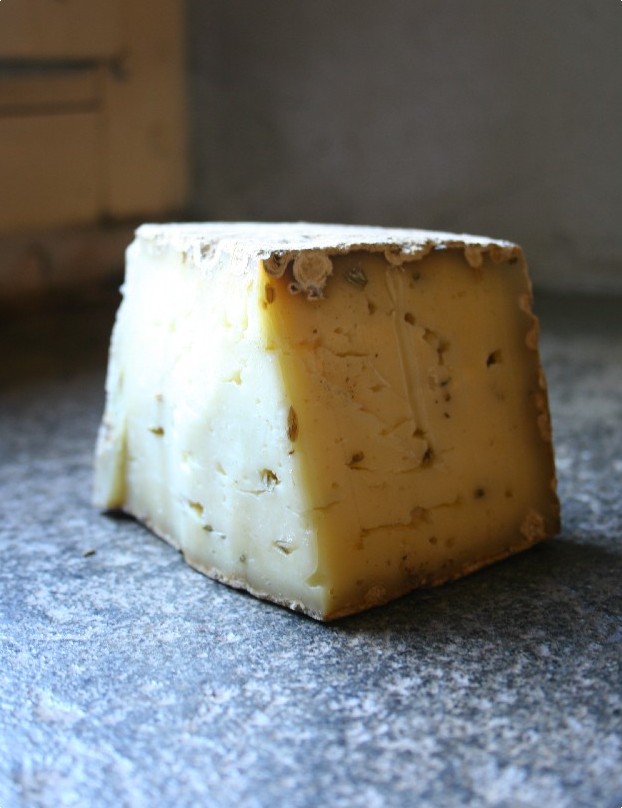
At the co-op in Thônes, the local farmers have several novel variations on the Tomme theme on offer, one of which I fell in love with, the Tomme au Fenouil. The fennel grains (Anise seeds?) impart such a beautiful flavor and this also adds some interest to the cheese plate. This is one kind of cheese I would eat in thick slabs on bread all day long if I could.

Labels: ,


Share/Bookmark

Friday, June 02, 2006

Les fromages de Colette et Pierre Meunier

You have to wonder about those city people who get out of their cars to take photos of cows. I tried to look as if this was something I do all the time, and I recall that in my mind I was thinking that I would plead eccentric artist if ever interrogated by the townfolk that I imagined would be coming around the corner any minute. The cow pulled a Sissy (the cat)- feeling a bit odd about being focused on so intently, she tried to act casual by scratching her ear, then she posed. I called this similarity to cats' behavior to the attention of my husband who murmered something I didn't quite hear.

The perfect excursion: Leave Lyon by car heading west in the afternoon, and as you roll along through residential areas on the outskirts of town, the stones begin to turn a golden color. The more golden the colored the stones become, the smaller the towns become and the more the space between them grows. An hour by slow winding country roads, the little yellow and black ones, some backtracking, and some roads dotted with green, and the color of the stones has deepened to a profound golden mustard color that glows in the afternoon sun. I would not call this France profond, but it is far enough away from our life in centre ville Lyon to feel like we've gone away.

We entered the town of Oingt. The name of the town got me joking with my mother, something Loic was not catching, because in French it is pronounced something like "Wa" which is respectable in every way (some things just don't translate). We pulled over in a municipal lot to locate ourselves on the map and saw that there was a door open and a sign advertising wine and cheese inside. Why not give it a try?


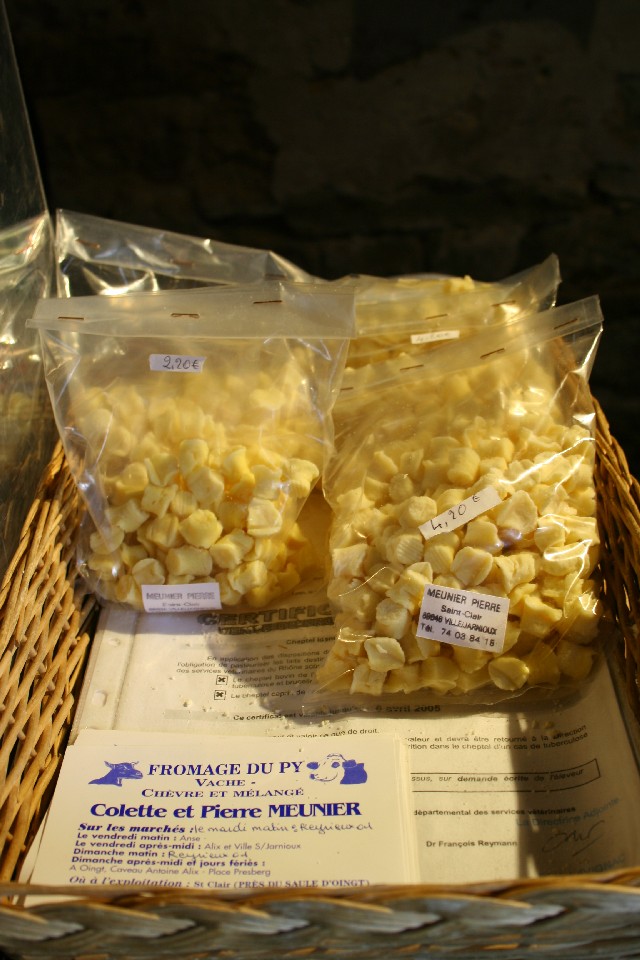
We purchased 8 bottles of wine, a package of aperetif cheeses, and a mi-chevre for the cheese plate. The aperetif cheeses, called Py, are simple and honest and taste of the fresh mild curds they are. The mi-chevre is creamy and tangy.

Labels: ,


Share/Bookmark

Tuesday, May 30, 2006

Time for Jam

Loic likes his toast with jam. What I do is take my leftover butter scraps (I buy all kinds of butter and have been known to have stumps of 6 different kinds cluttering up the fridge at a time) and the leftover herb bouquets, and give them a blitz in the moulinex. I then incorporate some sea salt, press the herbed butter into an old cheese pot, and enjoy my alloted amount in increments spread on my toast for breakfasts. Loic, however will have none of that, since he had a childhood butter trauma. He loves to slather his breakfast toast with jam and lots of jam. Now that the fruits are coming out I am taking the opportunity to make one jar batches of fresh home made jam for him, fruit by fruit.

Oh, it takes about 20 minutes. It doesn't take close surveying until the last couple of minutes when you have to watch a little and stir to make sure it doesn't burn, so you can put it on, get it going, and then do other things until it's done. Last week I made rhubarb jam by combining 3 finely chopped stems of fresh red rhubarb, 1/3 cup granulated cane sugar, a peeled, cored, and chopped apple, and 3 tablespoons of water until they reached 220F (my candy thermometer is in farenheit, since home candy making is a really American thing). And gave it a quick saucer test. I then poured it into a clean jar and let it cool. No need to sterilize or heat seal this jar of jam because Loic eats it very quickly. Tomorrow morning I will make a batch of strawberry jam, since the rhubarb is almost gone. These strawberries got me thinking of that.

the rhubarb jam is almost gone.

Labels: , ,


Share/Bookmark

Monday, May 29, 2006

Labels: , ,


Share/Bookmark

Sunday, May 28, 2006

Arôme de Lyon

We spent the day driving through the countryside yesterday and were surrounded by fields of ancient grape vines trained in antique homage to the sun of the Rhone Alpes as far as the eye could see. We rolled back into Lyon at the end of the day with our trunk full of wine and cheese.

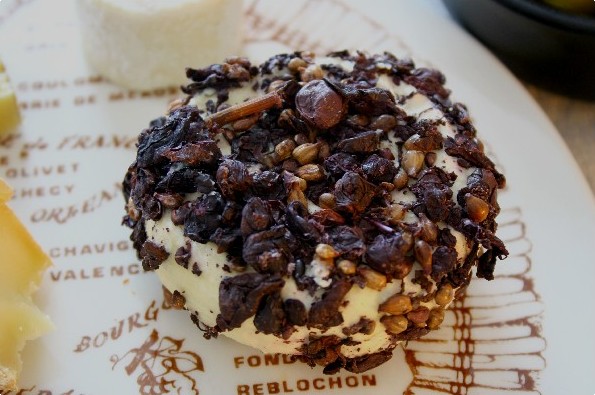
At my favorite restaurant, Pierre serves a little hand moulded log of chevre that he soaks in Marc and covers with raisins as an honorary gesture to the Arôme de Lyon. Back in the kitchen at Tetedoie I also saw the cheese boy prepare a chevre like this with pepper. We enjoy the original Arôme de Lyon on the cheeseplate at the café des Federations, and right now at the fromagerie they look and taste very good.

This Arôme de Lyon is a young St. Marcellin type cows cheese (some are also done with a chevre like a picodon depending on the producer) that macerates in Marc de Bourgogne for several weeks, and then is covered with mounds of the pressed stems, seeds, and skins leftover from the grape production. The cheeses are stored in old oak wine barrels starting soon after the grape harvest, and are set on palettes of 40 ready for sale starting from the winter months. Even so, we get them all year round. You can choose them at various states of affinage since they stay very well in their barrels, and once it's on the palette the Arôme de Lyon becomes harder and more dense with time. They age very well but don’t last long on the plate at home!

I love the crunch of the raisin seeds between my teeth. The raisin crust provides a delightful texture and in contrast, the cool smooth flavor of Marc floods our senses. Adding complexity to that mix, we also taste the counterpoint of the tangy but creamy smooth pâte that the cheese provides. Now that I'm weighing my cheeses I can say that this one weighs about 48 grams.

Labels: , ,


Share/Bookmark

Thursday, May 25, 2006

Soupe au Fenouil avec sa Truite de Petit Pecheur

Having some ultra fresh ocean fished trout on hand and wanting a simple way to enjoy it, little invisible strings pulled me to the little fennel and the herbs we've been enjoying lately. Poaching this kind of fish is just right, and why not in a palette of complimentary green flavors? Since for the past couple of days it has been sweater weather here in Lyon, soup was a natural choice. Here's the recipe.

Soupe au Fenouil avec sa Truite de Petit Pecheur

(serves 4 as an appetizer and 2-3 as a main dish)

2 small heads of spring fennel
1 new potato
1 small shallot
1 teaspoon minced fresh ginger root
6-10 (a handful)of fresh green beans
1 tied bouquet: bay, chervil, and parsley
2 cups of chicken stock
1 teaspoon rough sea salt or 1/2 t. fine salt
1/2 pound of fresh sea trout
2 leaves of fresh sorrel, minced

Wash your vegetables and peel the shallot and potato. Roughly chop the fennel, potato, shallot and green beans, and put them all into a sauce pan. Add the fresh ginger root and herb bouquet.

Pour the chicken stock in and add water to cover the veggies. Bring to a boil, and then lower the heat to simmer for 15 minutes. Once the simmering is over, remove the herb bouquet and puree the soup into a smooth veloute. Incorporate the sea salt. Bring to a simmer again, cut your fish into chunks, and place them into the barely simmering soup. Gently poach the fish cubes for approximately 3 minutes before adding the minced sorrel. Turn it about carefully and try to keep the disturbance of the fish to a minimum. When the sorrel turns from bright green to a warm olive color, that is in about 45 seconds, remove the soup from the heat and ladle it into bowls. Serve with warm crusty bread.

Note: Something that also adds to the visual appeal of this soup is to microplane cross cuts of fennel and add it to the soup just before serving.

Labels: , ,


Share/Bookmark

Wednesday, May 24, 2006

Les Cerises de Pascal


There was nothing to do but eat them plain. I got a livre - a pound.

Labels: , , ,


Share/Bookmark

Sunday, May 21, 2006

Mother's Visit

My mother's visit coincides with my having recently visited a medical nutritionist. I was referred to this doctor specialist because I expressed my concerns about diabetes (the big D word) to my general practitioner - it runs in my family. I don't have it, nor am I even close, but I have seen its effects on my family members. I watched a documentary on diabetes a few weeks ago and it freaked me out completely - I went crying to my doctor, and she referred me to this specialist.

What did the nutritionist say? Well, she looked at my numbers and measured me and stuff, and then said that while I was not actually going on a diet, she wanted me to follow a certain way of eating for awhile. This bummed me out me at first but now I am beginning to see that this way of eating will not curb my gourmandise in the least. In fact it is taking me one step further in my love of food, because I will have no excuse not to get out to the market and prepare lots of home cooked seasonal dishes.
I am cutting back on the creme fraiche and the butter. Very sorry to dissapoint, but I promise to make up for it in other ways. I'm also weighing what food I do eat to be aware of the nutritionist's recommended servings, being careful about how I flavor things with oils. After a few days of following her instructions, I see that really in the end it just means I'm going to be eating the same things, plus a little extra yougert!

What impact will this have on the blog? It means I'm choosing things that will be just as delectable, but probably healthier. I won't be posting desserts as much. I am making an extra effort to ensure my choices are creative and fulfil my need for a challenge in the kitchen as well as offer an equal if not more satisfying dining experience at my table. My projects and discoveries continue!

Labels: , ,


Share/Bookmark

Saturday, May 20, 2006


Fresh cantaloupe and Jambon Cru de Savoie

Labels: , , ,


Share/Bookmark

Friday, May 19, 2006

Mothers and Cheddar - My Favorite Things

My mother arrived from the States in time for lunch today, and brought me a years supply of New York State cheddar, the kind I like.

When I came to France for the first time, I was a student and was on my way to visit my (then) boyfriend (now husband). At the time they had these great $99 Thursday flights to London and this was the way I came through. He arranged for an actress friend of his to let me crash at her place so could catch the first train out the next morning. We enjoyed a glass of the Grey Goose that I'd purchased for her at duty free, and had a wonderful conversation. It began when she confessed that her weakness was sweets. She did this as I watched her daintly devour one chocolate after another.

I confessed that I had a weakness for cheese. Thoughts of hot summer afternoons when I would click from the back door across the yellow linolium kitchen floor still wearing my cleats and make myself up a nice snack - multiple thick slabs of New York State cheddar cheese cut with a dull butter knife and carefully lined up between two slices of white sandwich bread slathered with mayonnaise, the sweet American kind, Hellmans. I would listen to the summer chicadas, spoil my dinner, and close this down over the cheese, peel the bread back, and then top the sticky cheese with a generous sprinkling of Morton's salt. It stuck to the cheese better that way. In those days I could down a pint of whole red cap milk with one of those sandwiches a day and never give a second thought to my girlish figure.

This was the cheese that I was thinking of when I confessed my weakness, and I barely gave it a thought when she laughed and said that in France I'd have plenty to choose from. Oh yes, those cheeses they have in France. I didn't know them nor was I focusing on what prospect was in their existence at the moment. It wasn't cheese in general, but one very particular kind of cheese.

The appreciation for the ubiquitous cheddar of my youth came only once I'd left my home town. Still in America but far from home, I realized that in Monterey California, they don't sell cheddar like the kind I knew. As I moved from place to place, I learned that no, in the South they don't have this cheese, and no, not even in Washington, Boston, Chicago. They don't make cheddar like Upstate Cheddar in London, Frankfurt, Istanbul, Moscow, Beijing, Hong Kong, or anywhere in Asia for that matter. Locally made, delicious and tangy, just enough resistance in the bite to tell me it is real, NYS Cheddar cheese quietly haunted me for years. I carried with me a secret longing, and never told anyone about it, until the day before my first visit to Paris. Brought to light by a little juice glass half filled with Grey Goose.

Today my cheese plate creaks with slabs of Morbier, Reblochon, Picodon, Bleu d'Auvergne, 18 month aged Salers, Rocamadour, St. Marcellin, Banon, Roves de Garrigues, and New York State Fisherman's Delight, produced in Chateaugay, New York. Thank you, Mama. Your visit, I know, will prove to be yet another great one, with this auspicious beginning.

Labels: , ,


Share/Bookmark

Tuesday, May 16, 2006

No Blanquette de Veau Today

You've made the decision to prepare a simple beautiful blanquette de veau. You go to the butcher to get some gelatinous poitrine and some tender cuts as well to make it just right. You arrive at the butcher shop, and there's a scuffle going on near the shop. Some thugs have taken up outside and are demanding money from anyone who wants to go inside. Pay them, and enter quickly and easily. If you don't pay, you have to wait in line outside until those who have paid are finished with their business, then you can go in. Sound like a 3rd world communist block experience? Nope, this principle is being proposed by thugs trying to control access to the internet in the good old USA. Imagine if your access to pages on the internet was run completely by a business entity that had a commerical interest in controlling your web experience. Imagine that the corporation that controlled your web experience made it difficult and slow to download pages, podcasts, photos and information that weren't part of their agenda to make money from you, and made it easier and faster to see the pages that were a part of their money making scheme. Imagine that a fast lane and a slow lane were created on the information superhighway, and that blogs and non-commerical websites were put in the slow lane, while paying commerical sites with the goal of making money from you were put in the fast lane.

Sound like a science fiction nightmare? It's reality. The nation's largest telephone and cable companies — including AT&T, Verizon, Comcast and Time Warner — want to be Internet gatekeepers, deciding which Web sites go fast or slow and which won't load at all.

Please act now, and save your right to free equal access to the internet. Don't let lobbyists push this bill through to allow the big telecommunication groups to privatize and commercialize your access to bandwidth. You can do something about it.

Click the banner to see what you can do, join the net neutrality coalition, sign a petition, send an e-mail to your congress-person and senator, read the FAQ and understand what's about to happen. No matter where you live in the world you can do something. Learn more, and if you choose to, you can take action to stop this from steamrolling through congress.
You have the power!

Labels: ,


Share/Bookmark

Saturday, May 13, 2006

Brochettes de Caille - Quail Kebabs

The language side of my brain has been fully occupied on something other than English, which is the reason why I have not been writing much. I'm sorry about that, it won't last forever. I just have to give this language a hard push while I can. Please bear with me!

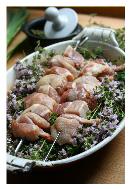
This morning Loic and I took the time to go to the market together where my volailler was moving some quail brochettes - how could we resist them? The breast meat and two legs per brochette made up one bird on a stick each, alternated by chunks of poitrine nature, which is unsmoked bacon. They promised to roast up quite nicely. I painted them with an olive oil based herb paste, and cooked them on a bed of flowered thyme (80 cents a bunch), keeping the dish covered with tin foil until the last few minutes, to keep the thyme from doing anything more than toasting to a nutty crisp. The crushed toasted thyme was used to mix up a flavored butter after the meal, which has been put away for a dinner planned for later in the week - I tasted a little bit and it will be perfect on fish - I can't wait!

The brochettes today were served with rice seasoned with minced mild fresh garlic and parsley, and the plate was followed by a simple salad. Loic mused that we could easily prepare them at home, carving up the birds ourselves, but a quick calculation tells me that my time is better spent on something else. I guess if we collect enough of these nice metal sticks that come with the brochettes, we might start doing more of this kind of thing. I think I like this presentation of a quail better than serving the whole bird. It's a nice festive and easy way to serve it for a lunch or a nice informal supper. The whole legs are on the scale of chicken wings, and the breast meat divides into two bites per breast. One brochette per person is enough. When I serve the whole birds, I always serve two per person.

Labels: , ,


Share/Bookmark

Friday, May 12, 2006

Labels: , ,


Share/Bookmark

Thursday, May 11, 2006

Toulon, Var

Labels: , ,


Share/Bookmark

Sunday, May 07, 2006

Labels: , ,


Share/Bookmark

Friday, May 05, 2006

Lunch at Café des Fédérations


Café des Fédérations is on our list of places to take visitors in town that are interested in eating in a Lyonnais bouchon. There are so many restaurants in Lyon that have the “Official Lyonnais Bouchon” label, but so few that really give a good quality sampling of the specialty dishes of Lyon and the region. Many of the restaurants in Vieux Lyon are faking it with inferior industrial products and the tourists are none the wiser.

We arrived without reservations, hoping for a table and got lucky. When we were seated, and before we ordered, three dishes, served family style, were served – Caviar de la Croix Rousse, named after the neighborhood on the hill, which is simmered lentils served with chopped shallots and vinaigrette, Salad de Museau, a charcuterie salad of brined beef muzzle, sliced thin and served with a caper vinaigrette, and an assortment of saucisson sec (dried sausage) and pickles. While we sampled these dishes, the waiter came out and let us know what was on that day: Tete de veau (that’s veal head), pork cheeks, tablier de sapeur (the flat cut of tripe which has been cut into a rectangle and fried), andouillette (chitterling sausage Lyonnais style), chicken in vinegar, quenelle, boudin noir (blood sausage), gâteau de fois de volaille (a serving sized poultry liver terrine, prepared with the white livers from the poulet de Bresse).

Loic’s andouillette was perfect and the kind we like, Alison’s pikefish quenelle indeed was the good kind (although the sauce Nantua was a bit reduced and salty), my pork cheeks in red wine sauce were divine (photo above), and Rick’s chicken in vinegar sauce was just right. The service was breezy and attentive, and the Côte du Rhone was surprisingly good - meaning the quality was velvety and rich and seemed better than the cost of the regular pot they offer, if I didn’t know any better, I’d think we were being given something better than we ordered.

We have instinctively sought out the best vendors of products like the Lyonnais quenelles, andouilette sausages, and cheeses here in Lyon over the years. My brother-in-law Sebastien, first guided by his very Lyonnais grandmother, instructed us to seek our quenelles at Le Petit Vatel in the 6th, and ever since we have always done so. It was nice to see that the quenelles served at the Café des Fédérations came from this supplier. We get our andouillette from Bobosse at Les Halles in the 3eme, and when we have a special cheese plate that includes chèvre or mountain cheeses, we always go to Le Cellerier, also at Les Halles - these two vendors also suppliers to this bouchon.

The cheese plate was a cute assortment of only local cheeses – the classic fromage fort in the center, which I actually tried and liked this time, St. Marcellin, a rustic tangy chevre which is macerated in Marc de Bourgogne with crunchy dried raisins full of seeds called the Arôme Lyonnais (I have seen more tame versions of this cheese constructed with seedless sultanas and merely painted with Marc by the cheese boy in fancy restaurants, no doubt inspired by this classic cheese), and a Picodon.

Desserts were very good, with an assortment of tarts and classic desserts on offer. The winner of the table was the pear simmered in red wine.

Lunch for 4 people was 98 euros with the standard family style appetizer of three dishes, a main course from the list above, a 'demi' and encore a 'quart' (because it was so good) of Cote du Rhone, cheese at will from the communal plate, and dessert. We will go there again.

Café des Fédérations
10-12 rue Major Martin
69001 LYON
04.72.07.74.52

Labels: , ,


Share/Bookmark

Wednesday, May 03, 2006

Labels: , ,


Share/Bookmark

Monday, May 01, 2006

Figatellu / Figatelli

Brigitte is fond of Corsican meat products, and has introduced us to many different types of sausage and smoked meats, one here, one there, each time we visit. This weekend we traveled down to the Cote d'Azur and sure enough on her terrace we were served a new one.

The name of this Corsican sausage comes from the Italian fegato, meaning liver. Liver is the central element, and it is lightly smoked. This past weekend, we enjoyed the dried sausages with aperitif before Sunday dinner. We had a couple of fickle eaters who wrinkled their nose at the idea of figatelli since pork blood plays a role in giving it a dark color and rich taste. Of course we were delighted, because it meant more for us!

The Corsicans are really good at acheiving that fine balance between the flavor of the meat and smoke. The dried sausage was not intensely smoke flavored. Loic began to peel the casing off the sausage like paper because the drying process had made it quite hard. Chewing it was difficult. Someone at the table said he enjoyed to heat up fresh figatelli sausage and serve it on toast.

During our drive back home, Loic took a wrong turn and we found ourselves winding up a mountain road we'd never been on before. The road continued on and on but we were not concerned, we had all day to get home. The view was beautiful, and we barely saw a soul. I had one of those feelings, and told Loic that when we reached the top of the mountain, there would be a cheap restaurant with great food. He laughed out loud and told me that we would most likely not even find a town. Sure enough, just after reaching the top of the mountain, we reached a town. There was a bustling roadside cafe/bar/tabac that I knew was going to be good when I caught sight of the wood pile and outdoor fireplace. Strangely enough, we glided into a parking spot that seemed as if it was made for us, and arrived just in time to get the last table on the terrace. The clientele was a mix of locals that circulated among the tables and talked to one another, and people like us passing through. We enjoyed our lunch in the sun.

Since it was on the menu and fresh in our minds, Loic ordered the fresh Figatellu for the first time. What he was served looked a bit like boudin noir, but was strongly flavored with garlic and wine, completely different from little dried sausages we had the day before. One more thing to add to the list of things to try at least a few times to come to a real understanding of this sausage and its possibilities.

To make Figatelli at home:

Take one part each of fresh ham, pork liver, and pork fat and chop them finely. Season with 2 teaspoons of salt, 2 teaspoons of ground black pepper, and 2 ground cloves (about 1/4 teaspoon) per pound. Let sit overnight in a cool dry place. In the morning, crush 2 cloves of garlic per pound of meat, and put the garlic into a strainer - pour about 2/3 cup per pound quality red or rose wine over the garlic into the meat so that the wine takes the flavor of the garlic. Adding wine will reduce the shelf life of the sausage, but adds an interesting depth of flavor. If you plan to dry the sausage, don't add the wine. Stuff your sausage casings with the mixture and smoke the sausages. Place it in a cool dry dark place to rest. It can be eaten fresh, grilled or braised and serve with polenta or potatoes, or dried, to be eaten as an aperetif snack.

Labels: , ,


Share/Bookmark

Thursday, April 27, 2006

Labels: , ,


Share/Bookmark